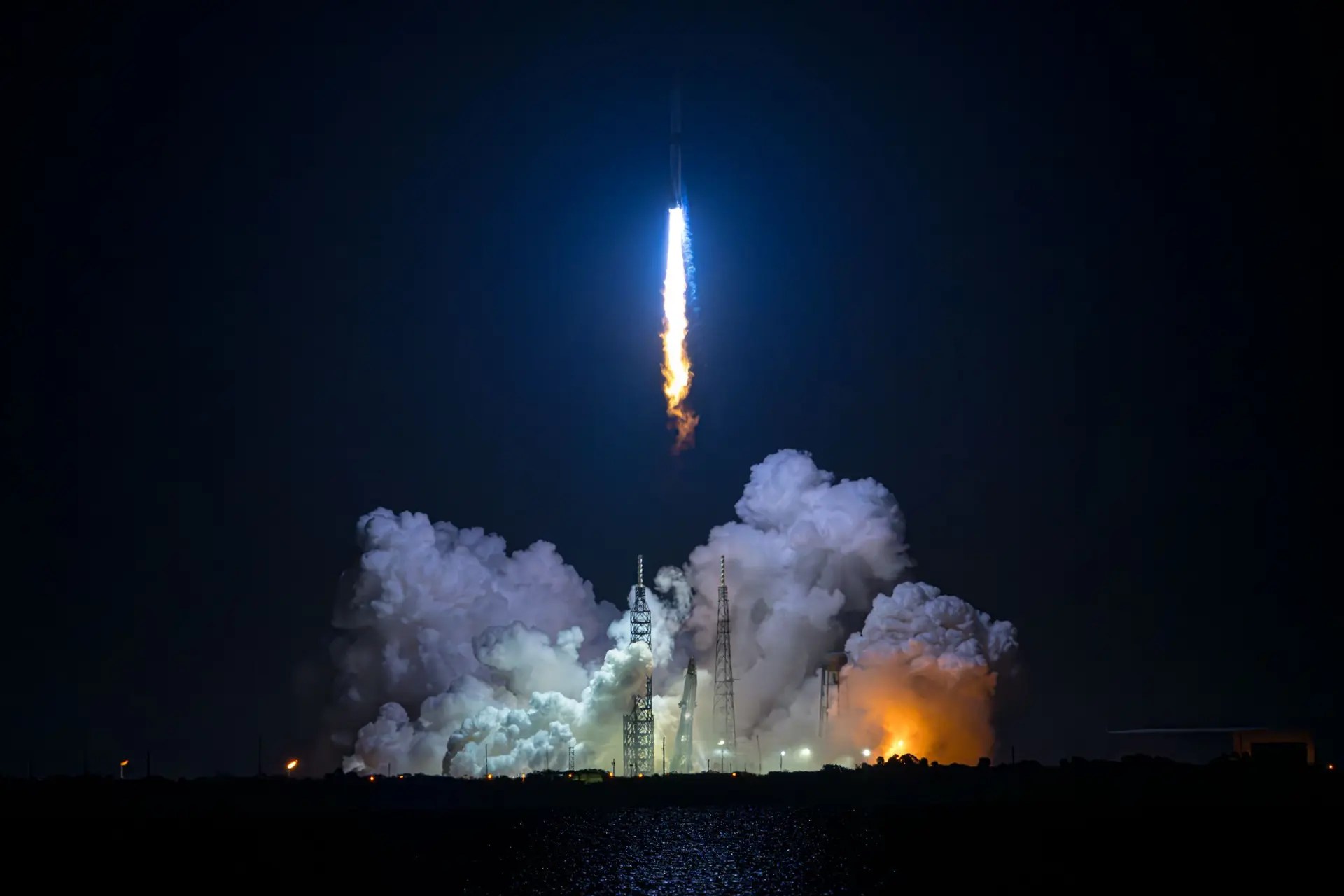
Image (Credit): Blue Origin’s New Glenn rocket lifting off on January 16, 2025. (Blue Origin)
Earlier today, Blue Origin’s New Glenn rocket safely made its way into the Earth’s orbit from its launch pad at the Cape Canaveral Space Force Station in Florida. The only piece of the mission that fell short was the loss of the booster that should have landed on a barge in the Atlantic Ocean.
I’m incredibly proud New Glenn achieved orbit on its first attempt…We knew landing our booster, So You’re Telling Me There’s a Chance, on the first try was an ambitious goal. We’ll learn a lot from today and try again at our next launch this spring. Thank you to all of Team Blue for this incredible milestone.
Even with the lost booster, the rocket launch has proven that the US space industry may soon have another reliable competitor to challenge SpaceX, which is good new for everyone.
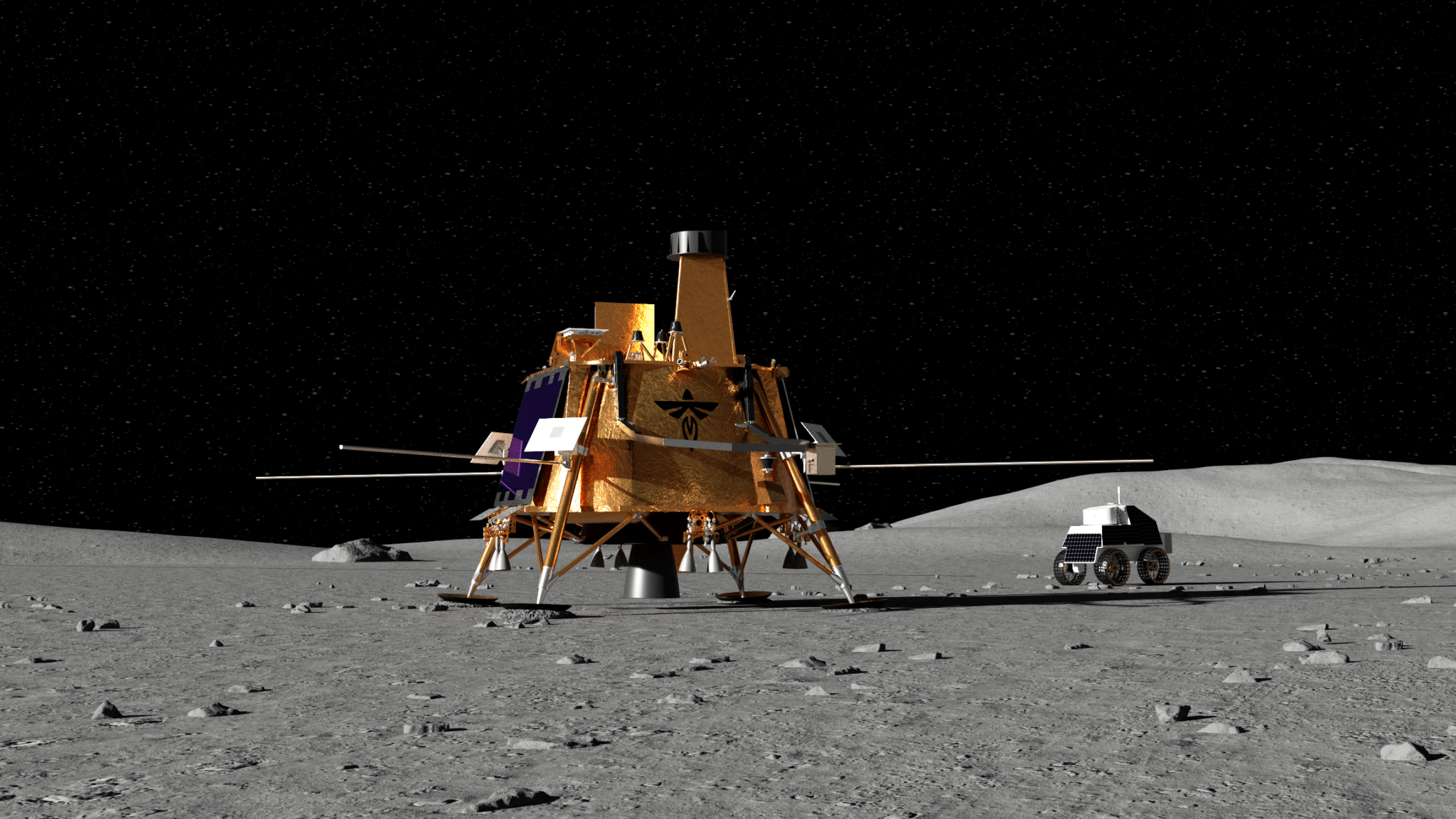
Image (Credit): Artist’s rendering of the Blue Ghost lunar lander on the Moon. (Firefly Aerospace)
Earlier today, a SpaceX rocket successfully launched Firefly Aerospace’s Blue Ghost mission. If it makes it to the lunar surface, it will be the second US mission to land on the Moon since the end of the Apollo program in the 1970s.
Firefly Aerospace issued a press release noting its the initial success of the mission:
Firefly’s Blue Ghost lunar lander launched on a SpaceX Falcon 9 rocket, successfully acquired signal, and completed on-orbit commissioning. With a target landing date of March 2, 2025, Firefly’s 60-day mission is now underway, including approximately 45 days on-orbit and 14 days of lunar surface operations with 10 instruments as part of NASA’s Commercial Lunar Payload Services (CLPS) initiative.
Blue Ghost Mission 1, named Ghost Riders in the Sky, launched from Launch Complex 39A at NASA’s Kennedy Space Center in Florida, at 1:11 a.m. EST on January 15, 2025. Blue Ghost separated from the SpaceX Falcon 9 rocket in a highly elliptical Earth orbit at 2:17 a.m. EST and established communications with Firefly’s Mission Operations Center in Cedar Park, Texas, at 2:26 a.m. EST. On-orbit spacecraft commissioning was then completed by 5:30 a.m. EST, which included verifying attitude determination and control capabilities, increasing the data transfer rate, establishing a power-positive attitude, and completing initial lander health checks.
This is a big step for Firefly Aerospace, which hopes to build on the success of this mission to launch other lunar missions in the next few years. But we need to take it one step at a time given the two US commercial lunar missions that failed earlier last year.
iSpace has shown resilience after the previous attempt. A successful mission will be a good sign for the company and the private lunar industry as well.
You can read more about the mission particulars here.
Image (Credit): The four large Unit Telescopes and the four smaller Auxiliary Telescopes that make up the European Southern Observatory’s (USO) Very Large Telescope. (USO)
Here are some recent stories related to astronomy telescopes.
When a study in 2023 crowned Cerro Paranal the darkest observatory site in the world, astronomers must have felt reassured to have chosen the right spot. The 2,635-meter (8,645-foot) mountain in Chile’s Atacama Desert is home to the European Southern Observatory’s (ESO) Very Large Telescope, one of the most advanced and prolific astronomical facilities. But now, if a company named AES Andes (a subsidiary of the U.S. power company AES Corporation) gets its way, Paranal’s observational prowess might soon be history: Light pollution emitted by a proposed industrial “megaproject” could do away with the dark skies over this observatory.
Researchers have finished equipping the Subaru Telescope with a new special “compound eye,” culminating several years of effort. This new eye is an instrument featuring approximately 2,400 prisms scattered across the extremely wide field of view available at the Subaru Telescope’s primary focus, allowing for simultaneous spectroscopic observation of thousands of celestial objects. This unrivaled capability will help researchers precisely understand the formation and evolution of galaxies and the Universe. Among 8-meter-class telescopes, the Subaru Telescope is the most competitive with the largest survey capability in the world. This instrument, the Prime Focus Spectrograph (PFS), will be ready to begin scientific operations in February 2025.
Astronomers have released a set of more than a million simulated images showcasing the cosmos as NASA’s upcoming Nancy Grace Roman Space Telescope will see it. This preview will help scientists explore Roman’s myriad science goals.“We used a supercomputer to create a synthetic universe and simulated billions of years of evolution, tracing every photon’s path all the way from each cosmic object to Roman’s detectors,” said Michael Troxel, an associate professor of physics at Duke University in Durham, North Carolina, who led the simulation campaign. “This is the largest, deepest, most realistic synthetic survey of a mock universe available today.”
Blue Origin’s New Glenn rocket launch was pushed off again earlier today when ice was found building up on one of the lines related to the hydraulic systems.
We’re standing down on today’s launch attempt to troubleshoot a vehicle subsystem issue that will take us beyond our launch window. We’re reviewing opportunities for our next launch attempt.
As a result, the new launch date is set for Thursday, January 16.
In the meantime, watch for the launch on Wednesday of Firefly Aerospace’s Blue Ghost Mission One as part of NASA’s Commercial Lunar Payload Services (CLPS) program. This mission will deliver 10 science and technology payloads to the Moon, including
Blue Ghost will spend approximately 45 days in transit to the Moon, allowing ample time to conduct health checks on each subsystem and begin payload science. Blue Ghost will then land in Mare Crisium and operate payloads for a complete lunar day (about 14 Earth days). Following payload operations, Blue Ghost will capture imagery of the lunar sunset and provide critical data on how lunar regolith reacts to solar influences during lunar dusk conditions. The lander will then operate for several hours into the lunar night.
Image (Credit): Blue Ghost Mission One schedule. (Firefly Aerospace)
While we await the return of the series Star Trek: Strange New Worlds, a new Star Trek film will premiere later this month, and this time it focuses on the dark side of the Federation.
On January 24, Star Trek: Section 31will premiere on Paramount+. If you anything about Emperor Philippa Georgiou from the television series Star Trek: Discovery, you will know she came from a mirror universe and found her home in the United Federation of Planets’ black ops division where she thrived. Later in that series, she was sent to another timeline and disappeared from the show. Well, she is back, this time running a night club.
The trailer for the new film promised plenty of action, as well as the trademark humor that follows Philippa Georgiou. She was one of the brighter spots in the Discovery series, where everyone else was usually too stressed out to have any fun.
The idea of another film or series involving the secret Section 31 has been rolling around for some time now. While a new series may have been preferable, a film is better than nothing. Moreover, maybe it will lead to more.
Just expect some fireworks from Trekkies because the film plays with the Star Trek timeline and emphasizes the dark side of the United Federation of Planets. I am not so concerned about the timeline since that was destroyed sometime ago when the films were rebooted, but the critics may have a point about the focus on the dark side. That said, we have at least two more seasons of Star Trek: Strange New Worlds to look forward to with its hopeful vision for the Federation.
I am okay with the balance. We all need some escapism, but we cannot banish the real world forever. It will leak in one way or another.



 Our Awesome Universe