Pic of the Week: Preparing for the Total Solar Eclipse

Credit: New York Department of Economic Development

This week’s image comes from the great state of New York, which is advertising the upcoming Total Solar Eclipse on April 8.

New York is one of the state’s that will experience the eclipse, and the New York Department of Economic Development is not missing the chance to ensure everyone knows this.

A handy map also provides the timing of the eclipse in each city.

Credit: New York Department of Economic Development

Space Stories: More Water on Mars, Senators Want Mars Sample Returned to Earth, and the ESA Considers Mission to Enceladus

Here are some recent stories of interest.

Euronews: Photos from NASA’s Curiosity Rover Suggest Mars had More Water for Longer Than Previously Thought

Scientists say Mars may have had more water and stayed wet for longer than they had previously estimated based on photos from NASA’s Curiosity rover. An international team of researchers led by Imperial College London recently found unusual formations in rock and sediment in unexpected places in the crater. The rocks allow scientists to compare the evolving geology of Mars with Earth.

U.S. Senate: Padilla, Butler Urge NASA to Fully Fund Mars Sample Return Program

Today, U.S. Senators Alex Padilla and Laphonza Butler (both D-Calif.) wrote to NASA Administrator Bill Nelson urging him to allocate the full $650 million necessary to fund the Mars Sample Return (MSR) mission in NASA’s FY24 spending plan. The Senators are issuing the letter following the passage of the FY 2024 appropriations package, which reiterated Congress’ strong commitment to the MSR mission.

European Space Agency: Saturn’s Moon Enceladus Top Target for ESA

A fresh, icy crust hides a deep, enigmatic ocean. Plumes of water burst through cracks in the ice, shooting into space. An intrepid lander collects samples and analyses them for hints of life. ESA has started to turn this scene into a reality, devising a mission to investigate an ocean world around either Jupiter or Saturn. But which moon should we choose? What should the mission do exactly? A team of expert scientists has delivered their findings...Aiming for transformational science, considering the characteristics of each moon and future planned missions to Jupiter and Saturn’s ocean worlds, the scientists identified Saturn’s moon Enceladus as the most compelling target, followed by Saturn’s moon Titan and then Jupiter’s moon Europa.

Television: Space Shuttle Columbia Special on CNN

NASA’s Space Shuttle Columbia had its maiden flight on April 12, 1981 and continued to fly for another 22 years until its final disastrous flight in February 2003.

More than 20 years after this tragedy, CNN is retelling the story in a special four-episode program titled Space Shuttle Columbia: The Final Flight that premieres on April 7th and ends on April 14th.

In its publicity for the series, CNN states:

Across four episodes, the story of the ticking-clock of Columbia’s final mission is told in dramatic detail, beginning months before the troubled launch, unfolding across the sixteen days in orbit, and concluding with the investigation into the tragic loss of the seven astronauts’ lives. Weaving together intimate footage shot by the astronauts themselves inside the orbiter, exclusive first-hand testimony from family members of the Shuttle’s crew, key players at NASA – some of whom have never spoken before – and journalists who covered the story on the ground, the series paints an intimate portrait of the women and men onboard and uncovers in forensic detail the trail of events and missed opportunities that ultimately led to disaster.

We are certainly in another place as a nation these days, but the end of the shuttle program crippled our human spacefaring capabilities for years until SpaceX came along. We are back to reusable spacecraft again, but in a whole new format – less spaceplane and more Apollo capsule.

I look forward to the look back. I just hope we are done with “missed opportunities” and have a new mindset as we head back to the Moon.

Another Safe Docking to the International Space Station

Image (Credit): The approach of the Soyuz MS-25 spacecraft as seen from the ISS. (NASA TV)

Earlier today, the two cosmonauts and one astronaut that launched on the Russian Soyuz MS-25 mission over the weekend safely attached themselves to the International Space Station. The station is now hosting a crew of 10.

Both cosmonauts Oleg Novitskiy and cosmonaut Marina Vasilevskaya (of Belarus) from this latest mission will return to Earth in the Soyuz MS-24 capsule in about 12 days along with NASA astronauts Loral O’Hara, who will have spent a total of 204 days on the station.

It’s a game of musical spacecraft, but it seems the routine is working and, other than the occasional leak, all is well with the station and its crew.

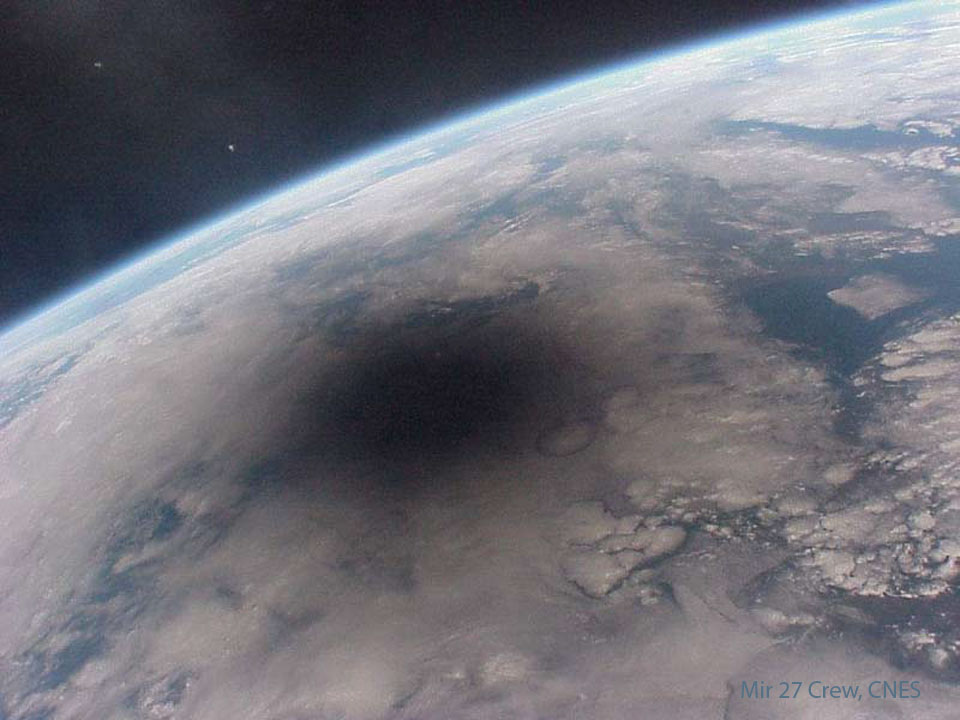
The Total Solar Eclipse: Some Reminders

Image (Credit): A view of the Moon’s shadow on Earth during the solar eclipse on August 11, 1999. The image was captured by Russia’s Mir space station. (Mir 27 Crew)

On April 8, should you be outside staring at the Total Solar Eclipse, you may want to take a few precautions so that you can witness future eclipses as well. In other words, protect your eyes!

NASA has provided a few tips related to photographing the eclipse. Please keep all of this in mind.

For instance, NASA notes:

Looking directly at the Sun is dangerous to your eyes and your camera. To take images when the Sun is partially eclipsed, you’ll need to use a special solar filter to protect your camera, just as you’ll need a pair of solar viewing glasses (also called eclipse glasses) to protect your eyes. However, at totality, when the Moon completely blocks the Sun, make sure to remove the filter so you can see the Sun’s outer atmosphere – the corona.

Let’s have some fun and be safe as well.