Space Stories: Starliner Preparing for Flight, New Volcano on Mars, and Questions About Dark Matter

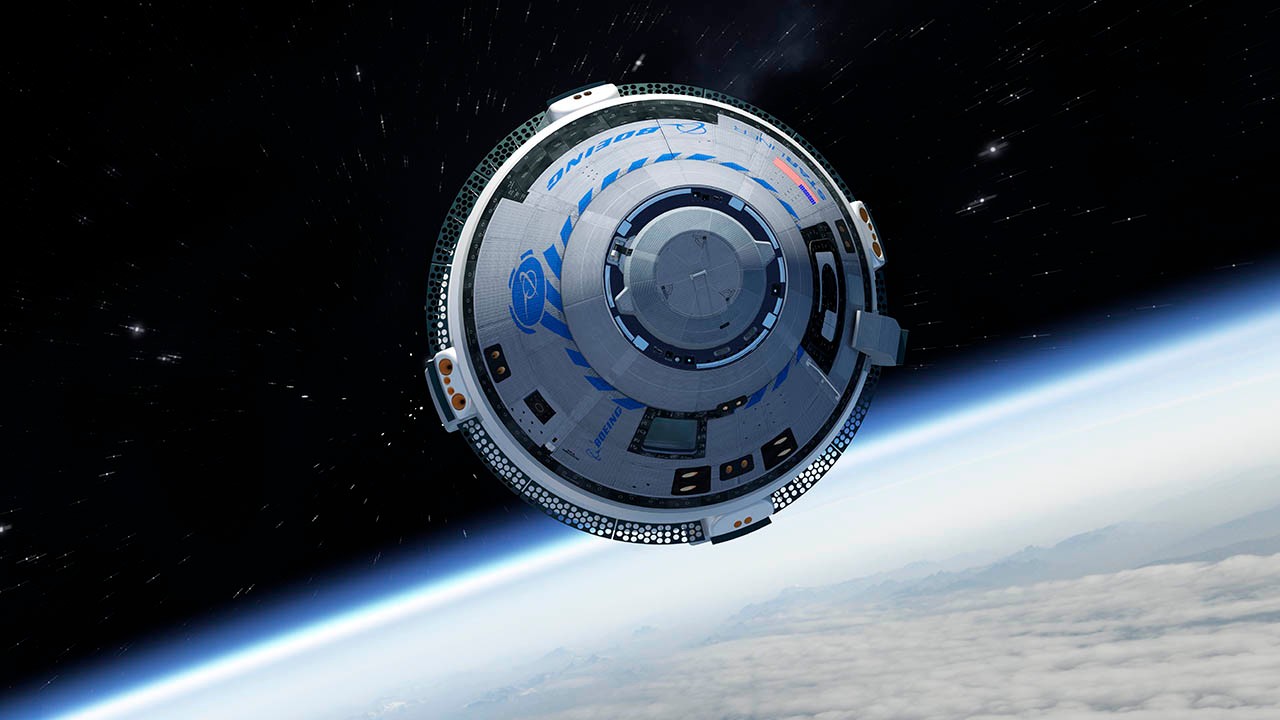
Image (Credit): Artist’s rendering of the Boeing Crew Space Transportation (CST)-100 Starliner spacecraft. (Boeing)

Here are some recent stories of interest.

Space.com: New NASA Astronauts ‘Thrilled’ to See 1st Boeing Starliner Crew Launch in May

A new spacecraft will at last launch its first crew in May, and a fresh group of NASA astronauts say they’re excited to support it. NASA’s newest astronaut group graduated from basic training on March 5, just in time for the first Boeing Starliner test launch with astronauts, which is now expected in May…When it’s up and running, Starliner will regularly carry astronauts to and from the ISS alongside SpaceX’s Crew Dragon vehicle, which began its own astronaut flights in 2020. The newest astronaut cohort can’t wait to climb on board the Boeing craft.

Sky & Telescope: Giant Ancient Volcano Discovered on Mars

It’s not every day that a giant volcano is discovered hiding in plain sight. By reviewing satellite imagery from many missions, scientists have spotted the remains of a colossal volcano on Mars. The volcano, provisionally named “Noctis Mons,” had been imaged repeatedly since the early 1970s, but extensive erosion had concealed it from view. Researchers have also spotted hints at an adjacent glacier buried underneath the volcanic slopes. Noctis Mons is located near the Martian equator, in the eastern part of the Tharsis volcanic province, sandwiched between the vast canyons of Valles Marineris and the fractured maze-like terrain of Noctis Labyrinthus.

University of Ottawa: New Research Suggests that Our Universe has No Dark Matter

The current theoretical model for the composition of the universe is that it’s made of ‘normal matter,’ ‘dark energy’ and ‘dark matter.’…A University of Ottawa study published today challenges the current model of the universe by showing that, in fact, it has no room for dark matter...This discovery challenges the prevailing understanding of the universe, which suggests that roughly 27% of it is composed of dark matter and less than 5% of ordinary matter, remaining being the dark energy.
RIP: Thomas Stafford, Apollo 10 Astronaut

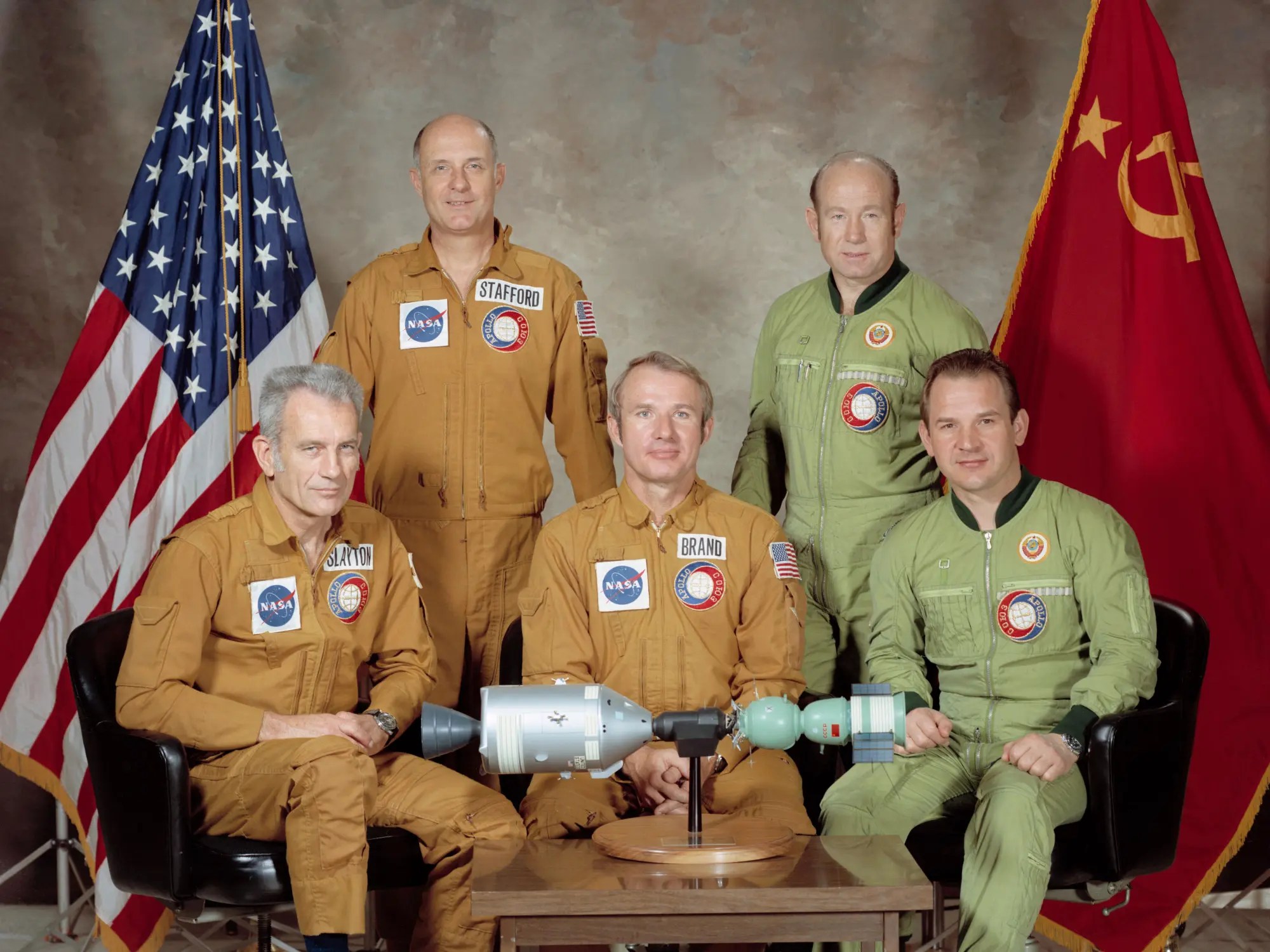
Image (Credit): The joint U.S.-USSR crew for the Apollo Soyuz Test Project. Astronaut Thomas P. Stafford (standing on left), commander of the American crew; Cosmonaut Aleksey A. Leonov (standing on right), commander of the Soviet crew; Astronaut Donald K. Slayton (seated on left), docking module pilot of the American crew; Astronaut Vance D. Brand (seated in center), command module pilot of the American crew; and Cosmonaut Valeriy N. Kubasov (seated on right), engineer on the Soviet crew. (NASA)

As we plan our return to the Moon, we cannot forget the Apollo astronauts who showed us the way last century. One of those astronauts, Thomas Stafford, died today at the age of 93.

Among his many achievements, including his Apollo 10 mission that prepared the way for the first Moon landing by Apollo 11, he may be most remembered for his 1975 space encounter with the U.S.S.R. cosmonauts.

The Apollo-Soyuz Test Project was the first international mission in space. It involved an Apollo spacecraft (crew of three) connecting with a Soyuz spacecraft (crew of two) in Earth orbit. The two days of joint activities created a precedent that was later followed by the International Space Station (ISS).

We were in the middle of the Cold War in 1975, so any cooperation with the U.S.S.R. was pretty amazing. It is just as surprising to witness SpaceX bringing cosmonauts to the ISS while the U.S. maintains severe sanctions on Russia.

Thomas Stafford died knowing that his early efforts to blaze a path to the Moon and cooperate with the Russians were still going strong today. That must have provided him with a little bit of peace in his final days.

You can watch a NASA video on Mr. Stafford’s accomplishments here.

You can also read more on Mr. Stafford’s life and career at these sites:

Rest in peace.

Make Your 2024 Solar Eclipse Plans Now

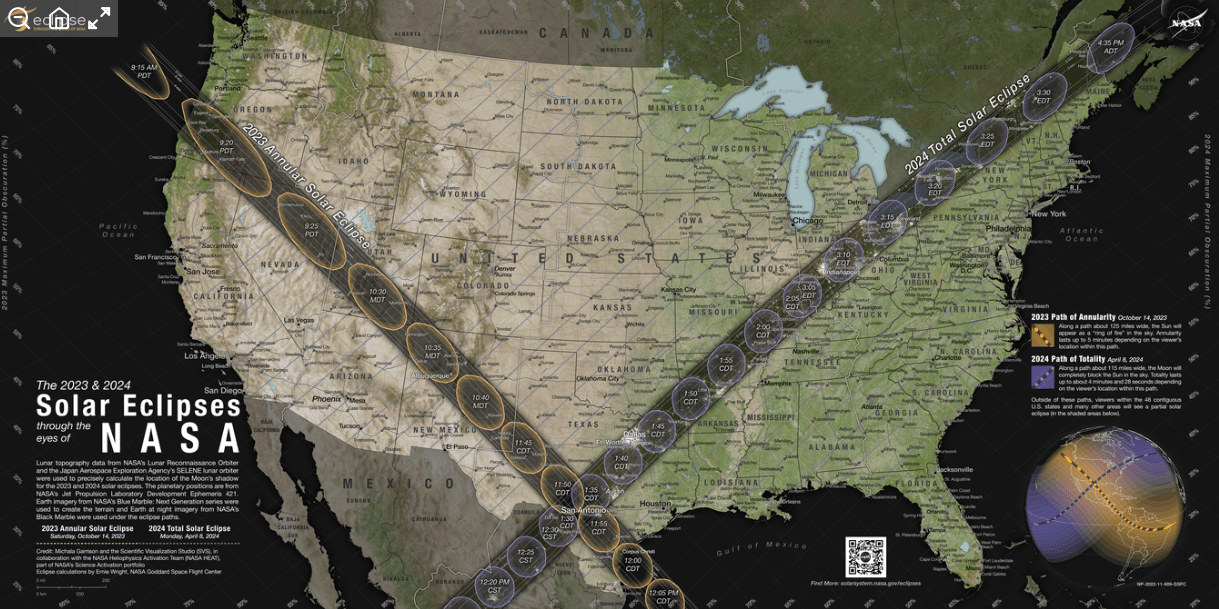
Image (Credit): A U.S. map showing the path of the Moon’s shadow during the 2023 annular solar eclipse (left side) and 2024 total solar eclipse (right side). (NASA)

If you are planning to get a good seat for the total solar eclipse on April 8, you may want to consult the NASA Solar Eclipses map (shown above) to figure our where you want to be. Hint for 2024 – California is not the place to be.

The 2024 solar eclipse map (shown below) from Scientific American magazine might also be helpful. It clearly highlights the cities that will have the best show.

Image (Credit): Map of the U.S. showing the path of the 2024 total solar eclipse on April 8. (Katie Peek/Scientific America, NASA)

Two Japanese Commercial Missions, Only One Reaching Space

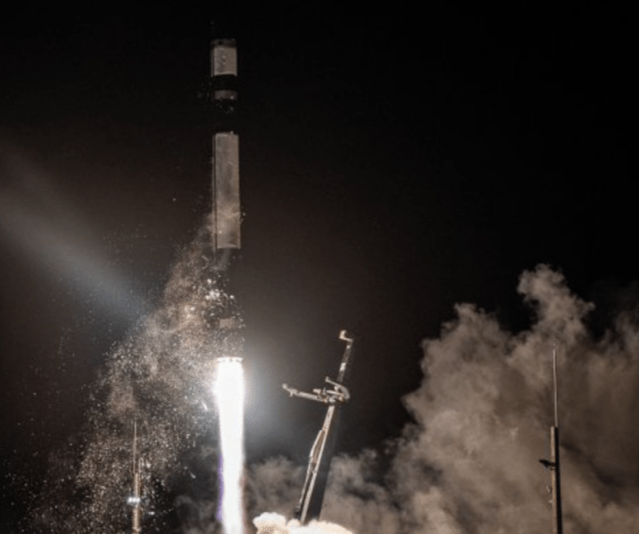
Image (Credit): Rocket Lab’s Electron rocket successfully deploying a fourth synthetic aperture radar satellite to Synspective’s Earth-observation constellation. (Rocket Lab)

Earlier this week, Japanese cargo was launched towards space by two commercial companies. Unfortunately, only of the rockets made it into space.

On March 13, US company Rocket Lab launched a payload for Japan’s Synspective, an Earth-imaging company, from its launch site in New Zealand. The launch was successful and the StriX-3 satellite was placed into Earth orbit.

The second launch on the same day by Japan’s Space One, which would have been the first commercial launch by a Japanese firm, ended quickly when the rocket burst into flames just a few seconds after liftoff. The rocket was carrying a mock-up of a government spy satellite.

Space One President Masakazu Toyoda stated, “We will find out the cause as soon as possible and clarify our measures to prevent a recurrence.”

Getting it right may take time, as we are seeing with SpaceX’s Starship. Japan wants to maintain strong launch capabilities in both the public and private sectors, and this is just part of the process to make that happen.

Image (Credit): Photos showing the launch and midair explosion of Space One’s Kairos rocket. (KYODO)

Last Chance to Get Your Name on the Moon

Image (Credit): An artist’s rending of NASA’s VIPER at the Moon’s south pole. (NASA/Daniel Rutter)

You have until midnight today to submit your name to NASA and be part of the Agency’s first robotic Moon rover, called Volatiles Investigating Polar Exploration Rover (VIPER). Go to this link and provide your name and PIN code to ensure your name goes to the Moon (and you also get your boarding pass as a virtual souvenir).

VIPER is expected to head to the Moon in late 2024 as part of NASA’s Commercial Lunar Payload Services initiative. Once on the lunar surface, it will spend 100 days on the Moon’s south pole to sample the soil and locate frozen water.

If you missed the chance to have your name aboard the Europa Clipper, you still have a chance to be part of this local moon mission.