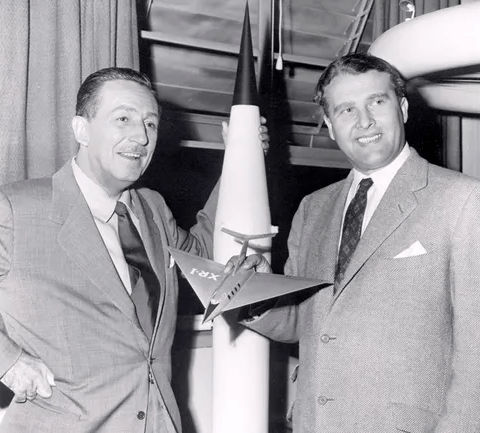
Image (Credit): Walt Disney (left) and Wernher von Braun. (NASA)
On this day in 1912, German-American aerospace engineer Wernher von Braun was born in Wyrzysk, which was part of Germany at the time and later became a Polish city. His full name was Wernher Magnus Maximilian, Freiherr von Braun.
Mr. Braun is best remembered for his part in the construction of Nazi Germany’s V-2 rockets as well as his later participation in development of the Saturn V rocket that became the workhorse of the U.S. Apollo space program.
In the above photo from 1954, you can see Walt Disney with Mr. Braun at the Guided Missile Development Operation Division at Army Ballistic Missile Agency in Redstone Arsenal, Alabama. Mr. Braun served as a technical consultant on a few Disney space films.
Image (Credit): Members of the Soyuz MS-25 crew – commander Oleg Novitskiy (bottom), NASA astronaut Tracy Dyson (middle), and Belarus guest cosmonaut Marina Vasilevskaya (top). (NASA/Bill Ingalls)
Earlier today, a Russian Soyuz rocket launched into space to bring three new crew members to the International Space Station (ISS).
The passengers on today’s delayed flight are cosmonauts Oleg Novitskiy and Marina Vasilevskaya as well as NASA astronaut Tracy Dyson. They are expected to board the ISS on Monday.
Astronaut Dyson, who plans to stay on the station for six months, will assist her fellow astronauts on the ISS with a variety of experiments, including “…[s]tudies of neurological organoids, plant growth, and shifts in body fluids,”
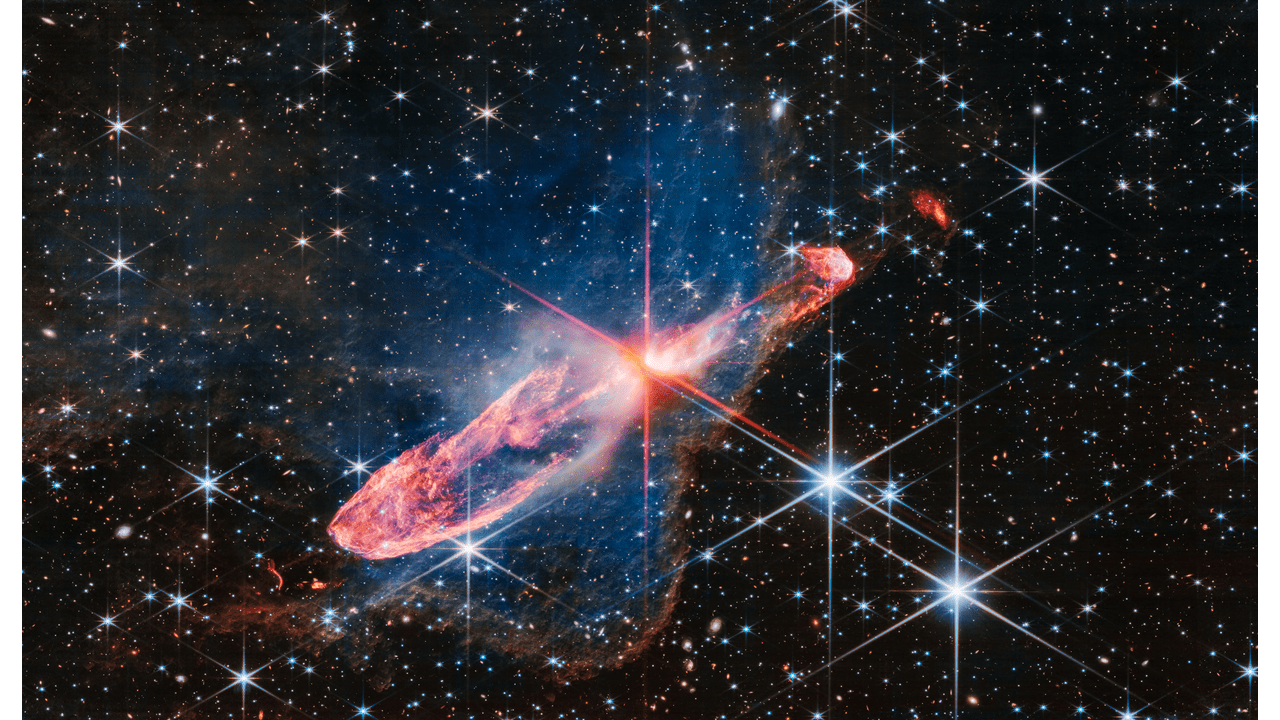
NASA’s James Webb Space Telescope has captured a tightly bound pair of actively forming stars, known as Herbig-Haro 46/47, in high-resolution near-infrared light. Look for them at the center of the red diffraction spikes. The stars are buried deeply, appearing as an orange-white splotch. They are surrounded by a disk of gas and dust that continues to add to their mass.
Herbig-Haro 46/47 is an important object to study because it is relatively young – only a few thousand years old. Stars take millions of years to fully form. Targets like this also give researchers insight into how stars gather mass over time, potentially allowing them to model how our own Sun, a low-mass star, formed.
The two-sided orange lobes were created by earlier ejections from these stars. The stars’ more recent ejections appear in a thread-like blue, running along the angled diffraction spike that covers the orange lobes.
Actively forming stars ingest the gas and dust that immediately surrounds them in a disk (imagine an edge-on circle encasing them). When the stars “eat” too much material in too short a time, they respond by sending out two-sided jets along the opposite axis, settling down the star’s spin, and removing mass from the area. Over millennia, these ejections regulate how much mass the stars retain.
Don’t miss the delicate, semi-transparent blue cloud. This is a region of dense dust and gas, known as a nebula. Webb’s crisp near-infrared image lets us see through its gauzy layers, showing off a lot more of Herbig-Haro 46/47, while also revealing a deep range of stars and galaxies that lie far beyond it. The nebula’s edges transform into a soft orange outline, like a backward L along the right and bottom.
The blue nebula influences the shapes of the orange jets shot out by the central stars. As ejected material rams into the nebula on the lower left, it takes on wider shapes, because there is more opportunity for the jets to interact with molecules within the nebula. Its material also causes the stars’ ejections to light up.
Over millions of years, the stars in Herbig-Haro 46/47 will fully form – clearing the scene.
We live in a time where we have plenty of science fiction options on television and at the theaters. Be it the Apple TV+ remake of Issac Asimov’s Foundation, the current showing of Frank Herbert’s Dune: Part Two at theaters, or the ongoing television series spinning more Star Wars and Star Trek tales.
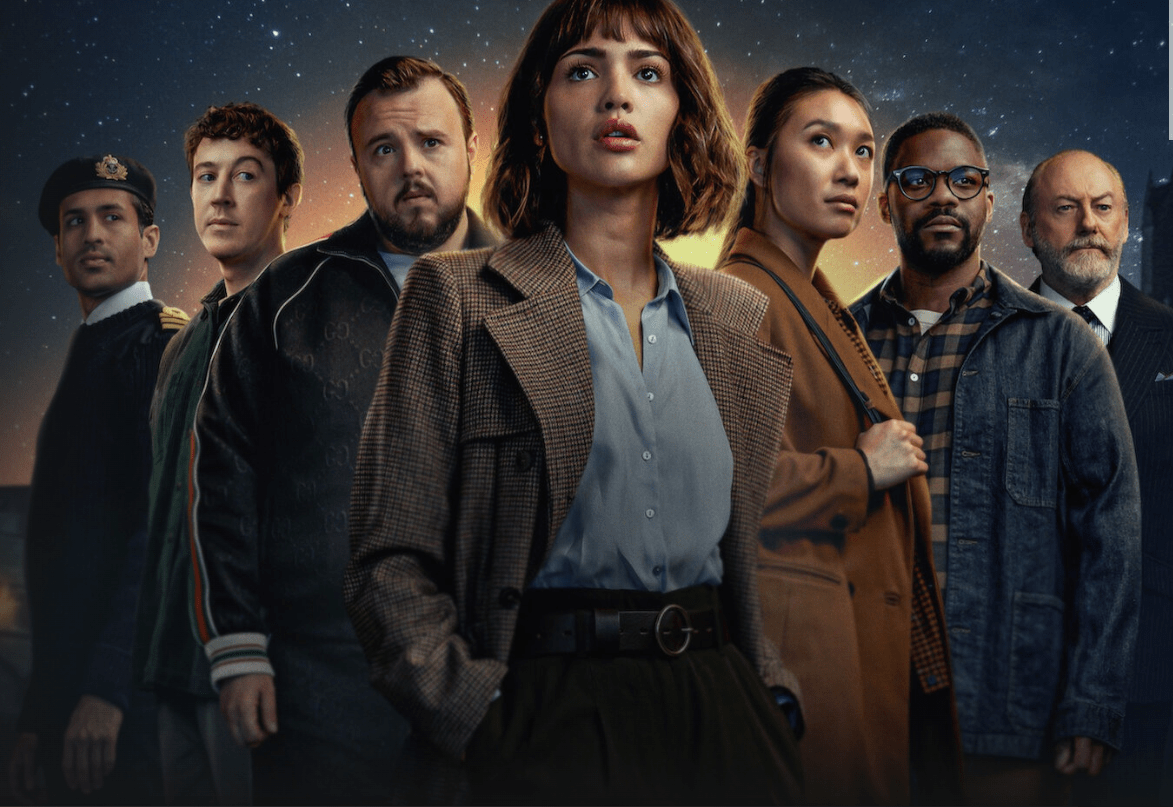
And now, starting tomorrow, we will be treated to a Netflix series on the 3 Body Problem, one of the more recent science fiction series from the mind of Chinese writer Liu Cixin. The new series based on the Hugo-awarding winning book was created by Game of Thrones showrunners David Benioff and DB Weiss, as well as Alexander Woo from HBO drama series True Blood.
So what is it about? Netflix has a paltry summary, so let’s go to the book summary itself (and the trailer):
Set against the backdrop of China’s Cultural Revolution, a secret military project sends signals into space to establish contact with aliens. An alien civilization on the brink of destruction captures the signal and plans to invade Earth. Meanwhile, on Earth, different camps start forming, planning to either welcome the superior beings and help them take over a world seen as corrupt, or to fight against the invasion. The result is a science fiction masterpiece of enormous scope and vision.
The reviews are mixed, though I am sure you will want to judge for yourself. But just in case you want some insights from others, check out these reviews:
Should you want to see the Chinese television series, you can find it here on Youtube. Or you may want to circle back to this version if you don’t care for the Netflix production.
Note: You can also find the Chinese version of the series on Amazon Prime. Rather than 8 episodes, you will find the Chinese version called Three Body has 30 episodes. I am working my way through the Amazon Prime series and so far prefer the slower-paced Chinese original. Netflix seems to rush through the ideas, whereas they are better developed in the longer series.