Image (Credit): The weather tower at the Mount Washington Observatory. (Robin Lubbock/WBUR)
With all of the excitement last week regarding Chinese balloons, which is continuing into this week with two “unidentified object” incidents in Alaska and Canada, I forgot to mention the -108 F wind chill temperature at the top of Mount Washington in New Hampshire on February 3rd. The Washington Post reported that this may be the lowest temperature ever reported in U.S. history.
In fact, the Mount Washington temperature was lower than the temperature experienced that day by the Curiosity rover in Gale Crater on Mars. It is still autumn in the crater, so temperatures could still fall to -225 F during winter. Let’s not try that in New Hampshire.
Europe may be complaining about the unusually warm mountain temperatures this year, but you will not hear this talk from the Yankees up north. They are getting the full Martian treatment and staying close to their wood stoves.
Image (Source): Early February temperatures experienced by the Mars Curiosity rover. (NASA)
Image (Credit): The Tesla Roadster leaving Earth’s orbit. (SpaceX)
It’s time to check in again with ChatGTP to discuss another Elon Musk issue – the Tesla vehicle he launched into space using a SpaceX rocket. I recently asked ChatGPT, which was funded in part by Elon Musk, to provide a three paragraph summary discussing the launch of the Tesla Roadster into space as well as the current location of that Roadster. Here is the response:
In February 2018, Elon Musk’s SpaceX launched its Falcon Heavy rocket into space, making it the most powerful operational rocket in the world. The rocket was carrying a special payload: a Tesla Roadster, driven by a mannequin named Starman wearing a SpaceX suit, was put into orbit around the sun. The Roadster, which was live-streamed as it traveled through space, was meant to be a whimsical demonstration of the Falcon Heavy’s capabilities, but it also became a symbol of Musk’s audacity and his willingness to take risks.
The Tesla Roadster is still orbiting the sun, travelling as far out as the orbit of Mars and as close to the sun as the orbit of Earth. Its precise location can be tracked using the website whereisroadster.com, which provides real-time updates on the car’s location based on data from the JPL Horizons system. The Roadster’s journey through space is expected to continue for millions of years, making it one of the longest-lasting man-made objects in space.
Although the Roadster was not intended to be a scientific mission, it has provided valuable data for astronomers and space enthusiasts. For example, it has been used to test the accuracy of simulations of the solar system, and to study the effects of space radiation on electric vehicle batteries. In addition, the Roadster’s journey has inspired a new generation of space enthusiasts and has sparked interest in the possibilities of space travel and exploration. It is a testament to the power of innovation, creativity, and the human spirit, and it serves as a reminder of the incredible things that can be achieved when people are willing to take risks and pursue their passions.
The summary amusingly states that this floating Roadster has provided “valuable data” and “…sparked interest in the possibilities of space travel and exploration.” It appears Mr. Musk still has his fingers in the program code. I believe NASA can get the data it needs without the use of a wandering automobile. Besides, you only need to know the impact of radiation on an EV battery if you plant to drive to Mars. And while I would agree that his “audacious” claims about a trip to Mars on the SpaceX Starship may have stimulated a few souls, creating a new form of space junk was seen for what it was – a dumb stunt.
All stunts aside, I look forward to seeing Mr. Musk focus again on Mars rather than areas outside of his expertise, such as Twitter. We need less space junk and more space missions with a destination in mind.
Image (Credit): Comet 2022 E3 (ZTF). (NASA and Dan Bartlett)
The so-called Green Comet that is garnering much attention in the media is captured in this image from last year. The comet was first discovered early last year.
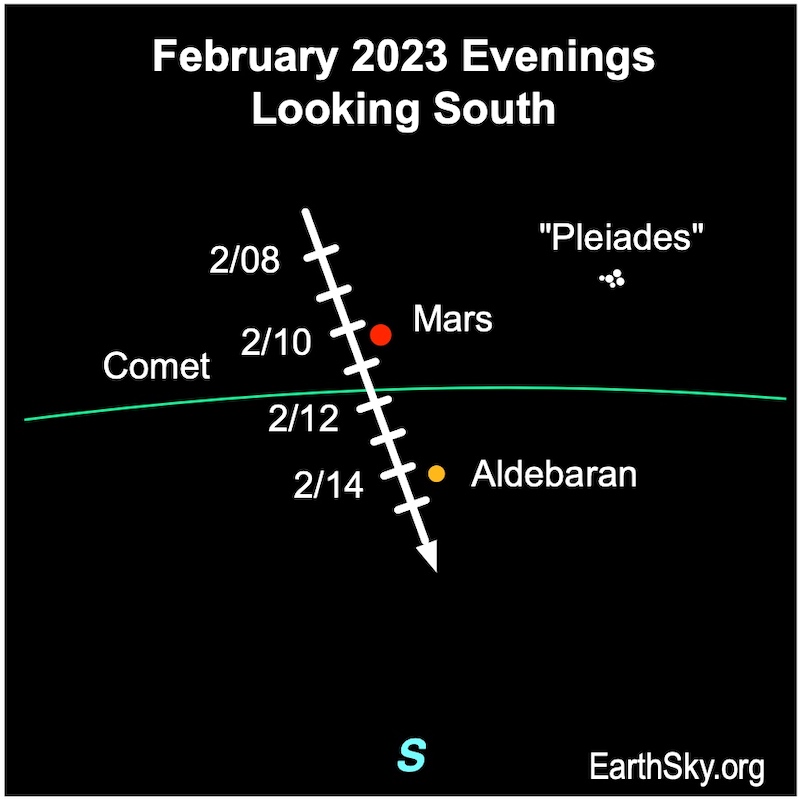
Comet C/2022 E3 (ZTF) was discovered by astronomers using the wide-field survey camera at the Zwicky Transient Facility this year in early March. Since then the new long-period comet has brightened substantially and is now sweeping across the northern constellation Corona Borealis in predawn skies. It’s still too dim to see without a telescope though. But this fine telescopic image from December 19 does show the comet’s brighter greenish coma, short broad dust tail, and long faint ion tail stretching across a 2.5 degree wide field-of-view. On a voyage through the inner Solar System comet 2022 E3 will be at perihelion, its closest to the Sun, in the new year on January 12 and at perigee, its closest to our fair planet, on February 1. The brightness of comets is notoriously unpredictable, but by then C/2022 E3 (ZTF) could become only just visible to the eye in dark night skies.
If you grab your binoculars, you can still see the comet over the next week by looking south. Check out the graphic below from EarthSky.org if you need a sky map to find it.
Take a look at the image above. Can you determine where this image originated? Take a guess and then check your answer by going to the “Where is This? The Answer Sheet” page.
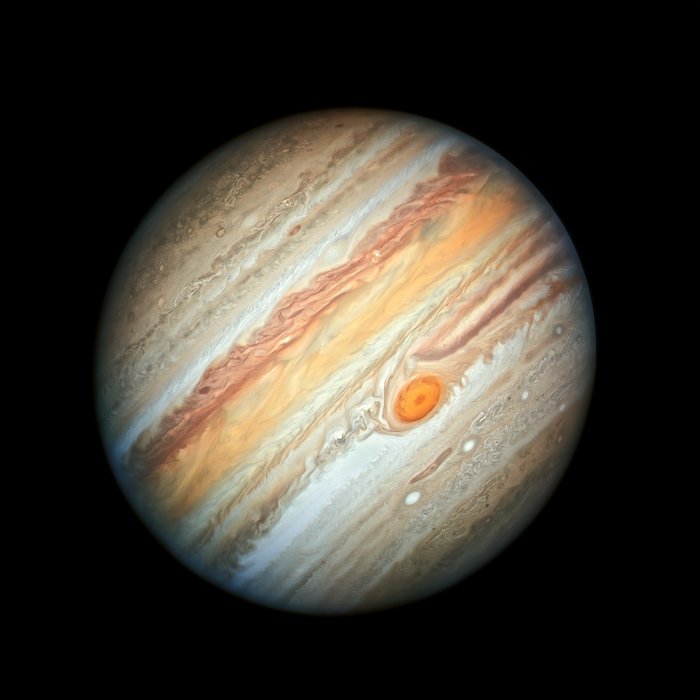
Image (Credit): Jupiter as seen by the NASA/ESA Hubble Space Telescope. (NASA, ESA, A. Simon (Goddard Space Flight Center), and M.H. Wong (University of California, Berkeley)
Jupiter was already the king of the solar system, and new discoveries give the massive planet another way to reign supreme: It now has the most moons. Twelve new moons discovered orbiting Jupiter have been confirmed, bumping the count from 80 to 92, and knocking Saturn — which has 83 moons — down a peg.
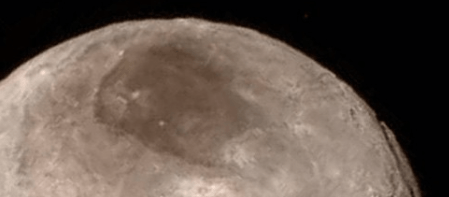
In 2015, when NASA’s New Horizons spacecraft encountered the Pluto-Charon system, the Southwest Research Institute-led science team discovered interesting, geologically active objects instead of the inert icy orbs previously envisioned. An SwRI scientist has revisited the data to explore the source of cryovolcanic flows and an obvious belt of fractures on Pluto’s large moon Charon. These new models suggest that when the moon’s internal ocean froze, it may have formed the deep, elongated depressions along its girth but was less likely to lead to cryovolcanoes erupting with ice, water and other materials in its northern hemisphere.
…perhaps the biggest question of all — that of “Are we alone in the Universe?” — remains a mystery. While the current generation of ground-based and space-based telescopes can take us far into the Universe, this is a question that’s currently beyond our reach. To get there, we’ll need to directly image Earth-like exoplanets: planets with sizes and temperatures similar to Earth, but that orbit Sun-like stars, not the more common red dwarf stars like Proxima Centauri or TRAPPIST-1. Those capabilities are precisely what NASA is aiming for with its newly announced flagship mission: the Habitable Worlds Observatory. It’s an ambitious project but one that’s well worth it. After all, finding out we’re not alone in the Universe would quite possibly be the biggest revolution in all of science history.