Pic of the Week: The Lynds 483 Hourglass

Image (Credit): Lynds 483 as captured by the JWST. (NASA, ESA, CSA, STScI)

This week’s image is from the James Webb Space Telescope. It shows two actively forming stars that are 650 light-years away. The formation is called Lynds 483, or L483, after American astronomer Beverly Turner Lynds, who studied nebulae in the early 1960s.

Here is more information about the image from NASA:

The two protostars responsible for this scene are at the center of the hourglass shape, in an opaque horizontal disk of cold gas and dust that fits within a single pixel. Much farther out, above and below the flattened disk where dust is thinner, the bright light from the stars shines through the gas and dust, forming large semi-transparent orange cones.

It’s equally important to notice where the stars’ light is blocked — look for the exceptionally dark, wide V-shapes offset by 90 degrees from the orange cones. These areas may look like there is no material, but it’s actually where the surrounding dust is the densest, and little starlight penetrates it. If you look carefully at these areas, Webb’s sensitive NIRCam (Near-Infrared Camera) has picked up distant stars as muted orange pinpoints behind this dust. Where the view is free of obscuring dust, stars shine brightly in white and blue.
Space Stories: NASA Spinoffs, Moving the NASA HQ to Ohio, and the Many Moons of Saturn

Credit: NASA

Here are some recent stories of interest.

NASA: NASA Releases its Spinoff 2025 Publication

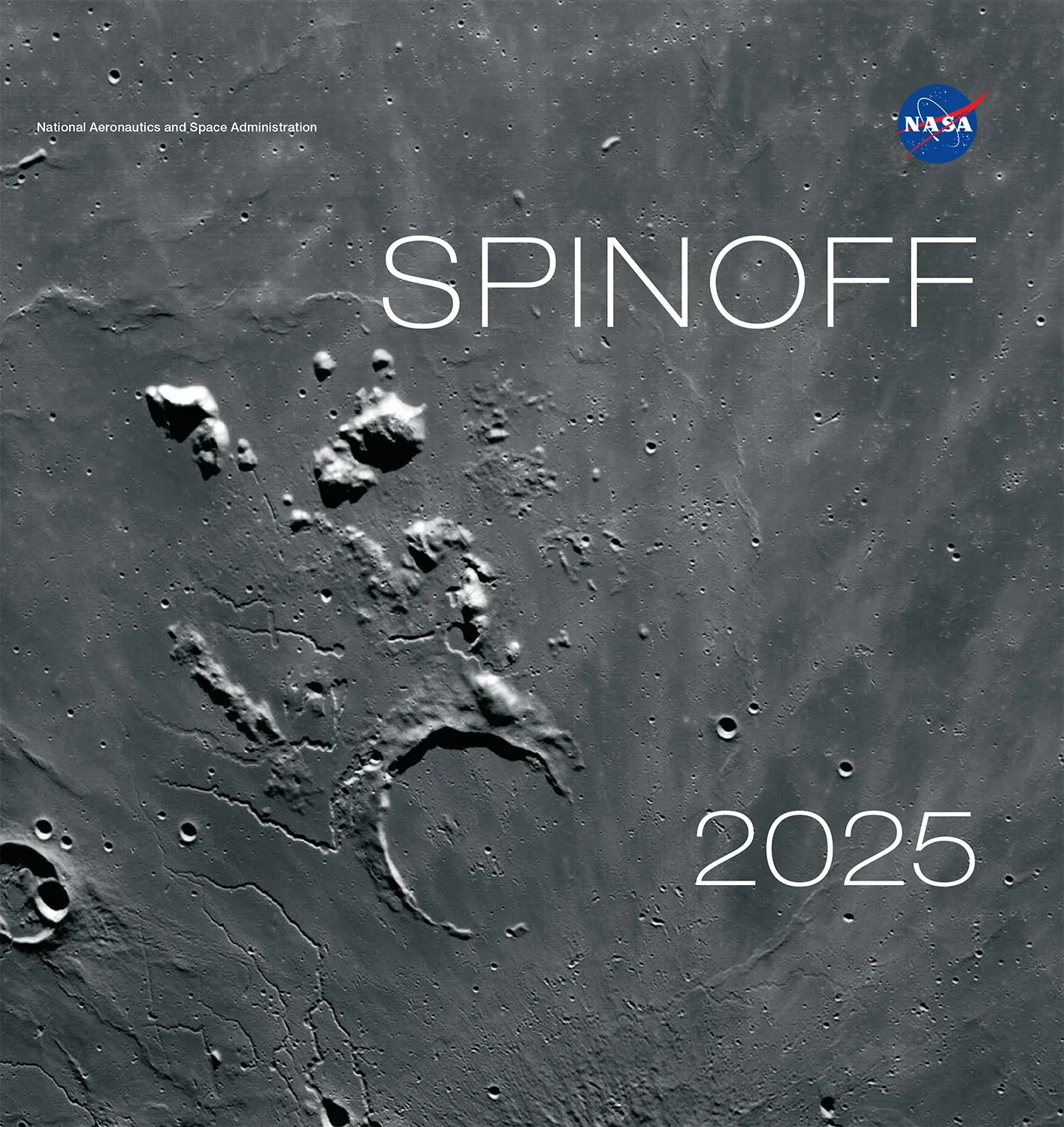
The work NASA conducts in space leads to ongoing innovations benefiting people on Earth. Some of these latest technologies, which have been successfully transferred from NASA to the commercial sector, are featured in the latest edition of Spinoff 2025 publication now available online. The publication features more than 40 commercial infusions of NASA technologies, including research originated at NASA’s Glenn Research Center in Cleveland.

Cleveland.com: NASA Urged to Move Headquarters to Ohio as D.C. Lease Expires

When the National Aeronautics and Space Administration‘s lease on its current Washington, D.C. headquarters expires in 2028, Ohio members of Congress want NASA to move its headquarters to Ohio. In a Tuesday letter to Vice President JD Vance and President Donald Trump’s nominee to be NASA Administrator, Jared Isaacman, Ohio Congress members argue that bringing the headquarters of the nearly 18,000 employee agency to their state would align with broader government efforts to decentralize federal agencies and reinvigorate parts of the country outside Washington.

USA Today: Moon King: Astronomers Discover 128 New Moons Orbiting Saturn. Here’s What We Know.“

Astronomers have discovered 128 new moons orbiting Saturn, further solidifying the planet as the “moon king” of our solar system. Astronomers from Taiwan, Canada, France and the U.S. announced the discovery on Tuesday. The findings push Saturn’s moon count to 274, towering over the previous record-holder Jupiter, which has 95 moons. The recent discovery points to what astronomers have speculated for decades, that Saturn’s rings were caused by a massive collision about 100 million years ago, researcher Mike Alexandersen, an astronomer at the Center of Astrophysics, told USA TODAY. A collision of such size could explain the small moons that orbit Saturn.

Weather Issues Impact SPHEREx Mission, But its Ready Now

Image (Credit): NASA’s SPHEREx observatory and PUNCH satellites at Space Launch Complex 4 East from Vandenberg Space Force Base in California on March 8, 2025. (SpaceX)

One can expect weather issues in Florida, but California? It seems that the west coast also has its issues, per a tweet yesterday from SpaceX:

Due to unfavorable weather at the launch site and an issue with one of the @NASA spacecraft, we are standing down from tonight’s Falcon 9 launch of NASA’s SPHEREx and PUNCH missions. Next launch opportunity is Tuesday, March 11 at 8:10 p.m. PT

Given that the Spectro-Photometer for the History of the Universe, Epoch of Reionization and Ices Explorer (SPHEREx) observatory mission has gotten this far with all of the challenges along the way, I think a few extra days are okay. NASA is also keen to see the Polarimeter to Unify the Corona and Heliosphere (PUNCH) satellites aloft as well.

Everything is ready to go in less than an hour (8:10 p.m. PDT, 11:10 p.m EDT). If you would like to watch it, you can go to NASA+.

Update: The SPHEREx and PUNCH missions were successfully launched yesterday evening, March 11th.

Space Quote: Hurry Up with that New Administrator

“The global space race is accelerating, and America faces an urgent challenge in maintaining its leadership in space exploration, technological innovation, and national security – especially in the face of China’s rapidly advancing space program…Jared Isaacman is uniquely qualified to deliver strong leadership that will strengthen NASA’s core programs and ensure the United States remains at the forefront of scientific discovery, space commerce, and exploration.”

-Statement by Tennessee Governor Bill Lee and six other governors in a letter to the Senate Commerce, Science, and Transportation Committee regarding the appointment of NASA’s next Administrator. It is likely that the governors see the continuing disruptions at NASA, including the recent elimination of two departments and office of chief scientist, and understand that this destruction will probably continue without permanent leadership at the agency.

The Mars Society is Looking for New Ideas from Students

If you are between the ages of 13 and 18, and you have an interest in future settlements on Mars, then you might be interested in The Mars Society’s Fourth Annual International Mission to Mars Engineering Design Competition.

Interested students are being offered a chance to attend a virtual classroom this summer while also helping to design an 18-month basic Mars surface mission. Aspects of this mission include habitats, vehicles, scientific instruments, power systems, crew composition, mission objectives, and exploration plans.

How often will you have a chance to be involved in something this critical and fun during summer break?

If you are interested, you have until May 15th to provide an application. Go to this link to learn more and file an application.