Television: The Silent Sea

Source/Credit: Netflix.

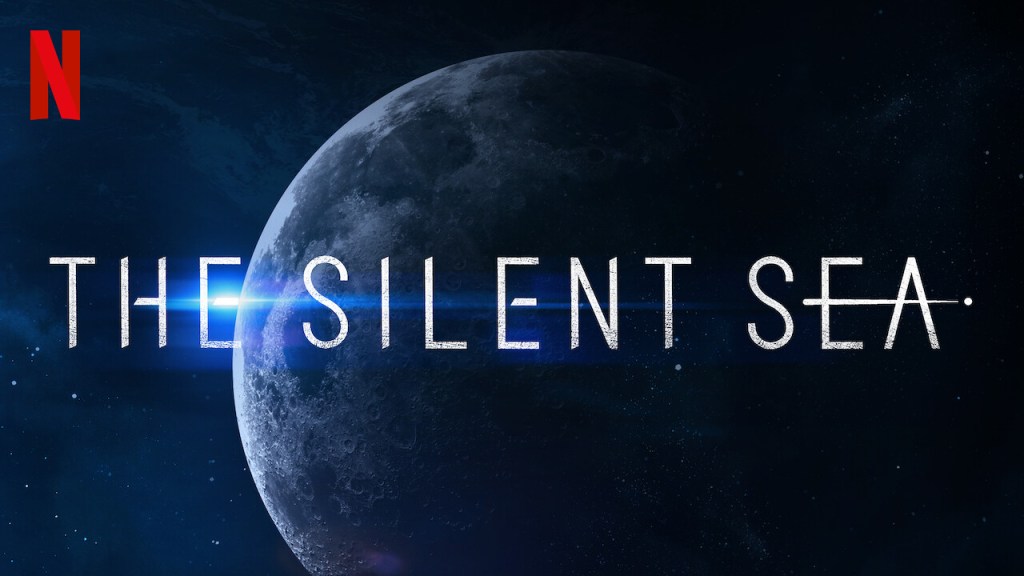
Netflix’s new series from South Korea, The Silent Sea, was released right before Christmas and did not get a lot of attention. It may not deserve a lot of attention, and would have probably been better as a short film (which is how it started) rather than an 8-part series, but it was passable as entertainment.

The year is 2075 and Earth has become a dust bowl where water is rationed and civilization is dying. We seem to have the ability to maintain manned stations on the Moon and Mars, but water conservation is beyond our abilities. It seems we did not have a Planet B ready to go. With this background, the series is about a special team sent back to the Moon to visit a failed station and retrieve critical scientific samples. I will not give you too many hints, but it relates back to the water shortage on Earth.

The trip to the Moon seemed more like a Southwest flight than a space mission, and the Moon base itself is a ridiculously gigantic facility at the edge of a chasm, yet the action mainly takes place within the Moon base at a good pace. Throughout the series there are mysterious deaths, unknown figures running around the station, and corporate espionage, so it does not lack a fair amount of drama. Sadly, the last episode unravels quickly with a somewhat dumb (and certainly unbelievable) ending.

I cannot recommend it after seeing much better series, such as The Expanse and National Geographic’s Mars. However, if you need to satisfy your science fiction fix before other space series are available, give it a try. You have been warned.


Source/Credit: Scene from The Silent Sea from Netflix.

Disarming Space Will Have to Wait

Source/Credit: Satellite imagery showing the military buildup in Yelnya, Russia as of November 1, 2021 from Maxar Technologies/Getty Images.

Politico reported this week that Russia has asked that next week’s discussion at the United Nations (U.N.) about arms in space be delayed. It is possible the Russians are busy preparing for war in Ukraine and have little time to look up. But it should be possible to resolve matters here on the surface and in space.

The  U.N. Committee on Disarmament established a working group after seeking member input on the “…development and implementation of norms, rules and principles of responsible behaviours and on the reduction of the risks of misunderstanding and miscalculations with respect to outer space.” Sounds like a good idea to me. You can find the report with the members’ input here.

Here is part of what the United States submitted in its response to the U.N. query:

Some States are developing, operationalizing, and stockpiling a variety of [anti-satellite] weapons that could be used to, or have the potential to, deny, disrupt, degrade, or destroy civil, commercial, or national security space capabilities and services. Some of these anti-satellite weapons could be used to deny or disrupt space services temporarily, while others are designed to permanently degrade or destroy satellites.

These threats against satellites and their supporting systems can generally be divided into four categories: 1) ground-space; 2) space-space; 3) ground-ground; and 4) space-ground. Within these categories, the threats can be described as 1) reversible, which include temporary effects such as interference with radiofrequency signals or dazzling of remote sensing systems, or 2) irreversible, which include measures that degrade or destroy a satellite. The consequences of all categories of threats could include loss of mission data; decreased lifespan or capability of space systems or constellations; the loss of positive control of space vehicles, potentially resulting in collisions that could impair systems or generate harmful orbital debris; or damage to or destruction of the space system.

The working group should have plenty to discuss if it can get everyone together. Let’s hope the Ukrainian matter can be resolved peacefully to allow work to start on a stable peace in space as well.

Note: The dates on the article and U.N. schedule do not align, but the main point about the Russians being too busy to worry about a space war remains the same.

Chinese Space Debris Clean-up or Something Else?

Source/Credit: Chinese Shijian-21satellite from Asia Times.

Phys.org reported the success of a Chinese mission to retrieve a dead satellite, a hopeful sign given the increasing number of satellites and related debris in orbit. The story, “A Chinese space tug just grappled a dead satellite,” discusses how the Chinese spacecraft, Shijian-21, retrieved a dead navigation satellite belonging to the Chinese CompassG2 network. The story also included a video from ExoAnalytic Solutions demonstrating the retrieval and eventual release of the CompassG2 satellite into a graveyard orbit.

Of course, every pro comes with a con. Is this just a maintenance spacecraft or could it be part of a future offensive strategy to take other non-Chinese satellites out of orbit? The media in India were skeptical, as you can see from this headline: “China Preparing for War in Space?” Not that China is alone should it be looking for an anti-satellite spacecraft. Other countries, including the US, have similar dual-use spacecraft.

According to the Phys.org article, the Chinese have been silent, so the whole operation is somewhat opaque. Given the various attempts by other nations to solve the debris problem, it benefits each nation to share information on debris mitigation efforts so everyone can learn from them. Greater transparency from China would be nice.

Pic of the Week: Distant Dancing Galaxies

Source/Credit: Galaxy cluster (described below) from NASA.

The image above is from the Hubble Space Telescope and shared on NASA’s site last month under the title “Hubble Spots a Starship-Shaped Galactic Pair.” While the author of the story below sees the USS Enterprise from Star Trek, I see a decloaking Klingon Bird-of-Prey. Here is the full description from NASA:

The subject of this image is a group of three galaxies, collectively known as NGC 7764A. They were imaged by the NASA/ESA Hubble Space Telescope, using both its Advanced Camera for Surveys (ACS) and Wide Field Camera 3 (WFC3). The two galaxies in the upper right of the image appear to be interacting with one another — indeed, the long trails of stars and gas extending from them both give the impression that they have both just been struck at great speed, thrown into disarray by the bowling-ball-shaped galaxy to the lower left of the image. In reality, however, interactions between galaxies happen over very long time periods, and galaxies rarely collide head-on with one another. It is also unclear whether the galaxy to the lower left is actually interacting with the other two, although they are so relatively close in space that it seems possible that they are. By happy coincidence, the collective interaction between these galaxies have caused the two on the upper right to form a shape, which from our Solar System’s perspective, ressembles the starship known as the USS Enterprise from Star Trek!

NGC 7764A, which lies about 425 million light years from Earth in the constellation Phoenix, is a fascinating example of just how awkward astronomical nomenclature can be. The three galaxies are individually referred to as NGC 7764A1, NGC 7764A2 and NGC 7764A3, and just to be really difficult, an entirely separate galaxy, named NGC 7764, sits in the skies about a Moon’s distance (as seen from Earth) away. This rather haphazard naming makes more sense when we consider that many of the catalogues for keeping track of celestial bodies were compiled well over 100 years ago, long before modern technology made standardising scientific terminology much easier. As it is, many astronomical objects have several different names, or might have names that are so similar to other objects’ names that they cause confusion.

Source/Credit: Klingon Bird-of-Prey from wallpapercave.com.

Space Quote: We Have Come A Long Way

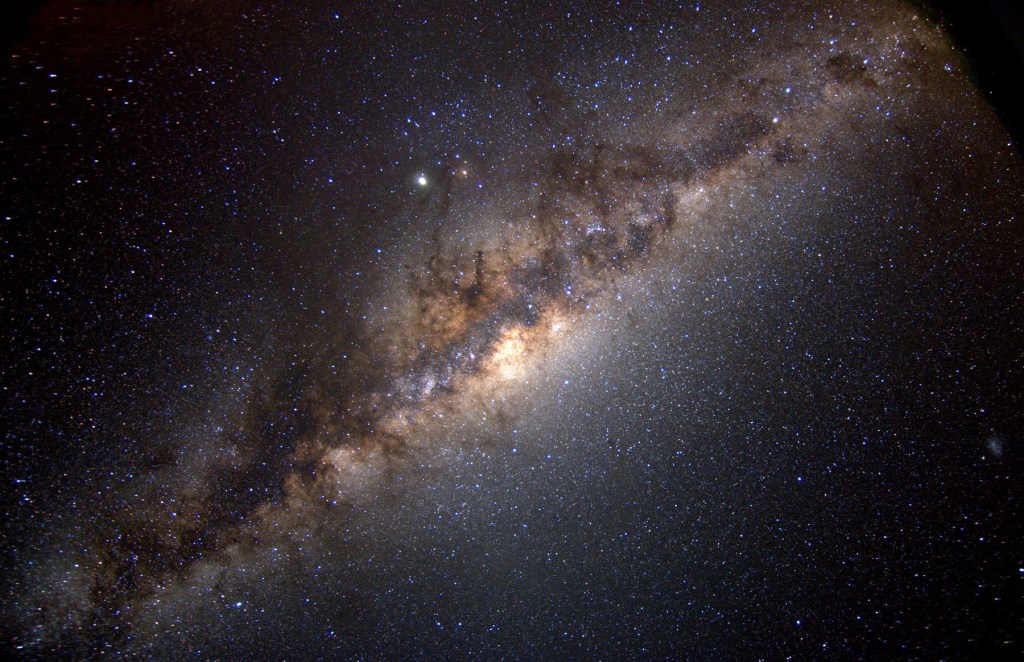
Source/Credit: Milky Way Galaxy from NASA.

“No competent thinker [can] maintain any single nebula to be a star system of coordinate rank with the Milky Way.”

–Agnes Mary Clerke, Irish astronomer, founding member of the  British Astronomical Association, and honorary member of the Royal Astronomical Society, commenting in 1890 on the likelihood that other galaxies existed beyond the Milky Way. This comment was captured in an excellent article from the July 31, 2021 Science News, “A Century of New Worlds,” which discusses discoveries in astronomy over the last 100 years. The article also notes that it was the work of another female astronomer, Henrietta Leavitt, that helped to eventually prove the existence of other galaxies.

Extra: A crater on the Moon is named after astronomer Agnes Mary Clerke (shown below).

Source/Credit: Clerke crater from NASA’s Apollo 17.