Sidebar: The Artemis Mission

Source/Credit: Orion spacecraft from NASA.

With all the previous posts about NASA’s Artemis mission, I should have outlined the three stages ahead as we return to the Moon:

Artemis I: This stage involves an uncrewed flight test around the Moon. The new Space Launch System carrying the empty Orion spacecraft will launch from NASA’s Kennedy Space Center in Florida. The mission will last from four to six weeks. The European Space Agency has supplied a key piece for this mission – a service module, which will supply the spacecraft’s main propulsion system and power (and also house air and water for astronauts on future missions).

Artemis II: This next stage will confirm all of the Orion spacecraft’s systems operate as designed with crew aboard in the actual environment of deep space as the spacecraft circles the Moon. The mission is expected to last just over 10 days

Artemis III: This third and final stage will land a crew on the surface of the Moon. NASA has awarded Human Landing System contracts to Blue Origin, Dynetics, and SpaceX. This final stage will be followed by annual crewed missions to the Moon.

The ultimate goal of Artemis is to establish a presence on the Moon as well as build an orbiting Gateway that can serve as a multi-purpose outpost providing essential support for long-term human return to the lunar surface. The Gateway will also serve as a staging points for deep space exploration, such as travel to Mars.

This is a broad and hopeful mission. The only thing that seems a bit odd is the website mission statement for Artemis:

With Artemis missions, NASA will land the first woman and first person of color on the Moon, using innovative technologies to explore more of the lunar surface than ever before. We will collaborate with commercial and international partners and establish the first long-term presence on the Moon. Then, we will use what we learn on and around the Moon to take the next giant leap: sending the first astronauts to Mars.

I think the first focus of this multi-billion dollar lunar mission should be space exploration, which should also include a diverse crew. Maybe it is better to stick to the more universal statement in the earlier Artemis Plan:

Under the Artemis program, humanity will explore regions of the Moon never visited before, uniting people around the unknown, the never seen, and the once impossible. We will return to the Moon robotically beginning next year, send astronauts to the surface within four years, and build a longterm presence on the Moon by the end of the decade…we will use the Moon as the stepping stone for our next greatest leap—human exploration of Mars.

You say potato and I say spuds.

Source/Credit: Artemis I mission map from NASA.

Note: NASA’s Artemis page was somewhat out of date when I posted this summary. For instance, in April 2021, SpaceX was chosen to provide the lunar lander.

Update: On March 31st, NASA announced it was looking for “…other U.S. companies to provide new lander development and demonstration missions from lunar orbit to the surface of the Moon.”

Follow-Up: SpaceX and Others Impacting the Night Sky

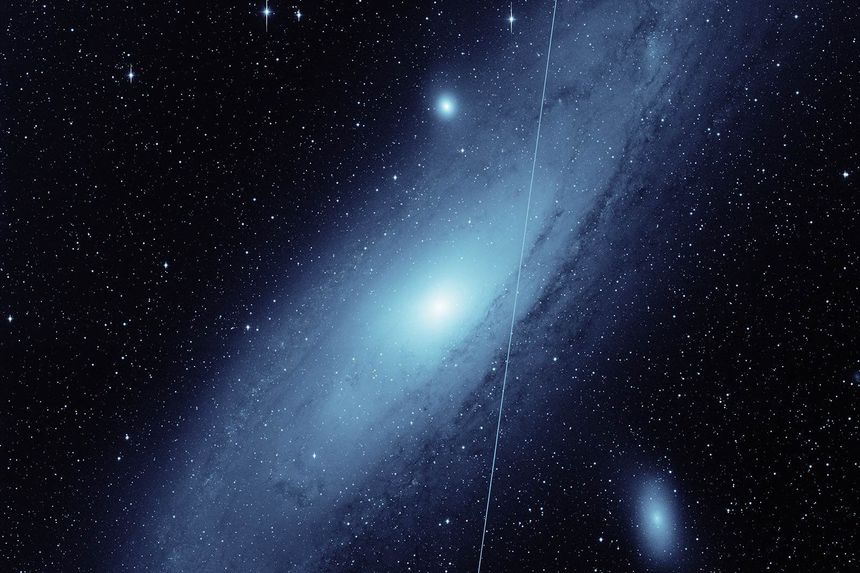
Source/Credit: Starlink satellite streak in an image of the Andromeda galaxy from CALTECH Optical Observatories/IPAC.

In an earlier post I discussed Elon Musk’s belief that low Earth orbit (LEO) can host billions of satellites, but don’t tell that to astronomers. The satellites already in orbit are corrupting telescope images, so the problem can only get worse. And should we really put up tens of thousands more (forget billions), we may not only find greater corruption, but even greater difficulties detecting dangerous asteroids threatening the Earth.

A Wall Street Journal article, “SpaceX Satellites Distort Astronomy Images, Study Finds,” highlights a January 14th study in the Astrophysical Journal Letters, “Impact of the SpaceX Starlink Satellites on the Zwicky Transient Facility Survey Observations” that found:

…researchers examined the effects of [SpaceX] Starlink satellites on about 300,000 images taken by an instrument at the Palomar Observatory in Southern California. Between November 2019 and September 2021, they noted a 35-fold increase in the number of corrupted images.

The Journal summary provided more details as well as a partial solution:

We find that the number of affected images is increasing with time as SpaceX deploys more satellites. Twilight observations are particularly affected—a fraction of streaked images taken during twilight has increased from less than 0.5% in late 2019 to 18% in 2021 August. We estimate that once the size of the Starlink constellation reaches 10,000, essentially all ZTF images taken during twilight may be affected. However, despite the increase in satellite streaks observed during the analyzed period, the current science operations of ZTF are not yet strongly affected. We also find that redesigning Starlink satellites (by installing visors intended to block sunlight from reaching the satellite antennas to prevent reflection) reduces their brightness by a factor of 4.6 ± 0.1 with respect to the original design in g, r, and i bands.

It appears SpaceX is aware of these issues and looking into the brightness of its satellites.

A separate paper from last September, “Visibility Predictions for Near-Future Satellite Megaconstellations: Latitudes near 50 Degrees will Experience the Worst Light Pollution,” stated the following concerns:

Megaconstellations of thousands to tens of thousands of artificial satellites (satcons) are rapidly being developed and launched. These satcons will have negative consequences for observational astronomy research, and are poised to drastically interfere with naked-eye stargazing worldwide should mitigation efforts be unsuccessful. Here we provide predictions for the optical brightnesses and on-sky distributions of several satcons, including Starlink, OneWeb, Kuiper, and StarNet/GW, for a total of 65,000 satellites on their filed or predicted orbits. We develop a simple model of satellite reflectivity, which is calibrated using published Starlink observations. We use this model to estimate the visible magnitudes and on-sky distributions for these satellites as seen from different places on Earth, in different seasons, and different times of night. For latitudes near 50 degrees North and South, satcon satellites make up a few percent of all visible point sources all night long near the summer solstice, as well as near sunrise and sunset on the equinoxes. Altering the satellites’ altitudes only changes the specific impacts of the problem. Without drastic reduction of the reflectivities, or significantly fewer total satellites in orbit, satcons will significantly change the night sky worldwide.

Again, without a satellite solution or fewer satellites, these craft will “significantly change the night sky worldwide.” And the scientists are now looking to the United Nations for help. So it may be in the interest of the satellite industry (four companies were named in the second study above) to come up with some quick solutions or face new restrictions. We should be able to solve this.

Source/Credit: Elon Musk and a Starlink satellite from Pascal Le Segretain/Getty; Samantha Lee/Insider.

Update: SpaceX lost about 40 of the 49 Starlink satellites launched on February 3, 2022 due to a geomagnetic storm.

Private Space Missions: Is Venus Next?

Source/Credit: Venus from Mattias Malmer/NASA/JPL..

NBC news reports that a privately-funding space probe could visit Venus as early as next year as phase one of a three-part mission. The goal of the Venus Life Finder Mission, involving MIT alumni and Rocket Lab, is to search for signs of life or microbial-type life. This effort is another encouraging sign of increased interest in scientific missions throughout the solar system.

An earlier press release on the Venus Life Finder site stated:

The Venus Life Finder Missions are a series of focused astrobiology mission concepts to search for habitability, signs of life, and life itself in the Venus atmosphere. While people have speculated on life in the Venus clouds for decades, we are now able to act with cost-effective and highly-focused missions. A major motivation are unexplained atmospheric chemical anomalies, including the “mysterious UV-absorber”, tens of ppm O2,  SO2 and H2O vertical abundance profiles, the possible presence of PH3 and NH3, and the unknown composition of Mode 3 cloud particles. These anomalies, which have lingered for decades, might be tied to habitability and life’s activities or be indicative of unknown chemistry itself worth exploring.  Our proposed series of VLF missions aim to study Venus’ cloud particles and to continue where the pioneering in situ probe missions from nearly four decades ago left off. The world is poised on the brink of a revolution in space science. Our goal is not to supplant any other efforts but to take advantage of an opportunity for high-risk, high-reward science, which stands to possibly answer one of the greatest scientific mysteries of all, and in the process pioneer a new model of private/public partnership in space exploration.

It has been more than a decade since a government has sent a mission to Venus. The last US mission to Venus was the Magellan launched in May 1989, which started to orbit Venus in 1990 and continued to do so for four years. The European Space Agency sent the Venus Express to the planet in November 2005, while Japan sent the Akatsuki in May 2010.

Interest continues among government parties. For example, just last year NASA announced two new missions to Venus:

DAVINCI+ (Deep Atmosphere Venus Investigation of Noble gases, Chemistry, and Imaging) to measure the composition of Venus’ atmosphere to understand how it formed and evolved, as well as determine whether the planet ever had an ocean. The mission consists of a descent sphere that will plunge through the planet’s thick atmosphere, making precise measurements of noble gases and other elements to understand why Venus’ atmosphere is a runaway hothouse compared the Earth’s. It will also will return the first high resolution pictures of the unique geological features on Venus known as “tesserae,” which may be comparable to Earth’s continents, suggesting that Venus has plate tectonics.

VERITAS (Venus Emissivity, Radio Science, InSAR, Topography, and Spectroscopy) to map Venus’ surface to determine the planet’s geologic history and understand why it developed so differently than Earth. In addition, it will map infrared emissions from Venus’ surface to map its rock type, which is largely unknown, and determine whether active volcanoes are releasing water vapor into the atmosphere. 

Source: Venuscloudlife.com.

Video: Cool Worlds and Exoplanet Moons

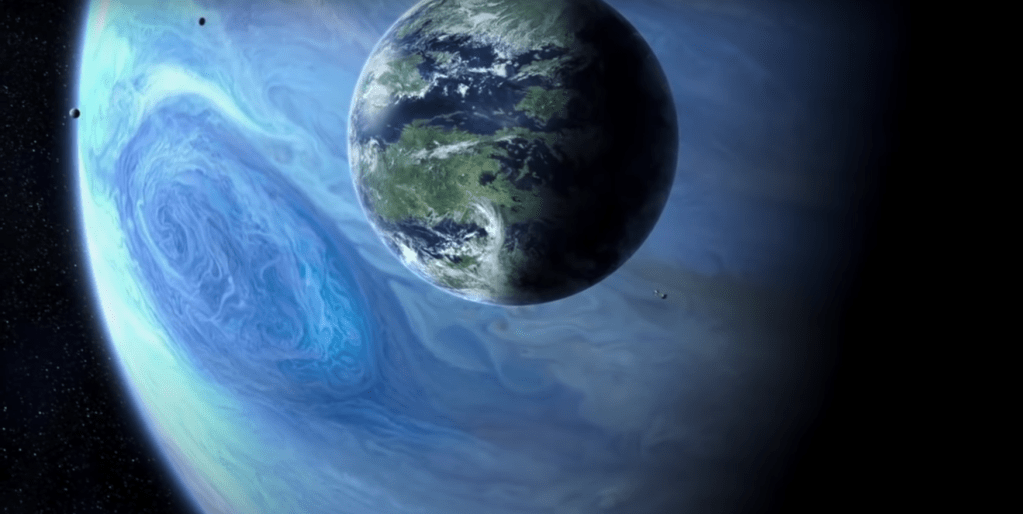
Source: Image of Exomoons from Cool Worlds.

We have located exoplanets (planets around other suns) and even free-floating planets (planets without a sun), but what about exoplanet moons? A recent video from the YouTube channel Cool Worlds titled “We Discovered a New Exomoon Candidate! A Survey of 70 Cool Gas Giants,” discusses efforts by the Cool Worlds Lab to find these new moons. The Cool Worlds Lab, based at the Department of Astronomy, Columbia University, is a team of astronomers seeking to discover and understand alien worlds, particularly those where temperatures are cool enough for life, led by Professor David Kipping.

In this video, Professor Kipping discusses his lab’s discovery of exomoon Kepler-1625b-I in 2018. This is a Neptune-sized moon orbiting a Jupiter-sized planet that orbits about the same distant from its star as Earth orbits from our Sun. The video goes into the lab’s “Cool Giant Exomoon Survey” to locate additional exomoons orbiting Jupiter-sized cool giants further out from the host star. I do not want to give away the findings since you can see this for yourself, but it can be safely stated that a new exomoon candidate has been located (and shared in Nature). The exomoon’s designation is given away in the article’s title, so the secret is out.

Check out the Cool Worlds YouTube page for other fascinating videos.