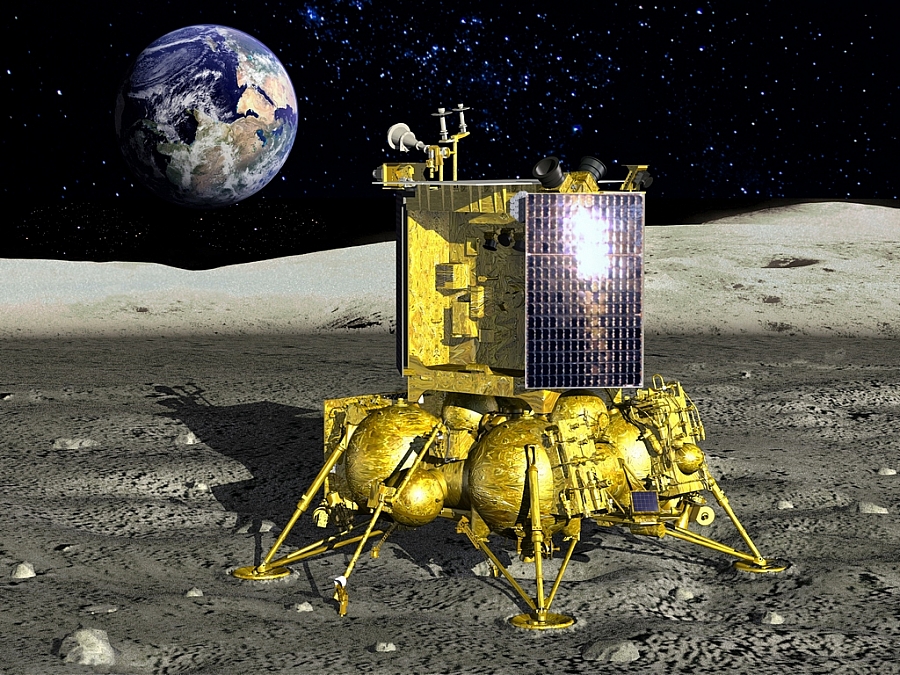
Source/Credit: The Luna-25 Moon Station from Russia’s Lavochkin Research and Production Association.
The image above is an artist’s rending of Russia’s Luna-25 Moon Station that was to be launched last year and is now scheduled to be launched in July 2022. It will be the first domestic spacecraft in the country’s modern history on the surface of the Moon. Luna-25 will be equipped with a soil-sampling robotic arm and camera to image the terrain. The last lunar mission was Luna-24 in 1976 by the then Soviet Union, which returned Moon samples to the Earth.
Source/Credit: NASA Administrator Bill Nelson, Official Portrait from NASA/Bill Ingalls.
“…in order for a space program to be successful it has to be a multi-administration effort. It’s like building an aircraft carrier; that takes about 12 years and spans many administrations. So the space program has to be the same way.”
–NASA Administrator Bill Nelson responding to a Time Magazine question about the lack of continuity among presidential administrations on moon missions.
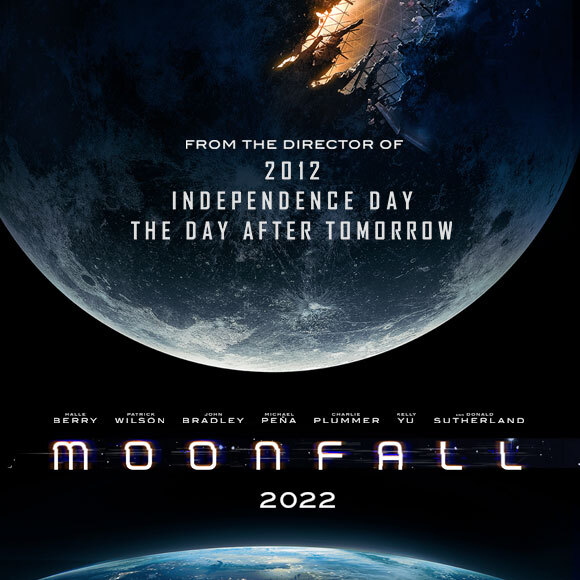
On Friday, February 4th, you can watch another crazy science fiction movie if you are up to it, but be prepared. Moonfall has the following premise from Movieinsider.com:
In Moonfall, a mysterious force knocks the Moon from its orbit around Earth and sends it hurtling on a collision course with life as we know it. With mere weeks before impact and the world on the brink of annihilation, NASA executive and former astronaut Jo Fowler (Academy Award® winner Halle Berry) is convinced she has the key to saving us all – but only one astronaut from her past, Brian Harper (Patrick Wilson, “Midway”) and a conspiracy theorist K.C. Houseman (John Bradley, “Game of Thrones”) believes her. These unlikely heroes will mount an impossible last-ditch mission into space, leaving behind everyone they love, only to find out that our Moon is not what we think it is.
Moonfall has plenty of stars, as was the case with the earlier disaster film Don’t Look Up. That said, I think you can just sit back and let this one wash over you without worrying about any science. I doubt NASA needed to be consulted on this one. In fact, late last week NASA sent out the following tweet:
At only ~240,000 miles away, our nearest neighbor affects our life here on Earth. Here are a few reasons why we’re grateful the Moon is stable in its orbit (no offense @MoonfallFilm)
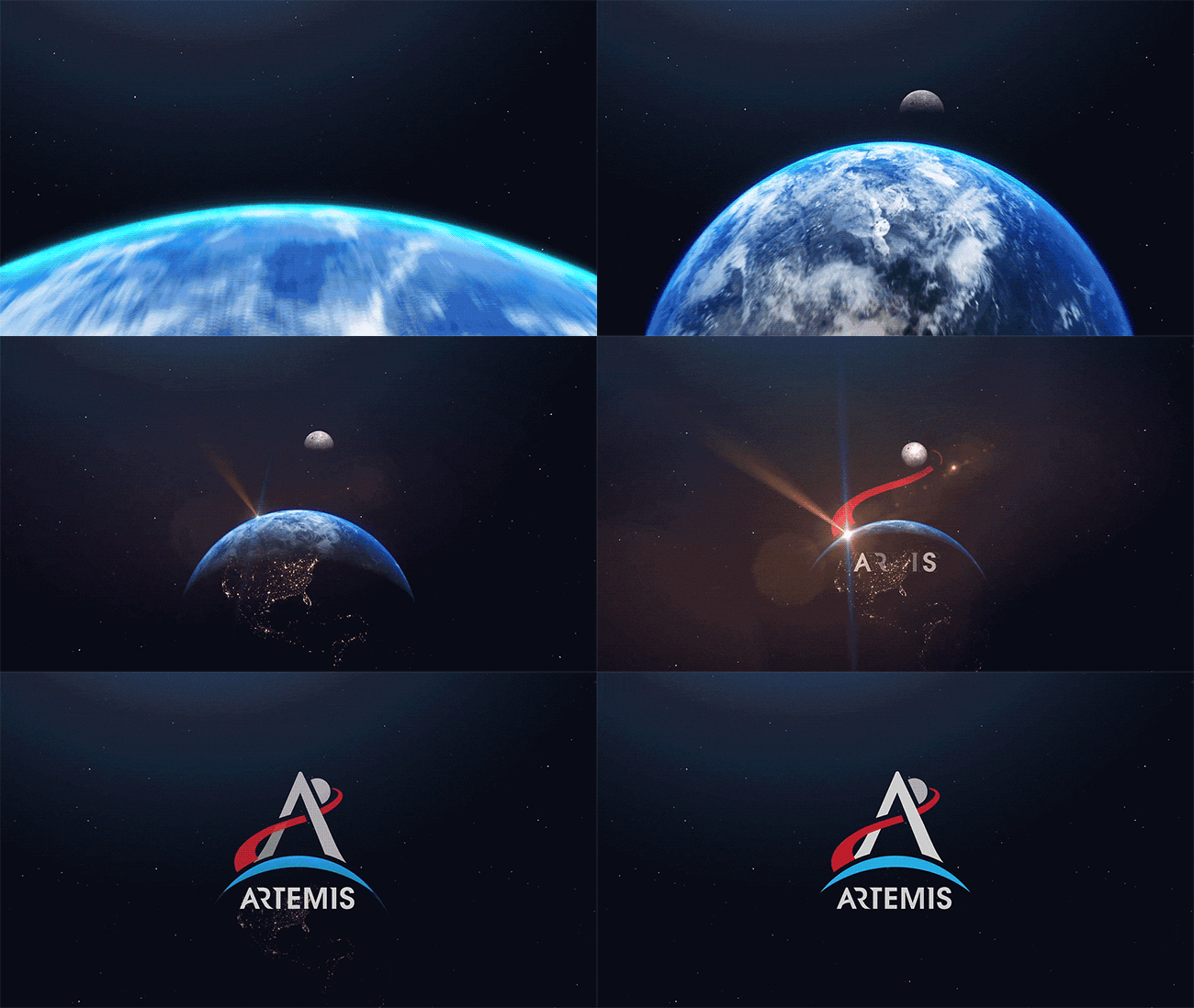
After you enjoy the show, you may want to check out what is planned for the Moon as part of the Artemis Program. This accompanying video by NASA, How We Are Going to the Moon, is pretty dramatic all by itself (with the Moon remaining in orbit, of course).
Source: Graphic from NOIRLab showing where the Earth Trojan asteroid 2020 XL5 would appear in the sky from the SOAR Telescope in Chile as the asteroid orbits the Earth-Sun Lagrange point 4 (L4).
The National Science Foundation’s NSF’s National Optical-Infrared Astronomy Research Laboratory (NOIRLab) recently reported that the Southern Astrophysical Research (SOAR) Telescope in Chile confirmed asteroid 2020 XL5 is in fact a second and the largest Trojan asteroid accompanying the Earth. “Trojan” means that the asteroid orbits the Sun along the same path as the Earth. The first discovered Trojan asteroid is called 2010 TK7, which is about 400 meters in diameter. The new asteroid 2020 XL5 is about 1.2 kilometers in diameter.
The Earth may have more than just two of these Trojan asteroids, so stay tuned. But we are not unique. Jupiter has more than 5,000 of them. Trojan asteroids are found at Lagrange point 4 (L4) and L5 (see graphic below). Both the the Trojans asteroids mentioned above are located in L4.
These companion asteroids could also be useful in the future. Cesar Briceño of NOIRLab stated:
If we are able to discover more Earth Trojans, and if some of them can have orbits with lower inclinations, they might become cheaper to reach than our Moon…So they might become ideal bases for an advanced exploration of the Solar System, or they could even be a source of resources.
Source: Lagrange points pertaining to Earth and the Sun (not to scale) from NOIRLab.
Extra: To learn what else you can find at these Lagrange points, see my earlier post.




 Our Awesome Universe