In Case You Missed It/Podcast: Retelling the Story of the Mission to the Moon

Image: Chesley Bonestell art printed in “The Conquest of the Moon” (1953). Mr. Bonestell’s art is mentioned in the Moonrise podcast.

If you are looking for a good story that you to listen to during your next car trip, you cannot do better than the Washington Post’s Moonrise podcast. It has a bit of everything, including science fiction stories, Nazi war machines, Russian persecution, American post-WWII politics, and a bit of astronomy as well.

Here is how the program sells itself:

Want to uncover the real origin story behind the United States’ decision to go to the moon? In the 50 years since the moon landing, as presidential documents have been declassified and secret programs revealed, a wild story has begun to emerge. “Moonrise,” a Washington Post audio miniseries hosted by Lillian Cunningham, digs into the nuclear arms race of the Cold War, the transformation of American society and politics ⁠— and even the birth of science fiction ⁠— to unearth what really drove us to the moon. Come along with us on a fascinating journey from Earth to the moon.

You can learn how President Kennedy tried to get the Soviet Union to join the Apollo program – twice. You can also hear about the Apollo 11 mission competing with a Soviet spacecraft trying to land on the Moon at the same time. And have you heard about the civil rights protests at the Apollo 11 launch site?

The podcast is a well crafted story trying to weave together many threads in a mostly successful way. It is still astonishing that the early Space Race was really lead by a former Nazi representing the United States and a former political prisoner representing the Soviets. Today the Apollo story is mostly a warm blur from the past, but I believe it is worth your time to listen to the full story. It is the foundation of our space exploration efforts, for better or worse.

Pic of the Week: The Pillars of Creation

Image (Credit): JWSP’s view of The Pillars of Creation. (NASA, ESA, CSA, STScI; Joseph DePasquale (STScI), Anton M. Koekemoer (STScI), Alyssa Pagan (STScI))

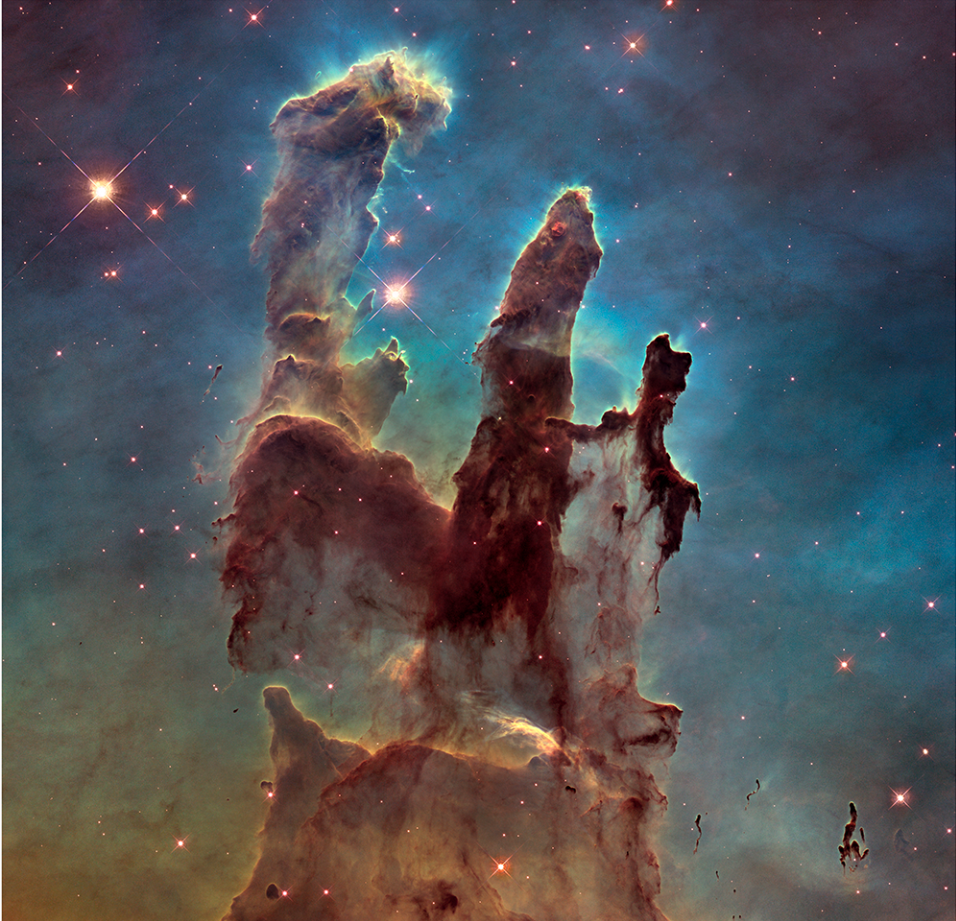
This week’s image is a redo of an earlier Hubble Space Telescope image (shown below), but this time we see the Pillars of Creation through the eyes of the James Webb Space Telescope (JWST). The pillars is part of the Eagle Nebula, which lies 6,500 light-years away.

Here is more from NASA on the JWST image:

Newly formed stars are the scene-stealers in this image from Webb’s Near-Infrared Camera (NIRCam). These are the bright red orbs that typically have diffraction spikes and lie outside one of the dusty pillars. When knots with sufficient mass form within the pillars of gas and dust, they begin to collapse under their own gravity, slowly heat up, and eventually form new stars.

What about those wavy lines that look like lava at the edges of some pillars? These are ejections from stars that are still forming within the gas and dust. Young stars periodically shoot out supersonic jets that collide with clouds of material, like these thick pillars. This sometimes also results in bow shocks, which can form wavy patterns like a boat does as it moves through water. The crimson glow comes from the energetic hydrogen molecules that result from jets and shocks. This is evident in the second and third pillars from the top – the NIRCam image is practically pulsing with their activity. These young stars are estimated to be only a few hundred thousand years old.

Although it may appear that near-infrared light has allowed Webb to “pierce through” the clouds to reveal great cosmic distances beyond the pillars, there are no galaxies in this view. Instead, a mix of translucent gas and dust known as the interstellar medium in the densest part of our Milky Way galaxy’s disk blocks our view of the deeper universe.

Image (Credit): Hubble Space Telescope’s view of The Pillars of Creation in 2014. (NASA, ESA, and the Hubble Heritage Team)

Space Stories: Volcanic Exoplanets, Medieval Star Maps, and Near-Earth Asteroids

Image (Credit): The lava lake that sits atop Mount Nyiragongo in the Democratic Republic of Congo (Stocktrek Images / Richard Roscoe via Getty Images)

Here are some recent stories of interest.

Universe.com: “Scientists Discover a New Way Exoplanets Could Make Oxygen; Unfortunately, it Doesn’t Require Life

The researchers have found an abiotic source of oxygen that stems from sulphur dioxide. Sulphur is not rare in celestial bodies, and since volcanoes produce sulphur and pump it into the atmosphere, terrestrial volcanic exoplanets may have oxygen in their atmospheres. And life needn’t be involved.

Nature.com: “First Known Map of Night Sky Found Hidden in Medieval Parchment

A medieval parchment from a monastery in Egypt has yielded a surprising treasure. Hidden beneath Christian texts, scholars have discovered what seems to be part of the long-lost star catalogue of the astronomer Hipparchus — believed to be the earliest known attempt to map the entire sky.

Phys.org: “30,000 Near-Earth Asteroids Discovered, and Numbers are Rising

We have now discovered 30,039 near-Earth asteroids in the solar system—rocky bodies orbiting the sun on a path that brings them close to Earth’s orbit. The majority of these were discovered in the last decade, showing how our ability to detect potentially risky asteroids is rapidly improving.

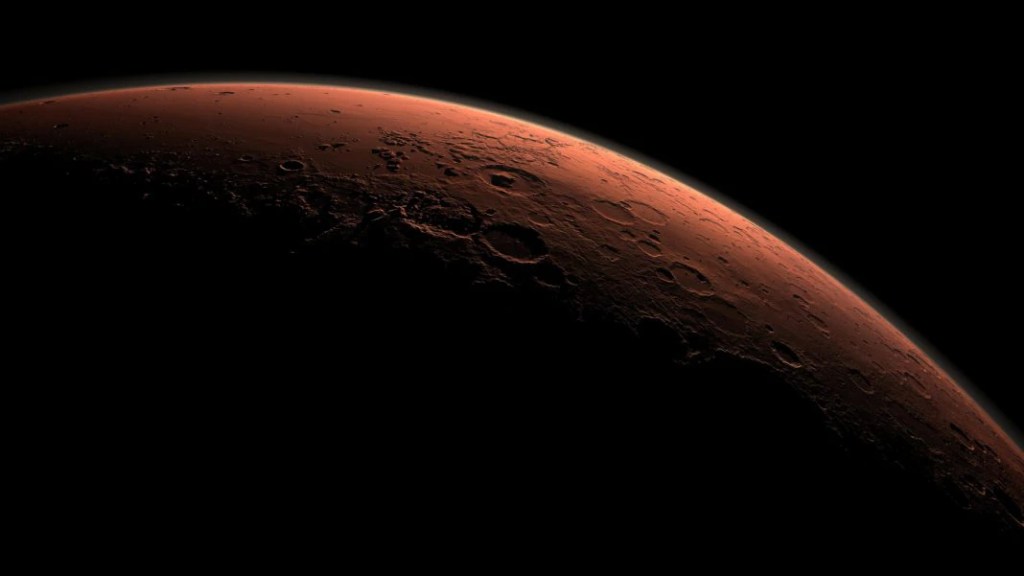
Study Findings: Early Mars Habitability and Global Cooling by H2-based Methanogens

Image (Credit): Image of present day Mars. (NASA)

Nature Astronomy abstract:

During the Noachian, Mars’ crust may have provided a favourable environment for microbial life. The porous brine-saturated regolith would have created a physical space sheltered from ultraviolet and cosmic radiation and provided a solvent, whereas the below-ground temperature and diffusion of a dense, reduced atmosphere may have supported simple microbial organisms that consumed H2 and CO2 as energy and carbon sources and produced methane as a waste. On Earth, hydrogenotrophic methanogenesis was among the earliest metabolisms, but its viability on early Mars has never been quantitatively evaluated. Here we present a probabilistic assessment of Mars’ Noachian habitability to H2-based methanogens and quantify their biological feedback on Mars’ atmosphere and climate. We find that subsurface habitability was very likely, and limited mainly by the extent of surface ice coverage. Biomass productivity could have been as high as in the early Earth’s ocean. However, the predicted atmospheric composition shift caused by methanogenesis would have triggered a global cooling event, ending potential early warm conditions, compromising surface habitability and forcing the biosphere deep into the Martian crust. Spatial projections of our predictions point to lowland sites at low-to-medium latitudes as good candidates to uncover traces of this early life at or near the surface.

Citation: Sauterey, B., Charnay, B., Affholder, A. et al. Early Mars habitability and global cooling by H2-based methanogens. Nat Astron (2022). https://doi.org/10.1038/s41550-022-01786-w

Study-related stories:

First Class Fun from the US Post Office

Credit: U.S. Postal Service

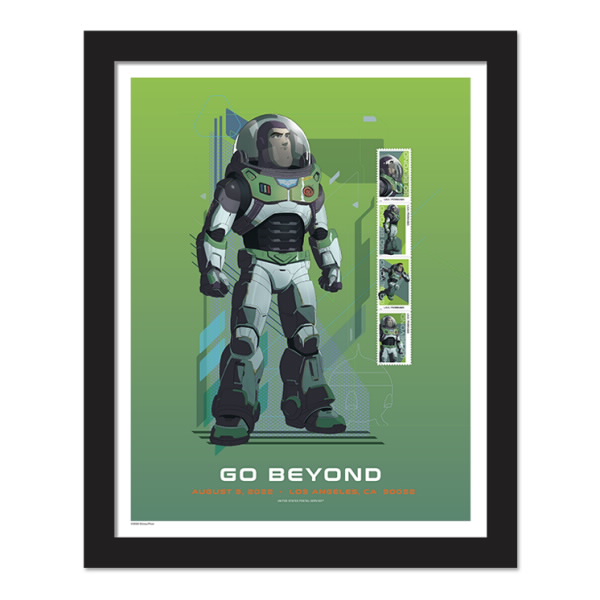
While the U.S. currency remains pretty boring, at least U.S. postage stamps continually change and highlight various aspects of American society. Two of those themes are science fiction and space exploration, and you have a few options if you want to show your interest in these areas.

These stamps include:

  • Star Wars Droids (above);
  • Space Ranger Buzz Lightyear (below); and
  • James Webb Space Telescope (below).

I know, you hardly ever write letters and you have a bunch of those boring flag stamps. Well, this is your chance to show a little more color on that birthday or anniversary card. Save the flag stamps for the bills.

Be a kid again, if only for a few moments.

Credit: U.S. Postal Service