Television: Debating Putin’s Nukes

Astrophysicist Neil deGrasse Tyson was a guest on HBO’s Real Time with Bill Maher last Friday. During the broadcast he discussed his new book, Starry Messenger: Cosmic Perspectives on Civilization, which I commented on in an earlier post.

The odd part of the discussion came when Mr. Tyson was trying to explain that hydrogen bombs are not as bad as atomic bombs because they give off less lethal radiation. Bill Maher had earlier expressed his concerns about Russia’s Putin using a nuclear weapon and was surprised to learn that a hydrogen bomb was less dangerous in terms of radiation. He asked about this again, but Mr. Tyson went onto a different topic about the power of conventional arms and never did get back to Mr. Maher’s main concern.

Sadly, Mr. Tyson missed a chance to inform the audience about the dangers of nuclear weapons, be they hydrogen or atomic. As I had noted in an earlier post about nuclear risks, scientists have found that even a limited nuclear exchange can do great damage to the world because of the soot it throws into the upper atmosphere. A Columbia Climate School study on this issue, “Even a Limited India-Pakistan Nuclear War Would Bring Global Famine, Says Study,” found that even 50 Hiroshima-size explosions, which are quite small by today’s standards, would “…launch some 5 million tons of soot toward the stratosphere.” This soot would “…cause production of the world’s four main cereal crops—maize, wheat, soybeans and rice—to plummet an average 11 percent over that period, with tapering effects lasting another five to 10 years.” The impact of famine would lead to the loss of countless lives around the world.

The real risk today is a nuclear winter, which Mr. Tyson never explained. Instead, the audience was left with the impression that a nuclear explosion is not all that serious. Apparently, he was more interested in sharing all of his knowledge about World War II than addressing the question on the table. Mr. Tyson is supposed to be a good science communicator, so he really needs to correct the record. This is no time to be sloppy about nuclear war.

Artemis I: If at First You Don’t Succeed…

NASA is ready to try the uncrewed Artemis I mission again next month. The planned date is November 14, with November 16 and 19 as back up dates.

Should you need it, here is a quick summary of the Artemis I mission again:

Artemis I will be the first integrated flight test of NASA’s deep space exploration system: the Orion spacecraft, Space Launch System (SLS) rocket and the ground systems at Kennedy Space Center in Cape Canaveral, Florida. The first in a series of increasingly complex missions, Artemis I will be an uncrewed flight that will provide a foundation for human deep space exploration, and demonstrate our commitment and capability to extend human existence to the Moon and beyond. During this flight, the uncrewed Orion spacecraft will launch on the most powerful rocket in the world and travel thousands of miles beyond the Moon, farther than any spacecraft built for humans has ever flown, over the course of about a three-week mission. 

I am tired of crossing my fingers, so let’s just hope these launch dates work.

Image (Credit): Artemis I mission map. (NASA)

Arecibo Observatory Gone Forever

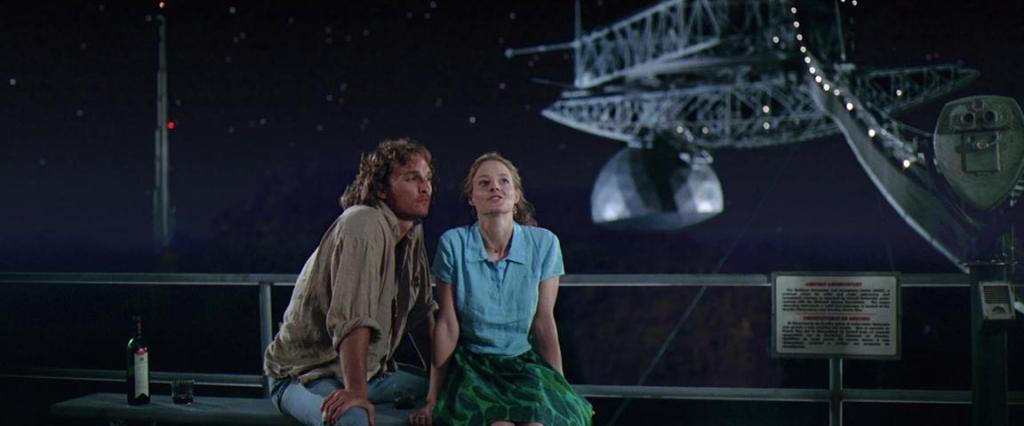
Image (Credit): Matthew McConaughey and Jodie Foster at the Arecibo Observatory in the movie Contact. (Warner Bros.)

If you were hoping that the Arecibo Observatory in Puerto Rico would have a second life, it may be time to say goodbye. Efforts to rebuild the radio telescope since it collapsed in 2020 have ended. Nature reports that the US National Science Foundation (NSF) has given up on the idea of rebuilding the telescope and instead plans to establish an educational center at the site.

You may have memories from the 1997 film Contact where Matthew McConaughey and Jodie Foster enjoyed some private time at the Observatory. Her character Dr. Ellie Arroway was working at the Observatory as part of the Search for Extraterrestrial Intelligence works (SETI) program. In fact, the SETI connection is true. You can see a SETI tribute to the telescope here.

Of course, scientists will remember almost 60 years of work with the radio telescope. While it was initially built for military purposes, it was soon transformed into a scientific site and served as the largest radio telescope on the planet for some time. As far as scientific accomplishments, here are a few of them from the NSF:

  • 1967: Arecibo discovered that the rotation rate of Mercury is 59 days, not the previously estimated 88 days.
  • 1981: Arecibo produced the first radar maps of the surface of Venus.
  • 1992: Arecibo discovered the first ever exoplanet: In subsequent observations, an entire planetary system was found around the pulsar PSR 1257+12.
  • 2008: Astronomers use Arecibo to detect for the first time, methanimine and hydrogen cyanide molecules — two organic molecules that are key ingredients in forming amino acids — in a galaxy 250 million light-years away.

So many new telescopes have come online in the past 60 years that some will say we will be fine with an educational center. This is true, but it is also worth remembering each of the telescopes along the way that helped us to understand this awesome universe of ours.

Image (Credit): The damaged Arecibo Observatory reflector dish after suffering damage from a broken cable. (University of Central Florida)

Pic of the Week: Stellar Tantrum

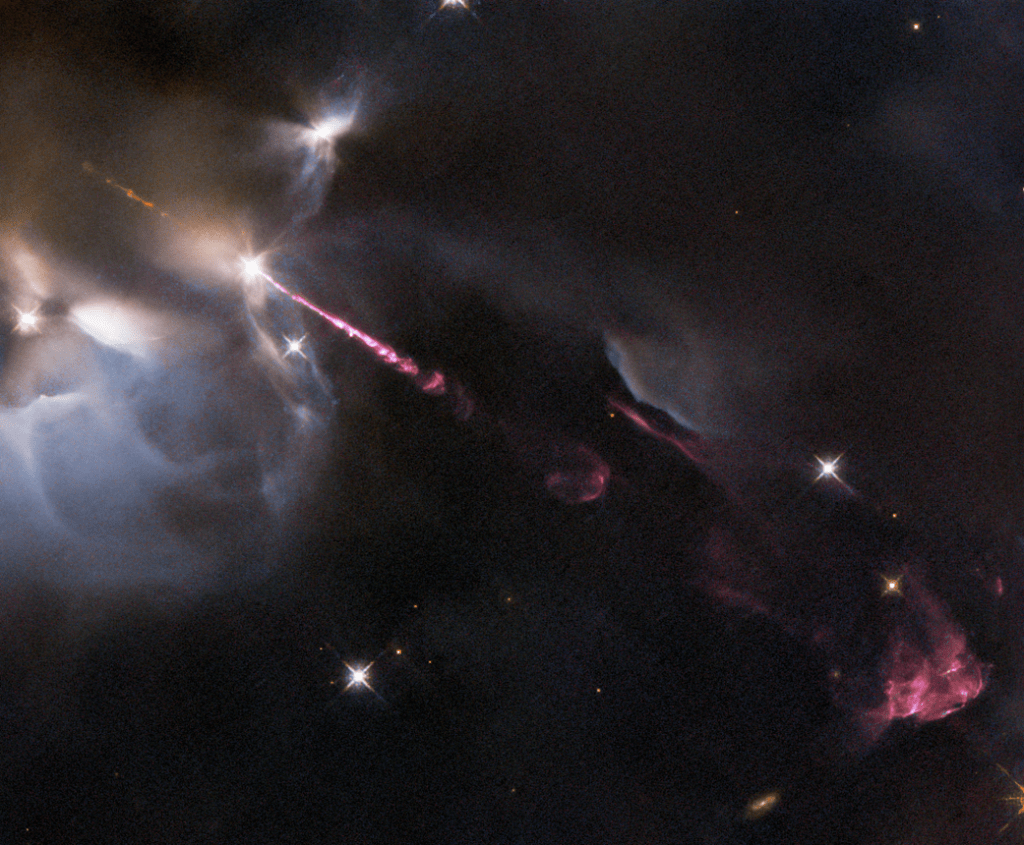
Image (Credit): Hubble image of an outburst from an infant star. (ESA/Hubble & NASA, B. Nisini)

This week’s image is from the NASA/ESA Hubble Space Telescope. While it may look like an enormous interstellar stingray, it actually shows gas streaming from a newly-formed star. Here is the story from the European Space Agency (ESA):

An energetic outburst from an infant star streaks across this image from the NASA/ESA Hubble Space Telescope. This stellar tantrum – produced by an extremely young star in the earliest phase of formation – consists of an incandescent jet of gas travelling at supersonic speeds. As the jet collides with material surrounding the still-forming star, the shock heats this material and causes it to glow. The result is the colorfully wispy structures, which astronomers refer to as Herbig–Haro objects, billowing across the lower right of this image.

Herbig–Haro objects are seen to evolve and change significantly over just a few years. This particular object, called HH34, was previously captured by Hubble between 1994 and 2007, and again in glorious detail in 2015. HH34 resides approximately 1,250 light-years from Earth in the Orion Nebula, a large region of star formation visible to the unaided eye. The Orion Nebula is one of the closest sites of widespread star formation to Earth, and as such has been pored over by astronomers in search of insights into how stars and planetary systems are born. 

Space Stories: Venusian Balloons, Sun Observations, and a Private Moon Trip

Image (Credit): Test of the one-third scale prototype aerobot designed to withstand the corrosive chemicals in Venus’ atmosphere. (Near Space Corporation)

Here are some recent stories of interest.

NASA.gov: “JPL’s Venus Aerial Robotic Balloon Prototype Aces Test Flights

A scaled-down version of the aerobot that could one day take to the Venusian skies successfully completed two Nevada test flights, marking a milestone for the project…The shimmering silver balloon ascended more than 4,000 feet (1 kilometer) over Nevada’s Black Rock Desert to a region of Earth’s atmosphere that approximates the temperature and density the aerobot would experience about 180,000 feet (55 kilometers) above Venus. Coordinated by Near Space, these tests represent a milestone in proving the concept’s suitability for accessing a region of Venus’ atmosphere too low for orbiters to reach, but where a balloon mission could operate for weeks or even months.

SkyandTelescope.org: “‘Chinese Observatory Will Study Violent Events on the Sun

China has launched a solar observatory to study solar flares and eruptions, and their connection with the Sun’s magnetic field…[the Advanced Space-based Solar Observatory (ASO-S)] is planned to operate at 720 kilometers (447 miles) above Earth’s surface in a Sun-synchronous orbit that will allow it to observe the Sun at all times. Its primary, four-year mission is timed to make the most of the 2024–2025 solar maximum, when the Sun is at its most active during its 11-year cycle.

Space.com: “‘SpaceX Says its 2nd Private Starship Trip Around the Moon will Help Make Humanity Multiplanetary

SpaceX’s newly announced tourist mission to the moon could help humanity extend its footprint far beyond Earth, company representatives say. That mission, which was revealed today (Oct. 12), will send wealthy entrepreneur Dennis Tito, his wife Akiko and 10 other people on a weeklong journey around the moon aboard SpaceX’s huge Starship vehicle, which is still in development. Who those 10 other passengers will be is unknown; only the Titos have reserved seats at the moment.