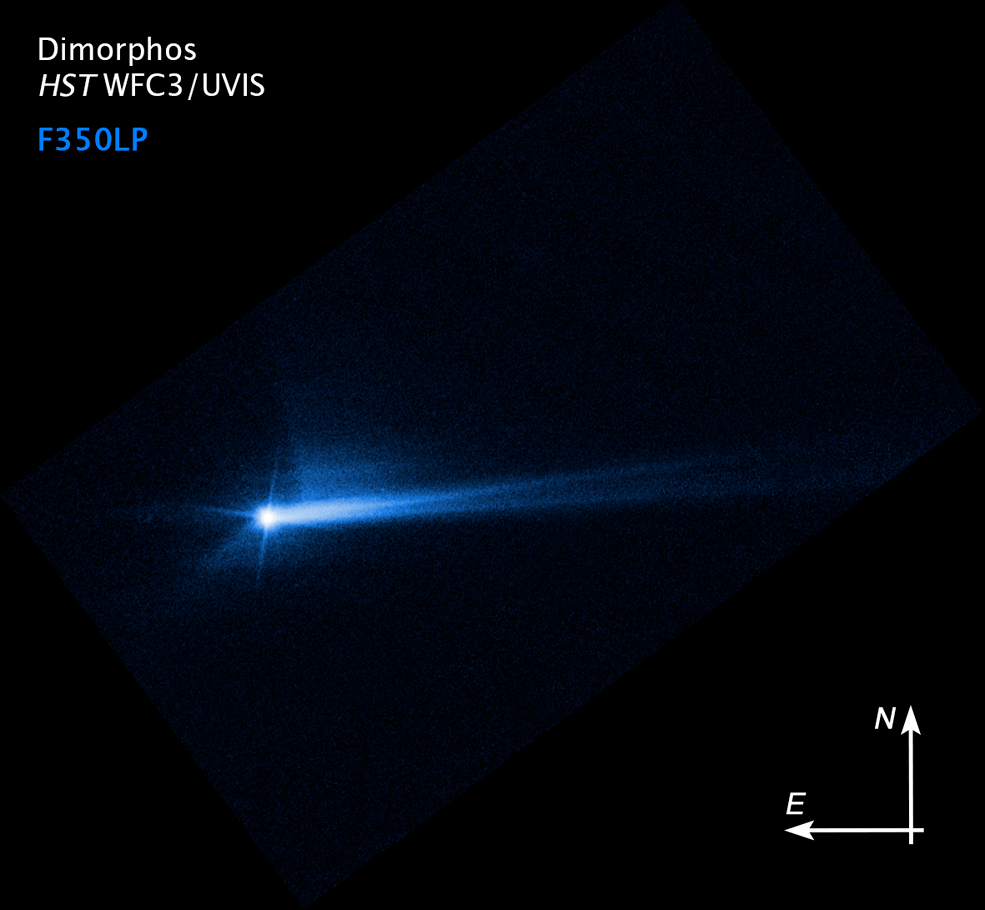
Image (Credit): The image above was taken on October 8, 2022 by NASA’s Hubble Space Telescope. It shows the debris blasted from the surface of Dimorphos 285 hours after the asteroid was intentionally hit by NASA’s DART spacecraft on September 26th. NASA stated that the shape of that tail has changed over time. ( NASA/ESA/STScI/Hubble)
NASA has saved the Earth, or it would have had the asteroid Dimorphos and its partner been heading towards us. That is the news from earlier today from the space agency. NASA’s Administrator Bill Nelson made the following comments regarding the results of the impact by the Double Asteroid Redirection Test (DART) spacecraft:
This mission shows that NASA is trying to be ready for whatever the universe throws at us. NASA has proven we are serious as a defender of the planet. This is a watershed moment for planetary defense and all of humanity, demonstrating commitment from NASA’s exceptional team and partners from around the world.
NASA scientists determined that the orbit of Dimorphos around its parent asteroid, Didymos, was truncated by 32 minutes as a result of the impact. Since minimum success would have been 1 minute 13 seconds, DART was a great success.
Hollywood may prefer a more dramatic method with oil rig astronauts and nuclear bombs, but sometimes a simple nudge will do the job.
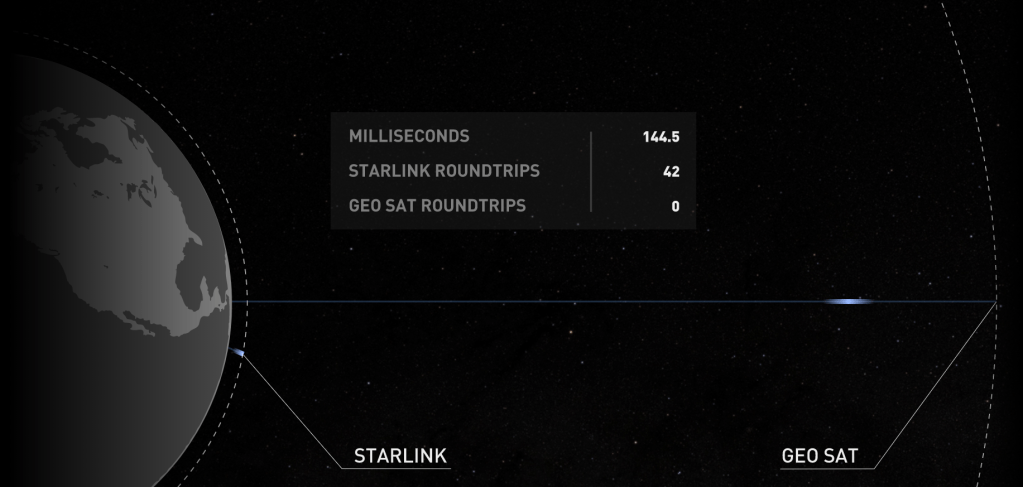
Image (Credit): Starlink page explaining why Starlink satellites are better then geostationary satellites. (SpaceX)
As if Elon Musk doesn’t have enough problems with his Twitter purchase and declining shares at Tesla, now the Ukranians are reporting that SpaceX’s Starlink internet service failed to work during a critical point in their battle to push the Russians out of Ukranian territory. This problem has been going on for weeks, but we are hearing about it now.
SpaceX was silent when these reports came out, but some suggested this may have been a feature rather than a bug in the Starlink system to prevent it from being used by Russians.
Mr. Musk later tweeted on this matter, stating:
Bad reporting by [The Financial Times]. This article falsely claims that Starlink terminals & service were paid for, when only a small percentage have been. This operation has cost SpaceX $80M & will exceed $100M by end of year. As for what’s happening on the battlefield, that’s classified.
Sadly, Mr. Musk did not clear the air but rather boasted about his company and attacked the media. But another media story from The Eurasian Times shed more light on the issue. The newspaper reports that Russia may be using its Tirada-2S satellite communications electronic jamming system to interrupt Starlink signals.
I would rather SpaceX is the cause of the problem rather than the Russians, but whatever it is we can only hope the Ukrainians, SpaceX, and Ukraine’s allies have a quick fix. Mr. Musk should received accolades for adding a novel asset to this war, yet his entire Starlink enterprise, and not just his donated equipment, is now at risk.
Update: Elon Musk is now asking the Pentagon to assume the costs of the Ukrainian Starlink program, expected to cost SpaceX about $100 million by the end of the year. Given the ongoing Twitter battle between Elon Musk and the Ukrainians related to Mr. Musk’s proposed peace plan for the region, the Ukrainians should probably be looking for another funding partner rather than continuing to count on the generosity of Mr. Musk.
Further Update: Elon Musk is now backing off on his attempts to seek more funding for Starlink, but as usual he is not very graceful about it. Here is his recent tweet:
The hell with it … even though Starlink is still losing money & other companies are getting billions of taxpayer $, we’ll just keep funding Ukraine govt for free.
Image (Credit): Surface of Mercury captured by NASA’s MESSENGER spacecraft.(NASA/Johns Hopkins University Applied Physics Laboratory/Carnegie Institution of Washington)
I often here of super-Earths among the spotted expolanets, but super-Mercuries? They are less common, with only eight spotted to date, including two recently found around exoplanet using the Echelle SPectrograph for Rocky Exoplanet and Stable Spectroscopic Observations (ESPRESSO) spectrograph on the European Southern Observatory’s Very Large Telescope in Chile. The two super-Mercuries were spotted in the star system HD 23472 along with two super-Earths.
Researcher researcher Susana Barros with the Astrofísica e Ciências do Espaço’s, who led the team that found the new super-Mercuries, stated:
For the first time we have discovered a system with two super-mercuries. This allows us to obtain clues about how these planets were formed, which could help us exclude some possibilities. For example, if an impact large enough to create a Super-Mercury is already very unlikely, two giant impacts in the same system seems very improbable. We still don’t know how these planets are formed but it appears to be connected to the composition of the parent star. This new system can help us find out.
Much of the exoplanet talk to date has been about super-Earths and mini-Neptunes, so it is nice to see a super-Mercury thrown into the mix. With the exoplanet search is still in its early days, expect more local planet terminology to be added to the discussion.
“We are going to keep flying [to the] International Space Station as long as our new infrastructure [is being] buil[t]. We don’t know yet how it’s going to be built and what kind of modules we will have, but I’m sure that we will stay in international partnership when we fly [to the] ISS and [the] future station and future infrastructure is also going to be with international partnership.”
–Statement by Sergei Krikalev, executive director of human space flight programs at Roscosmos, during an October 5th briefing following the successful SpaceX launch of the latest crew to the International Space Station (ISS), which included Russian cosmonaut Anna Kikina. His comments were seen as part of a continuing Russian clarification of earlier comments about the Russians leaving the ISS in 2024. It appears the Russian will be staying with the station even longer, even if this support does not last until 2030.
Neil deGrasse Tyson has put out quite a few popular astronomy books over the years, including:
One Universe: At Home in the Cosmos (2000);
The Sky Is Not the Limit: Adventures of an Urban Astrophysicist (2004);
Death by Black Hole: And Other Cosmic Quandaries (2007);
The Pluto Files: The Rise and Fall of America’s Favorite Planet (2009); and
Astrophysics for People in a Hurry (2017).
And while he often runs into the thick of current politics in his interviews, his books tended to stick to science. His latest book, Starry Messenger: Cosmic Perspectives on Civilization, is one of the exceptions and at least one reviewer is taking him to the woodshed.
Mr. Tyson says this in the book’s preface:
Starry Messenger is a wake-up call to civilization. People no longer know who or what to trust. We sow hatred of others fueled by what we think is true, or what we want to be true, without regard to what is true. Cultural and political factions battle for the souls of communities and of nations. We’ve lost all sight of what distinguishes facts from opinions. We’re quick with acts of aggression and slow with acts of kindness.
When Tyson sticks to his orbit of expertise, he remains as engaging as ever, like the professor of a popular college survey course that students might take to satisfy their science requirement… Yet while Tyson extols the virtue of a skeptical mind-set in scientific inquiry, he often comes off as none-too-skeptical in his discussion of how that mind-set can be applied to human and political affairs.
Just as Mr. Tyson followed and updated Carl Sagan’s work, such as the remake of the television series Cosmos, he may be trying to update Dr. Sagan’s 1995 book The Demon-Haunted World: Science as a Candle in the Dark. Dr. Sagan was concerned about the future of mankind and its silly prejudices, which he also illustrated in his fictional book Contact. In The Demon-Haunted World, Dr. Sagan wrote:
I have a foreboding of an America in my children’s or grandchildren’s time – when the United States is a service and information economy; when nearly all the key manufacturing industries have slipped away to other countries when awesome technological powers are in the hands of a very few, and no one representing the public interest can even grasp the issues; when the people have lost the ability to set their own agendas or knowledgeably question those in authority when, clutching our crystals and nervously consulting our horoscopes, our critical faculties in decline, unable to distinguish between what feels good and what’s true, we slide, almost without noticing, back into superstition and darkness.
He wrote that almost 27 years ago and we are now living in the time of his children and grandchildren. His predictions seem true enough in a time of Facebook and “fake news,” as well as various denials throughout the world, from elections to climate change.
Maybe Mr. Tyson’s book is far from perfect, but if he can really continue Dr. Sagan’s work of chipping away at opinions masquerading as facts, then he is pursuing the same noble path even if it he hits a few bumps along the way. We may not be able to save what we have if we continue with our games for another 27 years.




 Our Awesome Universe