Image (Credit): Picture of the Martian surface captured by the orbiting Mars Reconnaissance Orbiter. (NASA/JPL-Caltech/UArizona)
This week’s image comes from the High Resolution Imaging Science Experiment (HiRISE) onboard the Mars Reconnaissance Orbiter. You don’t need to look too hard to see a bear in this photo.
Here is a summary of what you are seeing from the Lunar and Planetary Laboratory at the University of Arizona, which operates HiRISE:
There’s a hill with a V-shaped collapse structure (the nose), two craters (the eyes), and a circular fracture pattern (the head). The circular fracture pattern might be due to the settling of a deposit over a buried impact crater. Maybe the nose is a volcanic or mud vent and the deposit could be lava or mud flows?
A top official with the European Space Agency said it had no plans to send European astronauts to the newly completed Chinese space station, making it clear for the first time that the agency is no longer committed to working with China in human space flight in the near future. “We are very busy supporting and ensuring our commitments and activities on the International Space Station,” ESA director general Josef Aschbacher told a press conference in Paris on Monday.
Is the Milky Way special, or, at least, is it in a special place in the Universe? An international team of astronomers has found that the answer to that question is yes, in a way not previously appreciated. A new study shows that the Milky Way is too big for its “cosmological wall”, something yet to be seen in other galaxies. The new research is published in Monthly Notices of the Royal Astronomical Society.
NASA’s Lucy spacecraft will add another asteroid encounter to its 4-billion-mile journey. On Nov. 1, 2023, the Southwest Research Institute-led Lucy mission will get a close-up view of a small main belt asteroid to conduct an engineering test of the spacecraft’s innovative asteroid-tracking navigation system. The Lucy mission was already on course to break records by its planned visit of nine asteroids during its 12-year mission to tour the Jupiter Trojan asteroids, which orbit the Sun at the same distance as Jupiter. Originally, Lucy was not expected to get a close-up view of any asteroids until 2025, when it will fly by the main belt asteroid (52246) Donaldjohanson. However, the SwRI-led Lucy team identified a small, as-yet unnamed asteroid in the inner main belt as a potential new and useful target for the Lucy spacecraft.
Image (Credit): China’s KZ-11 transport launch system, which may be a model for an anti-satellite system. (Chinaspaceflight.com)
Earlier this month, The Wall Street Journal published an article, “Space Launches Should Withstand Chinese Challenge, Pentagon Mandate Says,” regarding new rocket requirements being developed by the US Department of Defense (DOD). It appears the Pentagon is worried about both the Russians and Chinese interfering with the launches of spy satellites. It doesn’t help to have an ongoing war in Ukraine where the Russians have already threatened US satellites. As a result, commercial rocket companies will need to meet some new specs on future missions.
DOD has already started the move to smaller satellites with dispersed missions to eliminate big space targets, which also allows for smaller companies to get into the game. More satellites launched from more locations (if not mobile locations) can assist the military with its missions whether it is facing errors or attacks. Even with some recent rocket mishaps, the story on the ground is positive as more companies join the industry while satellites get smaller and smaller.
This is not the space race the astronomy community wants to have, but the militarization of space is nothing new and is the primary reason we even started the space program. If the Blue Marble is not enough for us to understand the cost of war on the ground and in space, I am not sure what will work.
If you have questions about the future of AI and astronomy, I recommend you visit Cool World Lab’s latest video titled “ChatGPT Takes A College Level Astrophysics Exam.” The video addresses concerns that ChatGPT can be used by students to cheat on tests and homework, and highlights how the program is far from perfect (as shown below in a clip from the video).
To test the abilities of ChatGPT, the host submitted questions from an astronomy final exam to see what would happen. The results were interesting, particularly when math was involved. I do not want to give away the final score (you should watch the video for yourself), but let’s just say a good student can do better than ChatGPT at the moment.
What happens in the future with this new technology is anyone’s guess, though in-class tests may be the best approach if a teacher truly want to know the capabilities of a student. Cheating happens all the time, and it will probably happen on the homework. We just need to ensure the final test is a real test of the student alone
Image (Credit): One of the questions asked in ChatGPT Takes A College Level Astrophysics Exam. (Cool World Labs)
Extra: The video also promotes Ground News so you can determine who is generating the “facts” you read in the news, human or otherwise. Check it out.
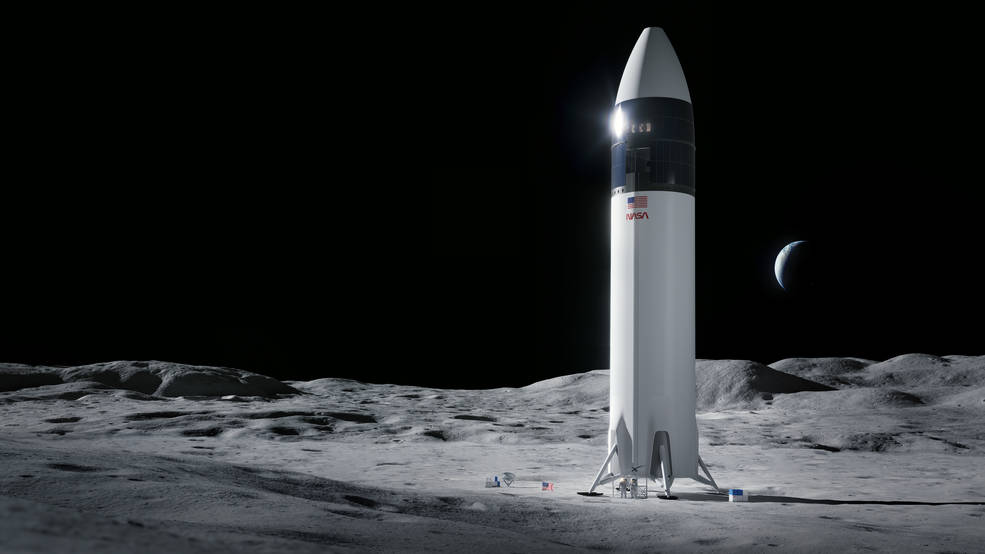
Image (Credit): Arstist’s rendering of SpaceX Starship human landing system design. (SpaceX)
The other week, NASA revealed an update on the Artemis III mission to the Moon in 2025. Now that Artemis I was a success and Artemis II is being readied, Artemis III is becoming much clearer on the horizon. The plan focuses on the first crew to land on the surface, noting that future missions will be involved in building the Gateway lunar space station.
While the Space Launch System (SLS) will get the crew into orbit on Orion, SpaceX has been chosen to bring this first crew to the moon. However, SpaceX will first need to test this human landing system on the Moon without a crew.
The landing site is likely to be on the Moon’s South Pole involving two astronauts who will take the SpaceX human landing system to the surface. They will conduct their research work in Axiom space suits.
It all may have become routine back in the 1970s, but NASA is demoing everything all over again to ensure new systems and new parties are up to par for this return to the Moon. The world is watching again, particularly China. We need to be perfect in this overdue first step back into human space travel.
You can view all of the parts of the mission in the graphic below.







 Our Awesome Universe