Image (Credit): Artist’s rendering of Lucy near an asteroid. The two large discs are the solar arrays. (Southwest Research Institute)
NASA’s Lucy spacecraft continues to face some engineering issues as it travels away from Earth after the first of two flybys before it can reach the Trojan asteroids where it will begin its survey. While the earlier problems with deploying its solar array continue, the matter will most likely need to be resolved in 2024 when the spacecraft is closer to Earth again. Fortunately, the array is 98 percent deployed, so there is no risk to the 12-year mission at this time.
NASA will keep all of us posted. You can read more about the solar array issues here.
Image (Credit): Lucy’s orbital path (shown in green). (NASA)
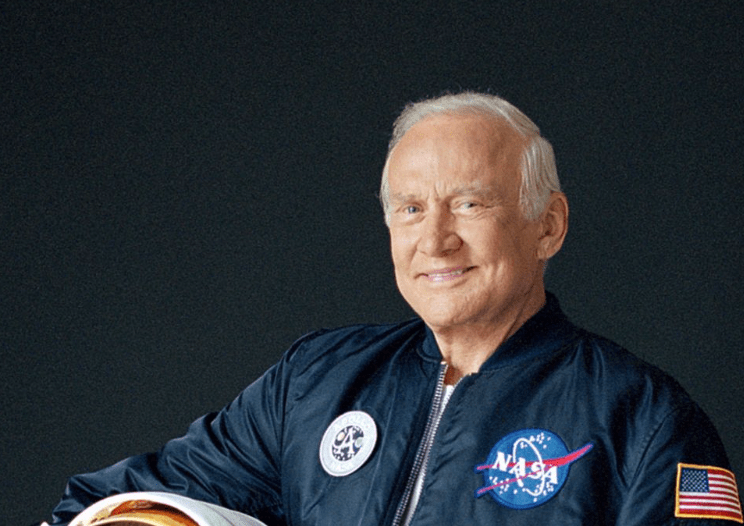
On this day in 1930, Edwin Eugene (Buzz) Aldrin Jr. came into the world. Since that day, he has been busy with adventures in the sky (US Air Force fighter pilot), in orbit (Gemini 12), and on the Moon (Apollo 11). He will always be remembered as part of the first pair of humans (Neil Armstrong being the other half) to step on the lunar surface.
Here are a few other interesting facts about Mr. Aldrin:
“Buzz” came from his sister mispronouncing “brother” as “buzzer”;
his father wanted him to go to the Naval Academy, but Buzz’s seasickness steered hims towards West Point;
he flew 66 combat missions in Korea;
the was the first astronaut with a doctoral degree;
the first person to hold a religious ceremony on the Moon;
following the Apollo 11 mission, Buzz, Neil Armstrong, and Michael Collins toured Michael Collins toured 22 countries over 38 days;
he was the oldest person to reach the South Pole at age 86;
he has written numerous books, including his autobiography Magnificent Desolation.
Image (Credit): The Sun’s coronal mass ejection. (Andrew McCarthy/@cosmic_background)
This week’s image is from LiveScience’s “10 most jaw-dropping space images of 2022.” It is described as a “false-color composite image of a coronal mass ejection measuring around 1 million miles firing away from the sun.” The image, attributed to photographer Andrew McCarthy, was created from hundreds of thousands of individual shots taken over six hours.
Image (Credit): Artist’s rendering of NASA’s New Horizons spacecraft. (NASA/JHUAPL/SwRI)
On this day in 2006, NASA launched the New Horizons spacecraft from Cape Canaveral Space Force Station. The objective of the mission was to explore Pluto and the Kuiper Belt. In 2015, the spacecraft spent six months studying Pluto and its moons. New Horizons is now on an extended mission exploring other parts of the Kuiper Belt.
New Horizons flew past Pluto in 2015 and the Kuiper belt object (KBO) Arrokoth in 2019. In its second extended mission, New Horizons will continue to explore the distant solar system out to 63 astronomical units (AU) from Earth. The New Horizons spacecraft can potentially conduct multi-disciplinary observations of relevance to the solar system and NASA’s Heliophysics and Astrophysics Divisions. Additional details regarding New Horizons’ science plan will be provided at a later date.
Image (Credit): Pluto as seen by the New Horizons spacecraft (with enhanced color). (NASA/JHUAPL/SwRI)
After 30 years in orbit, mission operations for the joint NASA-JAXA Geotail spacecraft have ended, after the failure of the spacecraft’s remaining data recorder. Since its launch on July 24, 1992, Geotail orbited Earth, gathering an immense dataset on the structure and dynamics of the magnetosphere, Earth’s protective magnetic bubble. Geotail was originally slated for a four-year run, but the mission was extended several times due to its high-quality data return, which contributed to over a thousand scientific publications. While one of Geotail’s two data recorders failed in 2012, the second continued to work until experiencing an anomaly on June 28, 2022. After attempts to remotely repair the recorder failed, the mission operations were ended on November 28, 2022.
Astronomers have released a gargantuan survey of the galactic plane of the Milky Way. The new dataset contains a staggering 3.32 billion celestial objects—arguably the largest such catalog so far. The data for this unprecedented survey were taken with the Dark Energy Camera, built by the US Department of Energy, at the NSF’s Cerro Tololo Inter-American Observatory in Chile, a Program of NOIRLab.
While much of the world’s press recently focused on Virgin Orbit’s failed ‘horizontal’ aircraft launch of a batch of 9 small satellites from Spaceport Cornwall, other rivals are gearing up to tap into the growing demand for satellite launches. Sweden has claimed the crown as “mainland Europe’s first orbital launch site”. Ursula von der Leyen, President of the European Commission, helped cut the ribbon at Kiruna, Sweden, saying: “This spaceport offers an independent European gateway to space. It is exactly the infrastructure we need, not only to continue to innovate but also to further explore the final frontier.”





 Our Awesome Universe