The photographer went on a nine-day, 2500-mile road trip, chasing gaps in the clouds, to capture the Aurora Borealis above the wreck of the Gardur in the Westfjords region of Iceland.
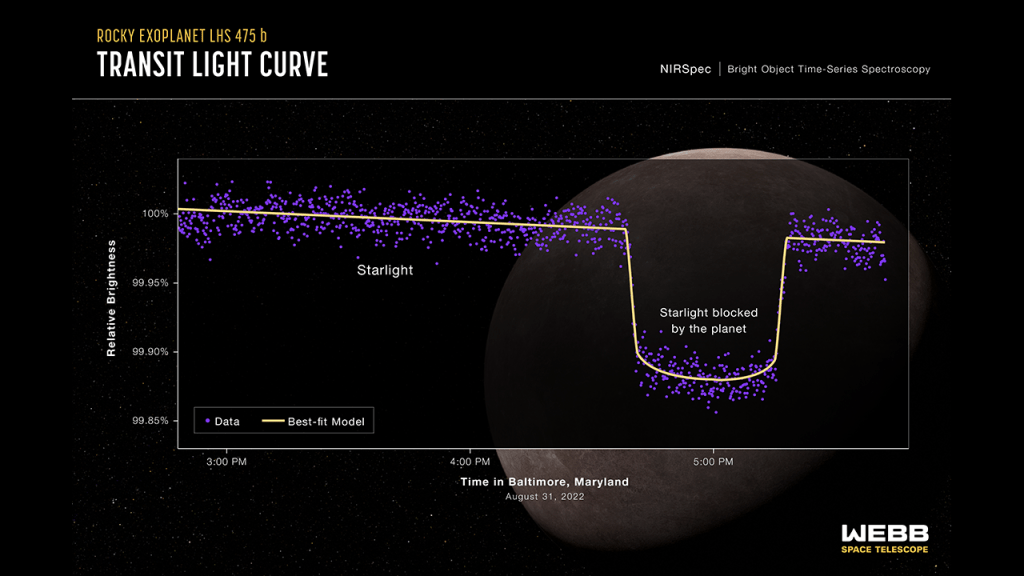
Researchers confirmed an exoplanet, a planet that orbits another star, using NASA’s James Webb Space Telescope for the first time. Formally classified as LHS 475 b, the planet is almost exactly the same size as our own, clocking in at 99% of Earth’s diameter. The research team is led by Kevin Stevenson and Jacob Lustig-Yaeger, both of the Johns Hopkins University Applied Physics Laboratory in Laurel, Maryland.
Russia will send up a new capsule next month to bring back three space station crew members whose original ride home was damaged, officials said Wednesday. The two Russians and one American will stay several extra months at the International Space Station as a result of the capsule switch, possibly pushing their mission to close to a year, NASA and Russian space officials told reporters.
In the space around Jupiter, a torus of plasma created and fed by Io’s volcanic emissions grew significantly richer between July and September of last year and persisted until December, showing the moon underwent a spate of volcanic activity that released a huge amount of material. For something that’s just a little bit bigger than Earth’s Moon, Io is an absolute beast of volcanism. It’s bristling with volcanoes, with around 150 of the 400 known volcanoes erupting at any given time, creating vast lakes of molten lava.
It was supposed to be the beginning of rocket launches from the England, but we will have to wait a little longer. While Virgin Orbit’s Cosmic Girl, the 747 carrying the LauncherOne rocket, successfully left Spaceport Cornwall, the launch itself from the belly of the plane did not go as planned. Both the rocket and payload were lost.
Virgin Orbit’s CEO, Dan Hart, made this statement:
While we are very proud of the many things that we successfully achieved as part of this mission, we are mindful that we failed to provide our customers with the launch service they deserve. The first-time nature of this mission added layers of complexity that our team professionally managed through; however, in the end a technical failure appears to have prevented us from delivering the final orbit. We will work tirelessly to understand the nature of the failure, make corrective actions, and return to orbit as soon as we have completed a full investigation and mission assurance process.
Here is the list of items lost in yesterday’s “Start Me Up” mission:
IOD-3 AMBER (aka IOD-3) – Developed by Satellite Applications Catapult (“SA Catapult”) and Horizon Technologies and built by AAC Clyde Space, all based in the U.K. IOD-3 Amber is expected to be the first of more than 20 Amber satellites to provide space-based Maritime Domain Awareness (MDA) data to users.
Prometheus-2 – Two cubesats owned by the U.K. Ministry of Defense’s (MOD) Defense Science & Technology Laboratory Dstl. These satellites, co-funded with Airbus Defence and Space who are designing them jointly with In-Space Missions, will support MOD science and technology (S&T) activities both in orbit and on the ground through the development of ground systems focused at Dstl’s site near Portsmouth.
CIRCE (Coordinated Ionospheric Reconstruction CubeSat Experiment) – CIRCE is part of a joint mission between the U.K.’s Defense Science and Technology Laboratory and the U.S. Naval Research Laboratory (NRL).
DOVER – Developed by RHEA Group in the UK, it is the company’s first satellite in its 30-year history. The satellite is being co-funded through the European Space Agency’s (ESA) Navigation Program (NAVISP) and built by Open Cosmos of the United Kingdom. DOVER is a SmallSat that was created as a pathfinder for resilient global navigation satellite systems.
ForgeStar-0 – Developed by Space Forge of Wales, the satellite is a fully returnable and reusable platform to enable in-space manufacturing. This launch will be the first for the company’s ForgeStar platform and will test future returns from space technology.
AMAN – Oman’s first orbital mission, it is a single earth observation satellite meant to demonstrate the future feasibility of a larger constellation and was developed after a memorandum of understanding among the Sultanate of Oman, Polish Small Satellite manufacturer and operator SatRev, Poland-originated AI data analytics specialists TUATARA, and Omani-based merging technology innovator ETCO. The agreement includes additional planned small satellites, including this, the first in Oman’s history.
STORK-6 –Stork-6 is the next installment of Polish Small Satellite manufacturer and operator SatRev’s STORK constellation. Virgin Orbit previously launched two spacecraft in this constellation on a previous launch and looks forward to continuing to launch SatRev’s STORK spacecraft in the future.
Virgin Orbit had four consecutive launch successes until this latest mishap. An investigation will be necessary to review what happened.
Take a look at the image above. Can you determine where this image originated? Take a guess and then check your answer by going to the “Where is This? The Answer Sheet” page.
While I recently used the new AI software ChatGPT (created by OpenAI, which was founded by Elon Musk and others) to draft up a poem, I did not use it to learn more about astronomy. Others have already attempted this and came back with mixed results.
Last month, the website Astronomy reported back on its results testing ChatGPT on a few questions. Some of these questsions included:
On average, how many stars are formed each year in the Milky Way?
What would happen if two supermassive black holes merged?
Why do the giant planets rotate so much faster than the terrestrial planets in our solar system?
The verdict? Astronomy was not impressed, reporting:
…once you start asking questions whose answers are not so obvious and dig into the subtleties of astrophysics — the types of informed, discerning questions that our readers regularly send us — ChatGPT becomes prone to giving answers that seem plausible, but are very wrong. To make things worse, ChatGPT is also very bad at knowing when it is making things up, and it can’t cite any sources.
Cloudy Nights users found ChatGPT to be a little more useful when listing out clear facts when answering questions such as “What are the best objects to observe in the night sky during January from the Northern Hemisphere?” It was also helpful answering this question – “What is the forum on the site Cloudy Nights about?”:
Cloudy Nights is a forum-based website that is focused on the hobby of astronomy. The site features a wide range of forums where members can discuss various topics related to astronomy, including telescopes, astrophotography, observing techniques, and more. In addition to the forums, the site also features reviews, articles, and other resources to help people learn more about astronomy and enjoy the hobby. Whether you are a beginner or an experienced astronomer, there is likely to be something of interest on the Cloudy Nights forum.
As with using Wikipedia as your main source, use ChatGPT at your own risk. I have more faith in Wikipedia because it represents the interaction of humans and therefore is based on more context for the answers. It also provides source material, unlike ChatGPT. If you use them as tools you should be okay. If you use them as oracles (in the original sense), then you are on your own.




 Our Awesome Universe