In Case You Missed It: More Trash, This Time on Mars

Image (Credit): Illustration of the Opportunity rover on Mars. The rover was declared dead in 2019. (NASA, JPL/ Cornell University)

In an earlier post, I noted the amount of poop as well as other trash left behind on the Moon from prior lunar missions. Well, Cagri Kilic, a Postdoctoral Research Fellow at West Virginia University, also ventured a guess at the amount of human trash that has already accummulated on the surface of Mars.

In the article he authored for The Conversation back in September, “Mars is Littered with 15,694 Pounds of Human Trash from 50 Years of Robotic Exploration,” he provided a figure as well as his methodology:

When you add up the mass of all spacecraft that have ever been sent to Mars, you get about 22,000 pounds (9979 kilograms). Subtract the weight of the currently operational craft on the surface – 6,306 pounds (2,860 kilograms) – and you are left with 15,694 pounds (7,119 kilograms) of human debris on Mars.

That’s a fair amount of trash and defunct equipment. And we are still adding to this toll, with plans to eventually send humans and material for settlements to the Red Planet. The same goes for the Moon, with multiple bases planned by the US, China, and Russia.

I expect we will see some other estimates in the future on what has been left on other planets, moons, and asteroids. And let’s not forget the five spacecraft we have shot beyond Pluto.

We humans do tend to leave a mess where ever we go. We may be explorers, but Boy Scouts would take issue given their principle “Leave No Trace.”
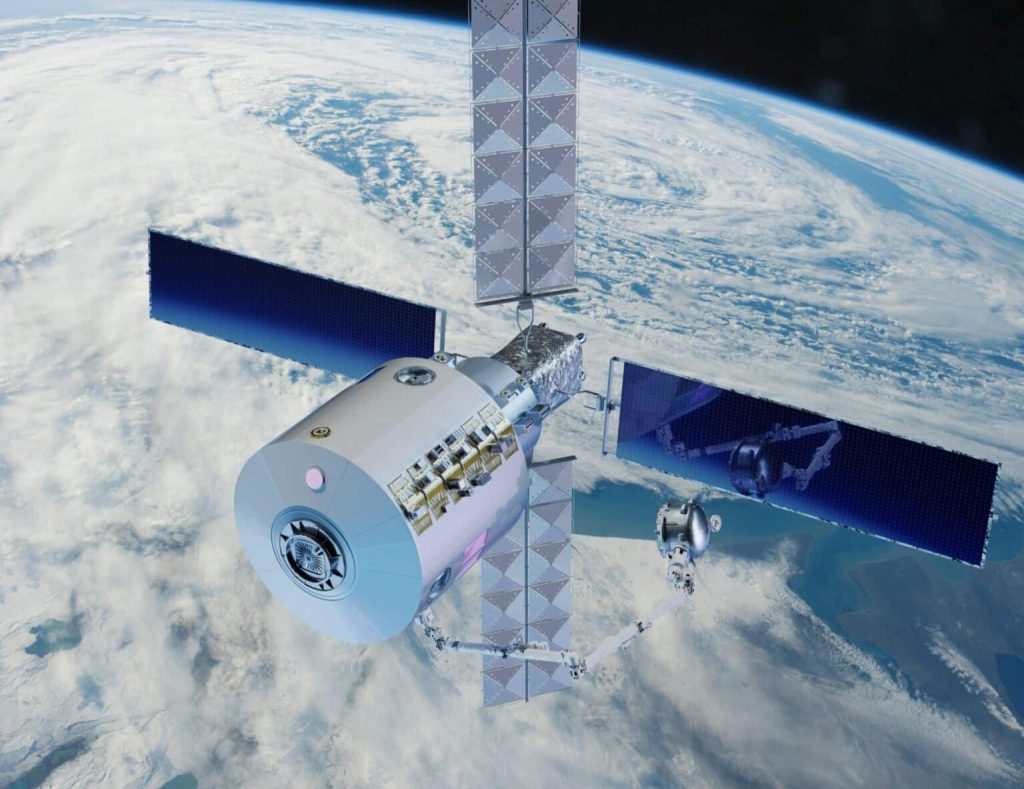
Space Quote: Starlab to Replace the ISS

Image (Credit): Image of Starlab from the Voyager Space website. (Voyager Space)

“This partnership with Voyager Space is the first step toward fielding the next generation of space stations to serve international astronauts. We are excited to support a project aimed at changing history…This collaboration is an important step in making Starlab a reality, providing a foundation for long-lasting European and American leadership in space. Our team is looking forward to diving in on the technology and putting our best engineers to work.”

-Statement by Jean-Marc Nasr, Executive Vice President of Space Systems at Airbus Defence and Space, in a press release regarding Voyager Space and Airbus Defence and Space partnering to develop and operate Starlab in 2028. The Low-Earth Orbit space station will serve NASA, ESA, and others in the scientific community following the retirement of the International Space Station. NASA has already awarded $160 million to Voyager and Nanoracks, its operating company, to create the new space station.

Pic of the Week: Disconnection Event

Image (Credit): “Disconnection Event.” (Gerald Rhemann)

This week’s image is from the Royal Observatory Greenwich’s Astronomy Photographer of the Year 2022 contest. The image above is the winner of the 2022 contest. It is titled “Disconnection Event,” captured by Gerald Rhemann.

Here is the language accompanying the winning image:

Comet Leonard was discovered by GJ Leonard on 3 January 2021. It made its closest pass on 12 December 2021 and, having left the solar system, won’t be seen from Earth again. On 25 Dec 2021, a piece of the comet’s tail was pinched off and carried away by the solar wind – a dramatic tail disconnection event. “Astronomy, myth and art come together beautifully in this shot. It holds great value to scientists, as it elegantly captures a disconnection event” – Imad Ahmed

Please visit The Guardian site for images from all of the winners.

Space Stories: Passing of Apollo Astronaut Walter Cunningham, Opal on Mars, and Juno Recovers

Image (Credit): Walter Cunningham adjusts his pressure suit before the Apollo 7 launch on October 11, 1968. (NASA)

Here are some recent stories of interest.

NASA: “Apollo Astronaut Walter Cunningham Dies at 90

Former astronaut Walter Cunningham, who flew into space on Apollo 7, the first flight with crew in NASA’s Apollo Program, died early Tuesday morning in Houston. He was 90 years old. “Walt Cunningham was a fighter pilot, physicist, and an entrepreneur – but, above all, he was an explorer. On Apollo 7, the first launch of a crewed Apollo mission, Walt and his crewmates made history, paving the way for the Artemis Generation we see today,” said NASA Administrator Bill Nelson. “NASA will always remember his contributions to our nation’s space program and sends our condolences to the Cunningham family.”

New Atlas: “Curiosity Finds Opal on Mars – a Possible Water Source for Astronauts

NASA’s Curiosity rover has discovered opal on Mars. The deposits may prove to be valuable to future Martian explorers not as jewelry but as a potential source of water. Opal is formed when water weathers silica-rich rocks, forming a solution that settles into cracks and crevices in the rock. Over time, this solution hardens into a solid lump that can be cloudy and dull or a dazzling display of color. Most supplies come from either Australia or Ethiopia, but now a new source has been discovered – Mars.

Space.com: “Juno Spacecraft Recovering its Memory After Mind-blowing Jupiter Flyby, NASA Says

NASA’s Juno probe is continuing to recover its memory at Jupiter after a data disruption interrupted communications between the spacecraft and its operators on Earth following a flyby of the giant planet in December. The Juno spacecraft’s latest flyby of Jupiter, its 47th close pass of the planet, was completed on Dec. 14. But as its operators at NASA’s Jet Propulsion Laboratory were receiving science data from the flyby they found they could no longer directly access the spacecraft’s memory. The team successfully rebooted Juno’s computer and on Dec. 17 they placed the spacecraft into “safe mode” with only essential systems operating as a precaution. 

Podcast: Discussing Science Fiction and Astronomy with Andy Weir & Rob Manning

Credit: Planetary Society

If you have not yet tapped into The Planetary Society’s podcast Planetary Radio, then now is the time to do so. Host Mat Kaplan and his guests had a great time on the recent podcast, One Last Blast: Author of ‘The Martian’ Andy Weir with JPL Chief Engineer Rob Manning.

Both Andy Weir (author of The Martian, Artemis, and Project Hail Mary) and Rob Manning (Chief Engineer at the Jet Propulsion Laboratory) were shooting the you-know-what as they chatted about science fiction books they read as teenagers, the role of real science in fictional tales, astronomical conspiracy theories, and mankind’s need to expand into the unknown.

It was interesting to hear Andy Weir talk about curiosity being humanity’s survival mechanism. He pointed out that curiosity has allowed humanity to survive disasters here on Earth because we were all spread out rather than clustered on one flood plain. The same applies to expansion beyond the Earth.

Check it out for yourself. You may want to check out some of the earlier podcasts as well, such as:

Credit: Random House Publishing Group