Movies: The Return of Star Wars Films

While The Mandalorian and Andor have does a nice job filling in the gap between Star Wars movies, three new film projects are now in the works. But we are not looking at another trilogy, or a trilogy of trilogies. Instead, the three films with three different directors will cover different periods in the Star Wars saga.

Here is how it was broken out by StarWars.com:

  • The film directed by James Mangold will “…go back to the dawn of the Jedi”;
  • The film directed by Dave Filoni will “…focus on the New Republic,” with tie-ins to the various TV series covering that period; and
  • The film directed by Sharmeen Obaid-Chinoy will “…be set after the events of Star Wars: Rise of Skywalker” and include the return of Daisy Ridley as Rey.

This sounds a lot like a bunch of Rogue One films that try to carve out an interesting piece from the original nine-film series, which is fine with me if it is done properly. So far the TV series spin-offs have been successful about half of the time, so there is a risk that the Star Wars name is not enough. Then again, I would rather see an attempt at more Star Wars then the current batch of superhero films.
Volunteers Wanted to Help Classify Stars

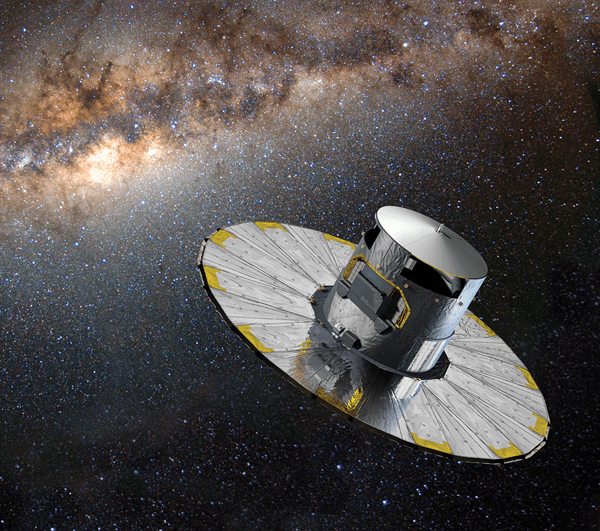
Image (Credit): Artist’s rendering of the Gaia probe floating at a Lagrangian point beyond the Earth-Moon system, also called L2. (ESA/D. Ducros, 2013)

The European Space Agency (ESA) is looking for amateur astronomers to assist with its review of data from its Gaia Mission. What is the Gaia Mission you ask? The ESA site explains this and much more:

The mission was launched in late 2013 and now lies some 1.5 million km from Earth. With its two powerful telescopes and three science instruments, Gaia is creating the largest and most precise 3D map of the Milky Way. It does so by determining the position of its target stars and registering how they change throughout time.

So far, Gaia has measured 1.8 billion stars with unprecedented precision, the richest star catalogue to date. Gaia’s third major data release, published in 2022, includes 10.5 million variable sources over the entire sky, identified using machine learning methods in a supervised classification scheme.

That’s a lot of data. ESA is now looking for assistance classifying the variable stars, which are the stars that change in brightness over time. This is being done under an ESA-funded citizen science project call the Gaia Vari.

As of today, the project already has over 520 volunteers. You can be one more.

Go here to learn more and be part of the fun.

Space Quote: The Value of the ISS

Image (Credit): Components of the International Space Station (ISS). (NASA)

“An attempt to do a cost-benefit analysis on ISS science would be rather difficult. Science research rarely conforms to that kind of examination while it’s being done. Only after the fact, when an entrepreneur rolls out some new product or service, can one point to something done in a laboratory as having helped to make it happen. The best bet for ISS science is the technology for 3D printing human organs for transplant patients. The number of lives that would be saved might make the $100 billion spent on the ISS worth it.”

-Statement in a recent editorial from The Hill titled, “Has the science on NASA’s International Space Station been worth the money?” In addition to 3D printing of human organs, you might want to view the other ISS achievements (also mentioned in the editorial) and decide for yourself: