
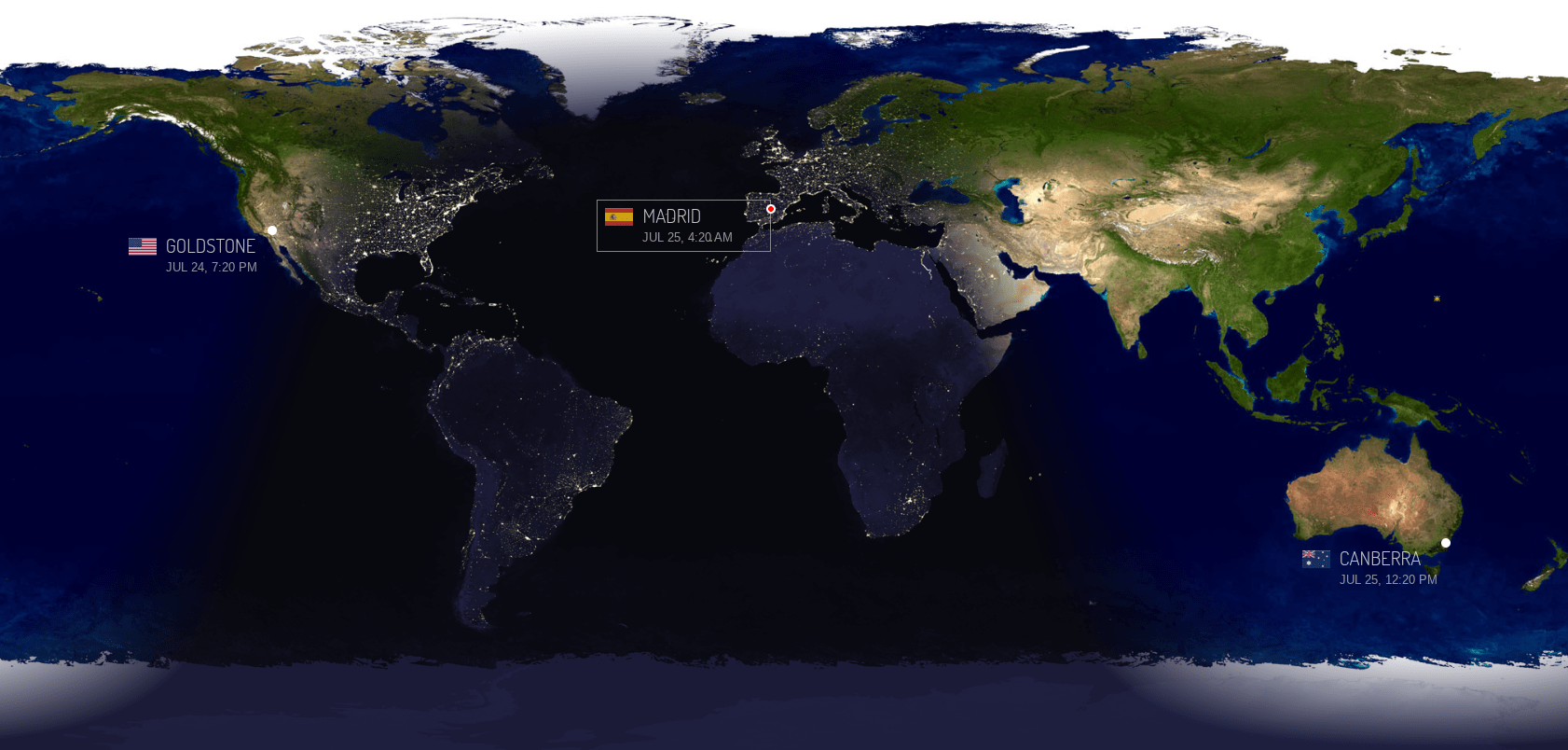
The Deep Space Network (DSN) is critical to NASA’s communications with space missions throughout the solar system, and even those that have left the solar system. It will also be critical to the upcoming Artemis mission to the Moon.
The radio telescopes that make up this system are located in three spots to ensure communications cannot disappear because of the Earth’s rotation – Madrid, Spain; Barstow, California; and Canberra, Australia. The image above shows you the spread of those locations.
One of the California DSN radio telescopes was damaged last year due to human error and is undergoing repairs until approximately 2028. Even so, the US facility is still able to perform its duties. And now the DSN facility in Spain is being threatened by wildfires. As a result, the facility has been evacuated for now.
As with the ongoing fires on this side of the Atlantic, as well as past fires threatening NASA sites, the world is a dangerous place and putting hardware anywhere has its risks. To stay in the game, we rely on the redundancy of these hardware sites, the resilience of space programs, and realistic budgeting to rebuild after such losses.
NASA has shown its ability to bounce back in the past, so whatever happens in Spain should not be a long-term blow to present and future space missions. Even so, we do not need to continually test the system with climate change, the weakening of the NASA program through continual cuts, and more budget threats on the horizon.
As C.S. Lewis said, “the doors of hell are locked on the inside.”
Note: Although C.S. Lewis is remembered primarily as a religious writer, he was also a science fiction writer with stories of space travel. Hence, I think I can creatively use his quote here.
Update: The DSN facility in Madrid fortunately survived the wild fires.

