Image (Credit): Artist’s rendering of a lunar base. (NASA)
“We believe once governments and the Artemis missions have re-established human presence on the moon, commercial services will follow that…every operation on the moon will require power”.
-Statement by Jake Thompson, director of novel nuclear and special projects at Rolls-Royce, in a Financial Times article. Rolls Royce is working on a micro nuclear reactor for use on space missions.
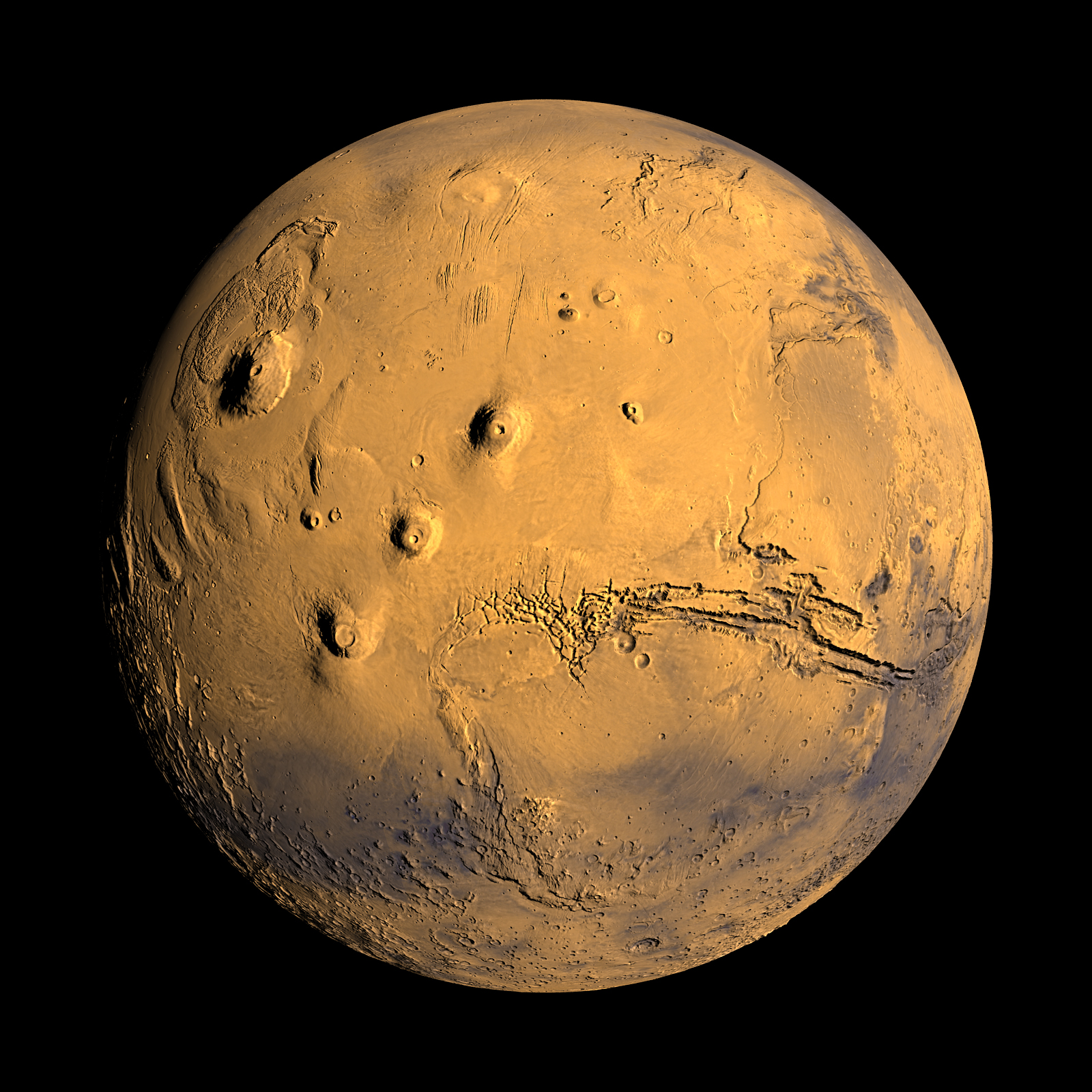
The Chinese Mars rover Zhurong is adding an exciting twist to the story and history of water on Mars. After landing in southern Utopia Planitia on Mars in May 2021, the now-defunct Zhurong rover went to work exploring the Martian surface, and its latest findings might just change the way we think about the Red Planet. Bo Wu and a team of researchers from Hong Kong Polytechnic University believe they’ve found compelling evidence of an ocean shoreline for a massive body of water that once covered Mars’ northern lowlands.
Something’s not quite right about the moons of Mars. They are too small — Phobos is 17 miles across, and Deimos is a mere nine miles in length. And they aren’t round, but lumpy, misshaped objects. Frankly, they don’t resemble moons at all…A study published Wednesday in the journal Icarus makes a case that the moons did indeed start out in asteroid form. But it’s not the genesis everyone was expecting. Using supercomputer-powered simulations, scientists describe a situation in which a large-enough asteroid was captured by Mars long ago and torn to shreds by the planet’s gravity, briefly forming a debris cloud — and possibly a ring system — around Mars that ultimately clumped together to form two moons.
An asteroid struck Mars 11 million years ago and sent pieces of the red planet hurtling through space. One of these chunks of Mars eventually crashed into the Earth somewhere near Purdue and is one of the few meteorites that can be traced directly to Mars. This meteorite was rediscovered in a drawer at Purdue University in 1931 and therefore named the Lafayette Meteorite. During early investigations of the Lafayette Meteorite, scientists discovered that it had interacted with liquid water while on Mars. Scientists have long wondered when that interaction with liquid water took place. An international collaboration of scientists including two from Purdue University’s College of Science have recently determined the age of the minerals in the Lafayette Meteorite that formed when there was liquid water. The team has published its findings in Geochemical Perspective Letters.
Image (Credit): Russia’s MS-19 Mission approaching the ISS yesterday. (NASA)
The International Space Station (ISS) had another visitor on Saturday morning – this time a Russian Soyuz capsule bringing about three tons of food, fuel, and supplies to the station as part of its Progress MS-29 mission (Progress 90 mission to NASA).
The Russian News Agency provided a list of items delivered to the ISS and also noted that the resupply mission also included Christmas gifts for the crew.
Here are the items delivered:
…869 kg of refueling propellant, 420 liters of potable water and 43 kg of pressurized nitrogen, and also 1,155 kg of material and equipment in the dry cargo hold, in particular, for experiments dubbed Vampire (growing crystals in an electric vacuum furnace), BTN-Neutron-2 (studying the neutron spectrum) and 3D Print (3D printing of polymer materials).
It nice that the Russians took the time to assist Santa with his gift giving.
Of course, the U.S. Department of Defense’s North American Aerospace Defense Command (NORAD) will be tracking the actions of Santa here on Earth this year, so be sure to visit the site closer to Christmas next month.
Image (Credit): in this image titled “A cloudy eclipse,” Planetary Society member Joshua Nichols captured this picture of the April 8, 2024, total solar eclipse in Texas, where light clouds highlighted the eclipse’s effects. (Joshua Nichols)
As the year rolls to a close, it’s time to think about the most interesting space moments of 2024. With that in mind, The Planetary Society is happy to help by providing images and events from the year that you can rank as the best of the year. To participate in the 2024 survey, just go to this link.
You can select your choice in categories such as:
Best space exploration image;
Most exciting moment in planetary science; and
Most exciting upcoming planetary science mission.
It’s also a great way to remember how busy 2024 was in terms of space accomplishments.
Image (Credit): The return of the Starship booster on November 19, 2024. It splashed down in the Gulf of Mexico. (SpaceX)
The sixth test of SpaceX’s Starship was a success this past Tuesday, even without the repeated stunt of a tower capturing the booster rocket. The launch from the Starbase pad in Brownsville, Texas allowed SpaceX to test additional features related to the rocket, including igniting one of its Raptor engines while in space. Overall, it was a quick turnaround from another successful test flight last month.
SpaceX also received additional good news this week when it learned that Colorado-based Lunar Outpost selected SpaceX’s Starship as the party to deliver its lunar rover to the Moon. Lunar Outpost is one of several companies working with NASA to ensure a rover is on the lunar surface as part of the Artemis mission. NASA has yet to select one or more companies to build and test the rovers on the Moon.
All of this is good news for SpaceX and NASA, assuming the Starship stays on schedule, NASA funding of Artemis continues, and a new administration in DC continues to support the Artemis approach.