So far it has been a pretty boring summer in terms of space-related movies, but that will change in August with the release of next Alien film. That’s right, the Alien franchise is still alive and kicking.
Alien: Romulus will be released on August 16th. It will be the seventh film in this series, and set between the events of Alien (1979) and Aliens (1986). Yes, more backstory, but we know what to expect going forwards or backwards with this series. Plenty of stomach-popping surprises for all.
The sci-fi/horror-thriller takes the phenomenally successful “Alien” franchise back to its roots: While scavenging the deep ends of a derelict space station, a group of young space colonizers come face to face with the most terrifying life form in the universe.
Check out the trailer, which hits on all the fun bits we expect with any Alien movie.
While we are now 45 years into this series, it is still nice to have something interesting playing this summer. It is always a spectacular view of space travel until everything goes to hell.
Image (Credit): The Boeing Starliner approaching the International Space Station. (NASA)
“We are strategically using the extra time to clear a path for some critical station activities while completing readiness for Butch and Suni’s return on Starliner, and gaining valuable insight into the system upgrades we will want to make for post-certification missions.”
–Statement by Steve Stich, manager of NASA’s Commercial Crew Program, regarding delays in the return of Boeing’s Starliner capsule. The language is becoming as flowery as SpaceX’s language when something goes wrong. NASA has already nixed the June 26 return date and has yet to provide a new date.
Back in early April, officials from NASA, FEMA, other domestic and foreign government agencies, and private think tanks conducted an exercise – Planetary Defense Interagency Tabletop Exercise 5 – to devise ways to deal with an incoming asteroid that threatened the planet. You can see the presentation components and results in the May 13th NASA report.
Here is the scenario:
72% chance than an asteroid may hit Earth in 14 years.
Requirements for preventing its impact are unknown.
Models indicate the asteroid could devastate a regional- to country-scale area, if it should impact.
And the objective:
Awareness raising; space mission options; disaster preparedness; information sharing and public messaging.
Some of the takeaways were as follows:
Many stakeholders expressed that they would want as much information about the asteroid as soon as possible but expressed skepticism that funding would be forthcoming to obtain such information without more definitive knowledge of the risk.
Misinformation and disinformation would have to be dealt with.
Although specific disaster management plans for an [Near Earth Object] impact threat do not currently exist, plans for response to other catastrophes may be a suitable starting point.
You can read all about the results in the report itself, but it is clear we are not ready for such an event.
Maybe we would do better with a NASA tabletop exercise covering an alien invasion 400 years in the future, giving us plenty of time to plan it out. Of course, this scenario is already being played out on television (as well as the book that started it all).
Image (Credit): RCW 7, a nebula located just over 5,300 light-years from Earth. (ESA/Hubble & NASA, J. Tan (Chalmers University & University of Virginia), R. Fedriani (Institute for Astrophysics of Andalusia))
This week’s image is from the NASA/European Space Agency’s (ESA) Hubble space telescope. It shows the nebula called RCW 7, which is located about 5,300 light-years away.
Clouds of gas and dust with many stars. The clouds form a flat blue background towards the bottom, and become more thick and smoky towards the top. They are lit on one side by stars in the nebula. A thick arc of gas and dust reaches around from the top, where it is brightly lit by many stars in and around it, to the bottom where it is dark and obscuring. Other large stars lie between the clouds and the viewer.
Image (Credit): Stairwell of the Braude observatory’s main building with a painting of Alexei Leonov, the Soviet cosmonaut who performed the first spacewalk in 1965. (Science.org/Eric Lusito)
In November 2023, photographer Eric Lusito made a rare visit to the Braude Radio Astronomy Observatory near Kharkiv, Ukraine, once one of the nation’s flagship scientific facilities. Since his visit, the Kharkiv region, which was partly occupied by Russian forces in 2022 but liberated later that year, has again faced a renewed Russian assault. As of this writing, military specialists say that effort has stalled. Here is Lusito’s account of his visit.
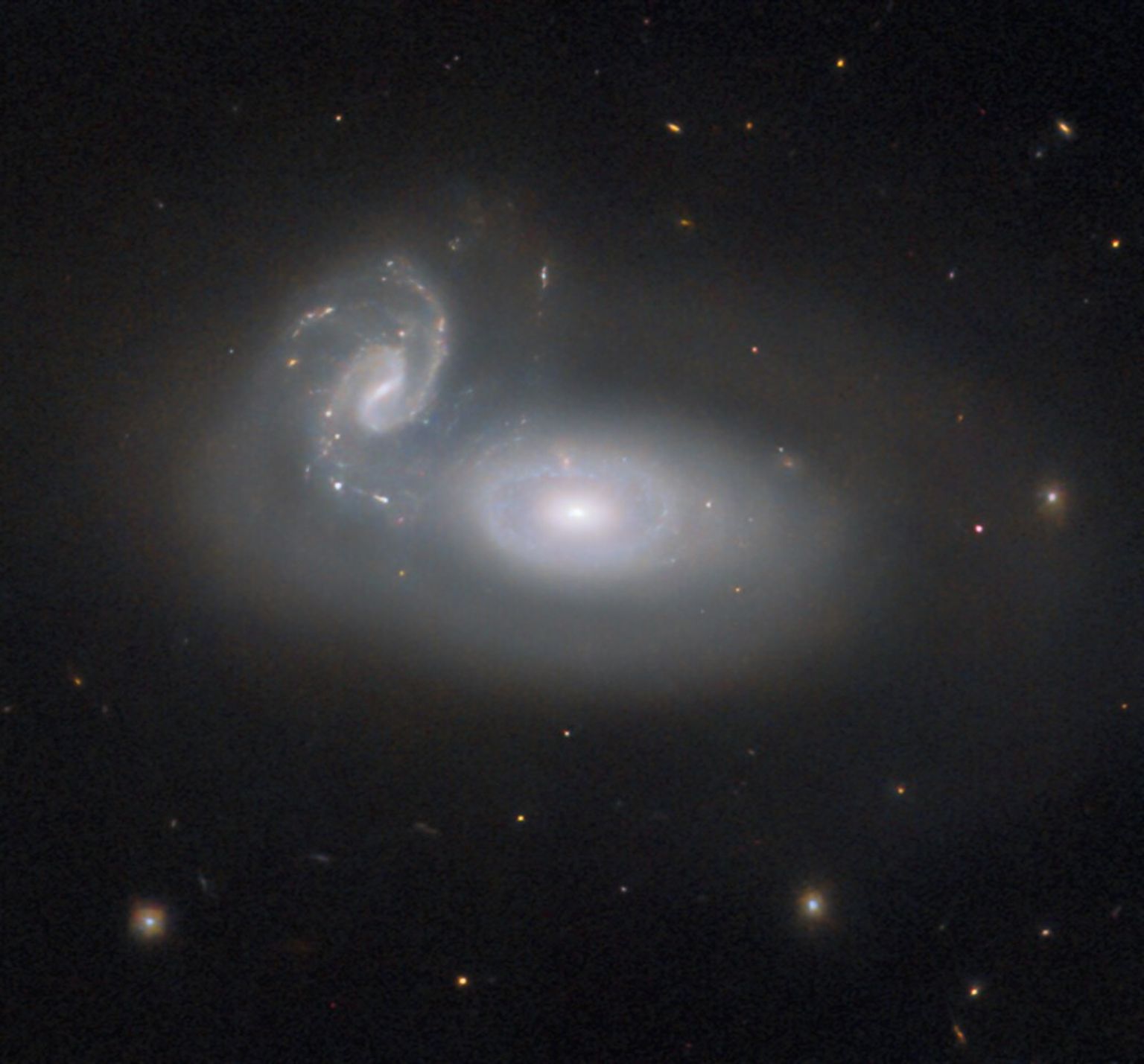
The mysterious brightening of a galaxy far, far away has been traced to the heart of the star system and the sudden awakening of a giant black hole 1m times more massive than the sun. Decades of observations found nothing remarkable about the distant galaxy in the constellation of Virgo, but that changed at the end of 2019 when astronomers noticed a dramatic surge in its luminosity that persists to this day. Researchers now believe they are witnessing changes that have never been seen before, with the black hole at the galaxy’s core putting on an extreme cosmic light show as vast amounts of material fall into it.
As a popular icon among objects in the Solar System, Jupiter’s Great Red Spot (GRS) is probably the best-known atmospheric structure. Its large size (right now its diameter is that of the Earth) and the contrast of its reddish colour against the planet’s pale clouds make it an object that can be easily seen even with small telescopes…Speculation about the origin of the GRS dates back to the first telescopic observations made by the astronomer Giovanni Domenico Cassini, who in 1665 discovered a dark oval at the same latitude as the GRS and named it the ‘Permanent Spot’ (PS), since it was observed by him and other astronomers until 1713. Track of it was subsequently lost for 118 years and it was not until 1831 and later years that S. Schwabe again observed a clear structure, roughly oval in shape and at the same latitude as the GRS; that can be regarded as the first observation of the current GRS, perhaps of a nascent GRS.