Space Stories: Missing Water on Venus, More About Planet Nine, and Possible Life on an Exoplanet

Image (Credit): Venus from a composite of data from NASA’s Magellan spacecraft and Pioneer Venus Orbiter. (NASA/JPL-Caltech)

Here are some recent stories of interest.

University of Colorado at Boulder: Venus Has Almost No Water: A New Study May Reveal Why

Planetary scientists at the University of Colorado Boulder have discovered how Venus, Earth’s scalding and uninhabitable neighbor, became so dry. The new study fills in a big gap in what the researchers call “the water story on Venus.” Using computer simulations, the team found that hydrogen atoms in the planet’s atmosphere go whizzing into space through a process known as “dissociative recombination” — causing Venus to lose roughly twice as much water every day compared to previous estimates.

UniverseToday: New Evidence for Our Solar System’s Ghost: Planet Nine

Does another undetected planet languish in our Solar System’s distant reaches? Does it follow a distant orbit around the Sun in the murky realm of comets and other icy objects? For some researchers, the answer is “almost certainly.” The case for Planet Nine (P9) goes back at least as far as 2016. In that year, astronomers Mike Brown and Konstantin Batygin published evidence pointing to its existence. Along with colleagues, they’ve published other work supporting P9 since then. Now, they’ve published another paper along with colleagues Alessandro Morbidelli and David Nesvorny, presenting more evidence supporting P9. It’s titled “Generation of Low-Inclination, Neptune-Crossing TNOs by Planet Nine.” It’s published in The Astrophysical Journal Letters.

Astonomy.com: Possible Hints of Life Found on Exoplanet K2-18b – How Excited Should We Be?”

Data from the James Webb Space Telescope (JWST) has shown that an exoplanet around a star in the constellation Leo has some of the chemical markers that, on Earth, are associated with living organisms. But these are vague indications. So how likely is it that this exoplanet harbours alien life? …The planet in question is named K2-18b. It’s so named because it was the first planet found to orbit the red dwarf star K2-18.

Boeing Needs Just One More Day

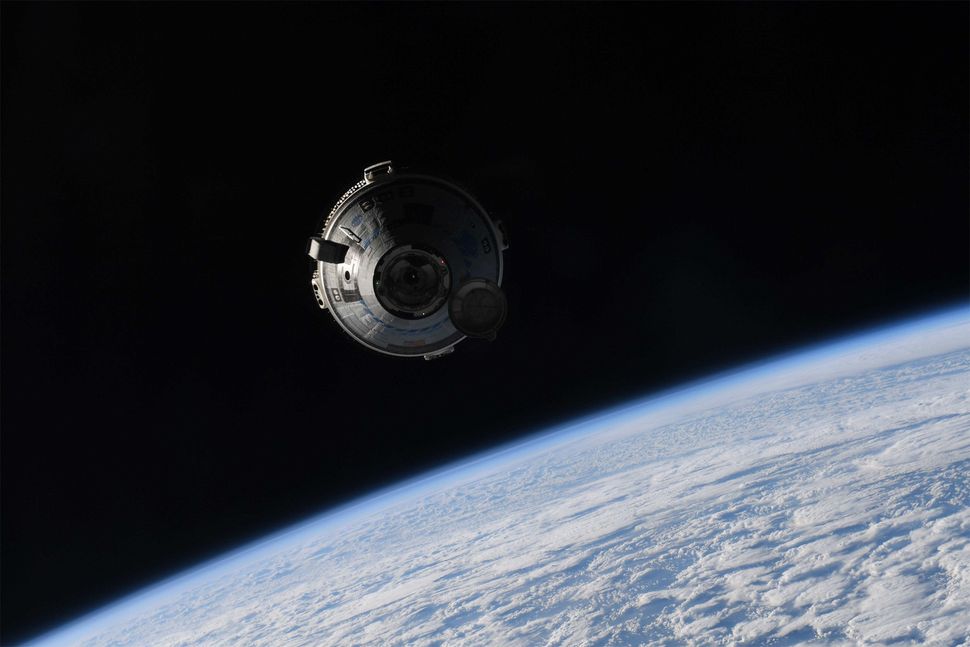
Image (Credit): Starliner autonomous uncrewed flight test to the ISS in May 2022. (NASA)

Today was supposed to be the day that Boeing launched a crewed capsule to the International Space Station (ISS), but things did not go according to plan (again). Two hours before the planned launch a valve issue on the Atlas V rocket’s second stage put everything on hold. A launch as early as tomorrow is still possible if the matter can be resolved.

The two astronauts aboard the Starliner capsule, Suni Williams and Butch Wilmore, will need to come back another day to lead this historic mission. The Starliner will be the second commercial vehicle contracted by NASA to bring and return astronauts from the station. SpaceX has been performing this task since its first successful crewed test flight in 2020.

Boeing needs this win after so many bad stories over the years, and not just the stories associated with the Starliner mission. Serious aircraft woes has put a spotlight on the company. A successful launch will not erase the past, but it would be much needed positive press.

Update: Okay, Boeing will need at least until May 17 to inspect the problem valve and prepare for a new launch. Not a great start, but at least the are still expecting a May launch.

China Returns to the Far Side of the Moon

Image (Credit): China’s Chang’e 6 lunar probe at the Wenchang Space Launch Site in Hainan province prior to the launch on Friday. (CNSA)

Last Friday, China launched the Chang’e-6 lunar probe towards the moon with the goal of returning the first lunar soil sample from the far side of the Moon. An earlier mission in 2020, Chang’e-5, successfully returned lunar soil samples from the near side of the Moon for the first time in 44 years. Before that, in 2019, China place a rover on the far side of the Moon via the Chang’e-4 mission.

China is making some bold strides in space with, it might be added, some help from the Europeans. While the US bans any cooperation with the Chinese, France, Italy and Sweden have contributed to the Chang’e-6 mission. For example, Sweden added the Negative Ions at the Lunar Surface (NILS) instrument to the lunar probe.

Maybe one day we can join the Chinese on some of these missions, but that day seems to be far away. That said, we were able to find a way with the Russians, which allowed for the ongoing success of the International Space Station.

Audit Report: Is NASA Ready for Artemis II?

The NASA Office of Inspector General (OIG) issued an audit report earlier this week, NASA’s Readiness for the Artemis II Crewed Mission to Lunar Orbit, that expressed concerns about problems with the Artemis I test flight mission in late 2022. For example, the report noted:

…the Artemis I test flight revealed critical issues that need to be addressed before placing crew on the Artemis II mission. In particular, the test flight revealed anomalies with the Orion heat shield, separation bolts, and power distribution that pose significant risks to the safety of the crew…Specifically, NASA identified more than 100 locations where ablative thermal protective material from Orion’s heat shield wore away differently than expected during reentry into Earth’s atmosphere…Beyond the Orion anomalies, the Artemis I launch-induced environment caused greater than expected damage to ML-1 elevators, electrical equipment, enclosure panel doors, and pneumatic tubing, requiring extensive repairs that will cost more than $26 million, roughly 5 times more than the $5 million the EGS Program had originally set aside for postArtemis I launch repairs.

While NASA is already working on repairs and improvements in each of these areas, it still puts a bit of a damper on NASA’s earlier video about all of the successes of Artemis I. NASA has already lost too many astronauts to heat shield issues in the past, so this is a serious matter that needs to be resolved before putting humans in the Orion capsule.

The OIG auditors made six recommendations to NASA management. NASA concurred with these recommendations, but noted that the audit was conducted at a difficult time, stating:

Being audited in the middle of a development process presents several challenges including disruptions to ongoing workflow and priorities due to the reallocation of resources and the coordination challenges associated with audit activities.

Of course, auditors are never really welcome at any point in the process. If they come too late, they are accused of shooting the dead.

NASA conducted the test flight to learn about such issues, so in that sense it was a success. Hopefully, the space agency can make the necessary improvements while keeping the Artemis II mission on track given that it has already been delayed.