Space Quote: Preparing for the Boeing Starliner’s Crewed Mission

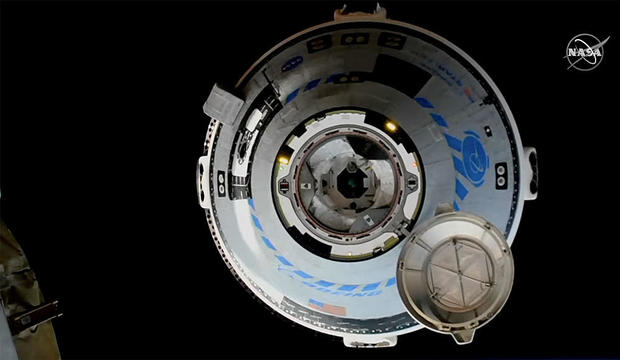
Image (Credit): Boeing’s Starliner spacecraft being placed atop an Atlas 5 rocket at the Cape Canaveral Space Force Station. (United Launch Alliance)

“Today was a was a huge day for our Commercial Crew Program…All the (international) partners and then our whole team polled ‘go’ to proceed to the launch on May 6. Not only that, but we (signed) what we call an interim human rating for Starliner for this crewed flight test. … It was a was a huge deal for NASA and our entire team.”

-Statement by Steve Stich, manager of the Commercial Crew Program for NASA, as quoted by CBS News. After numerous delays, the Starliner’s first Crew Flight Test will take place on May 6. If successful, the Starliner will start bringing astronauts to the International Space Station (ISS) in 2025. This will provide NASA with greater redundancy in its ISS resupply runs.

NASA Experiences Early Success with its Solar Sail

Image (Credit): Artist’s rendering of NASA’s Advanced Composite Solar Sail System spacecraft in Earth Orbit. (NASA/Aero Animation/Ben Schweighart)

On Tuesday, NASA’s Advanced Composite Solar Sail System was launched from New Zealand aboard a Rocket Lab’s Electron rocket. The successful launch was followed shortly thereafter by the deployment of an 80 square meter experimental solar sail.

In describing the mission, NASA noted:

Like a sailboat turning to capture the wind, the solar sail can adjust its orbit by angling its sail. After evaluating the boom deployment, the mission will test a series of maneuvers to change the spacecraft’s orbit and gather data for potential future missions with even larger sails.

If all goes well, larger sails will be developed to potentially replace large rocket engines and accompanying fuel tanks for future trips to the Moon, Mars, other parts of the solar system, and even interstellar locations.

You might be able to see the solar sail in the night sky as it orbits the Earth, so keep looking up.

Pic of the Week: New Crew Launched to the Tiangong Space Station

Image (Credit): April 25, 2024 launch of the Shenzhou 18 mission to the Tiangong space station. (CMSA)

This week’s image shows today’s launch of three astronauts to China’s Tiangong space station on the Shenzhou 18 mission aboard a Long March 2F rocket. The crew successfully reached the space station 6.5 hours after launch.

One of the new crew members has already spent 182 days in orbit aboard the Tiangong space station. The Tiangong space station has been continuously crewed since June 2022.

Image (Credit): Shenzhou 18 crew members Li Cong, commander Ye Guangfu and Li Guangsu. Guangfu has logged 182 days in orbit during a stay aboard the Tiangong space station in 2021-22. (CMSA)

New Crew will Help Strengthen the Chinese Space Station Against Space Debris

Image (Credit): China’s Tiangong space station captured by a returning Shenzhou spacecraft. (CMSA)

China is getting ready to send a new crew to its Tiangong space station tomorrow. The Shenzhou-18 spacecraft will carry three new crew members to the station, replacing the crew that has been on the station since last October.

The current crew had to deal with space debris that damaged its solar panels and led to a power loss. Two spacewalks were recently conducted to make the necessary repairs. The arriving crew is coming with additional repair material, including “space debris protection reinforcements for extravehicular piping, cables and critical equipment,” according to China Daily.

Unfortunately, space debris is a constant hazard in orbit. The International Space Station (ISS) has dodged debris as well as repairing damaged areas. Of course, the ISS is also dropping space debris on Florida, but that’s a different story.

A Day in Astronomy: First Spaceflight Fatality

Image (Credit): Soviet cosmonaut Vladimir Komarov. (RIA Novosti)

On this day in 1967, the Soviet Union’s Vladimir Komarov became the first spaceflight fatality when his Soyuz 1 spacecraft crashed during reentry as the result of a failed parachute. The accident occurred during what was his second trip to space, his first being aboard the Voskhod 1. Yuri Gagarin served as the backup cosmonaut on the Soyuz 1 flight.

The Soyuz 1 mission was already experiencing problems before reentry, particularly with its solar panels. These problems were enough to end the mission early and delay the launch of a second Soyuz spacecraft that would have met up with the orbiting Soyuz 1. The spacecraft was not up to the mission. Before the crash, Komarov could be heard stating, “This devil ship! Nothing I lay my hands on works properly.”

This fellow cosmonauts had this to say via Pravda:

For the forerunners it is always more difficult. They tread the unknown paths and these paths are not straight, they have sharp turns, surprises and dangers. But anyone who takes the pathway into orbit never wants to leave it. And no matter what difficulties or obstacles there are, they are never strong enough to deflect such a man from his chosen path. While his heart beats in his chest, a cosmonaut will always continue to challenge the universe. Vladimir Komarov was one of the first on this treacherous path.

Image (Credit): Burkina Faso stamps commemorating cosmonaut Vladimir Komarov. (stamps-world.eu)