Image (Credit): Image from July 14, 2026 showing the smoke from Canadian fires covering eastern parts of Canada and the U.S. (NASA Earth Observatory/Lauren Dauphin)
For those in the northeastern part of the United States, the impact of the ongoing Canadian fires is clear to see outside your window. A more distant view from a satellite (as shown above from earlier in the week) gives a better picture of what is occurring in Ontario and its impact on the surrounding region.
According to the latest data from the Canadian Interagency Forest Fire Centre (CIFFC), about 904 fires are currently burning across Canada, with 190 of the fires burning in Ontario.
Image (Credit): Wildland fire activity in Canada as of July 17, 2026. (CIFFC)
Image (Credit): Image of asteroid 2016 HO3, also called Kamo‘oalewa, captured by a Chinese probe. (China National Space Administration )
This week’s image comes from a Chinese probe called Tianwen-2. It shows the spinning asteroid 2016 HO3, or Kamo‘oalewa, which is labeled by some of a “quasi-moon” of Earth until it decides to move on. Unlike the actual Moon, this asteroid is simply joining the Earth as it circles the Sun. The asteroid is about the size of a school bus.
The Chinese probe, launched from China in May 2025, is believed to have started its orbit of asteroid Kamo‘oalewa on June 6th of this year. It is now believed to be a rubble-pile asteroid, meaning it is basically loose material rather than a solid object. Even so, the Chinese probe may try to grab a sample to be returned to Earth in November 2027.
The source of the asteroid is still being debated, with some believing it is a piece of the Moon dislodged by an incoming asteroid while others believe it comes from the main asteroid belt.
In a paper released last year, scientists were leaning towards its origin being the main asteroid belt, noting:
Quantitative estimates show that population models of [Near Earth Asteroids] based on the migration of objects from the main belt are capable of accounting for Kamo‘oalewa-like objects. This relative contribution supports the hypothesis that (469219) Kamo‘oalewa originated from the main belt, which will be further investigated by future observations and in situ exploration of the Tianwen-2 spacecraft.
How long will it remain Earth’s partner? Back in 2021, Renu Malhotra, a UArizona planetary sciences professor, stated:
It will not remain in this particular orbit for very long, only about 300 years in the future, and we estimate that it arrived in this orbit about 500 years ago.
Image (Credit): One artist’s version of a Martian base. (NASA/JPL-Caltech/MSSS)
“So, who should have the right to acquire property in space? My answer: those who have the financial means to get there, develop, and use the land. For instance, if SpaceX succeeds in reaching Mars and starts to build permanent settlements on the red planet, then the ownership of land should go to SpaceX first. Not of the entire planet, of course, but of a practicable area, for example the size of Singapore. The surface area of Mars is 200,000 times that of Singapore, so SpaceX would initially only own 0.0005 percent of Mars. That would be enough to develop multiple settlements, but not so many that others would no longer have a chance.”
-Statement by Rainer Zitelmann, a historian and sociologist, in his Reason magazine article titled “Why You Can’t Settle Mars or Colonize the Moon Without Real Property Rights.” You do not need to agree with his conclusion, but he discusses a timely topic. The Moon Agreement and Outer Space Treaty may need to be revisited now that the idea of permanent settlements on the Moon and Mars are not simply science fiction, as they were in the 1960s and 1970s when these provisions were agreed to (and not by all nations, keep in mind).
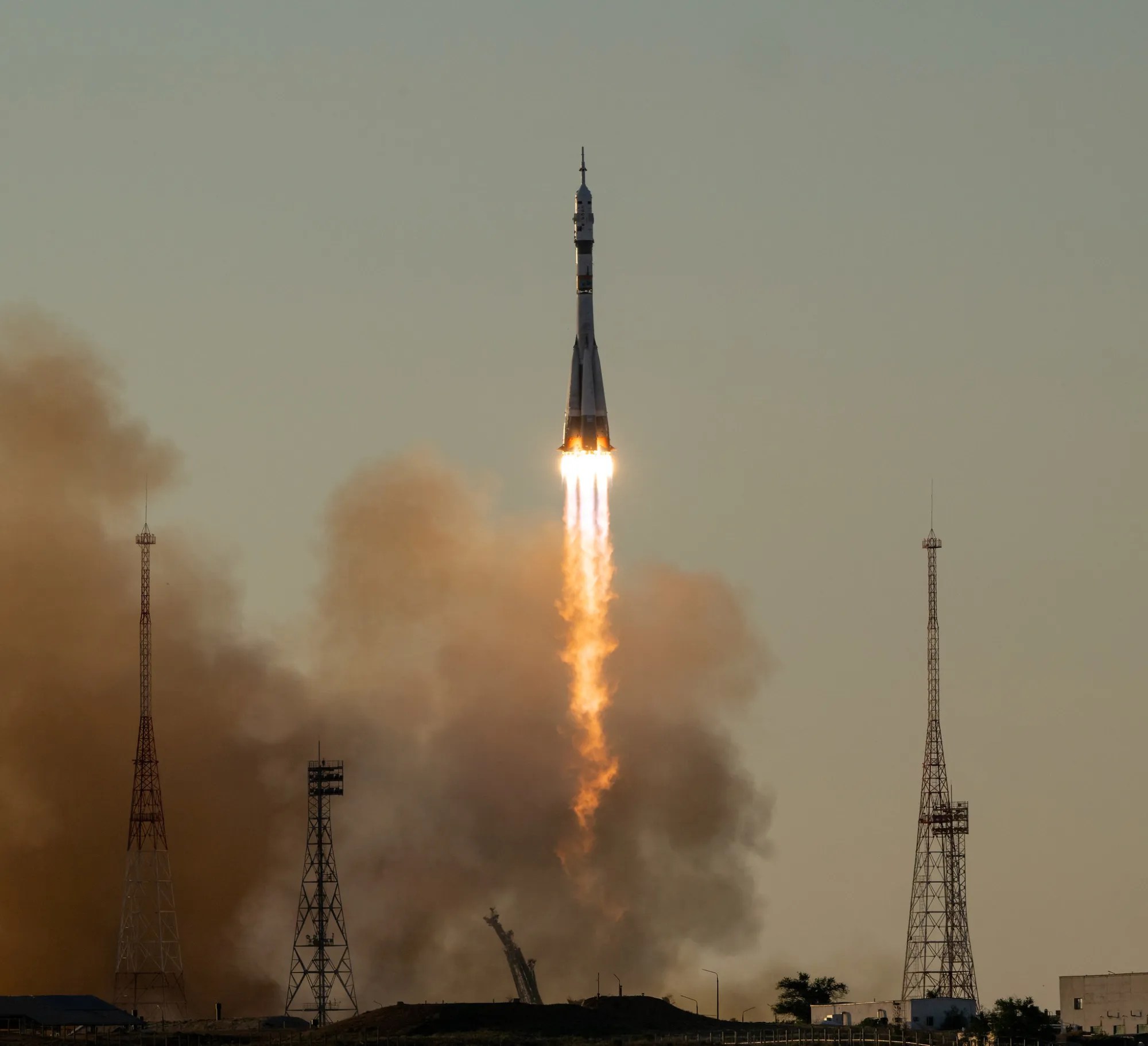
Image (Credit): An American astronaut and two Russian cosmonauts head to the ISS aboard a Soyuz rocket launched earlier today from the Baikonur Cosmodrome in Kazakhstan. (NASA/Bill Ingalls)
With their arrival, Expedition 74 will come to a close by month’s end and Expedition 75 will begin.
The Expedition 74 crew currently on the ISS includes NASA astronauts Jessica Meir, Jack Hathaway, and Chris Williams; European Space Agency astronaut Sophie Adenot; and Roscosmos cosmonauts Sergey Kud-Sverchkov, Sergei Mikaev, and Andrey Fedyaev.
Expedition 75 will begin once NASA’s Williams and Roscosmos’s Kud-Sverchkov, and Mikaev depart the station after an eight month mission.
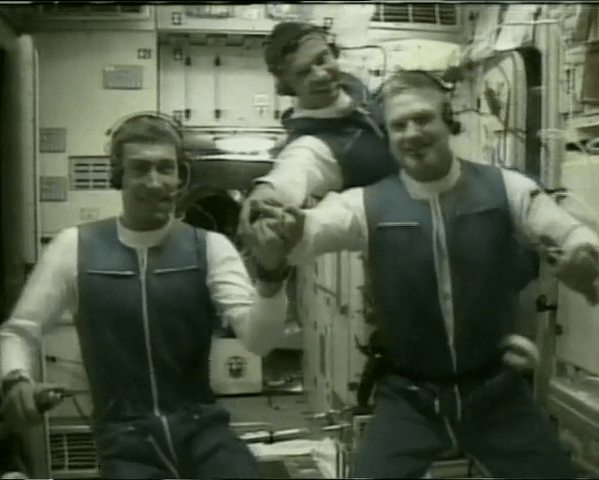
With all of the attention on the Chinese and race to the Moon, it is sometimes easy to forget that Russian cosmonauts have been working together with NASA aboard the ISS for over 25 years. The first crew on the ISS in November 2000 was composed of NASA astronaut William M. Shepherd and Russian cosmonauts Yuri P. Gidzenko and Sergei K. Krikalev (shown below). The three were the Expedition 1 crew, and stayed aboard the station until March 2001.
Image (Credit): Expedition 1 crew members (from left to right) Sergei K. Krikalev, Yuri P. Gidzenko, and William M. Shepherd in the ISS’s Zvezda Service Module. (NASA)
The United States Federal Communications Commission (FCC) has granted approval to Reflect Orbital to proceed with testing its innovative Earendil-1 satellite. This spacecraft features a substantial mirror engineered to redirect sunlight towards the nighttime side of Earth. The primary objective of the startup is to augment energy supply to solar power facilities and illuminate extensive regions up to 5 kilometers in width. By the year 2035, the company intends to deploy a constellation comprising 50,000 such orbital reflectors.Notwithstanding the potential advantages for agriculture and emergency services, the initiative has elicited grave concerns within the community.
The space between stars just got a little sweeter. Astronomers have detected a type of sugar in space that’s also found in raspberries and self-tanners. The sugar, called erythrulose, lurks in what’s called the interstellar medium: thin clouds of gas and dust littered between stars. Sugar does more than sweeten tea and powder doughnuts. Different varieties fuel our cells and even make up DNA. Scientists are itching to know how sugars form because they’re a key ingredient for life as we know it.
Low Earth orbit is becoming increasingly crowded with satellites, and they’re quietly erasing our view of the Universe…Chaturvedi and a team of researchers in the UK think they might have the answer: Vantablack 310, a specific formulation of one of the blackest materials ever developed, intended for use on spacecraft. In lab tests, coating satellites with Vantablack 310 meant that only 2 percent of incoming light was reflected.