
Here are some recent space-related stories of interest.
—Reuters: “Martian Meteorite Found in the Sahara is 4.1 Billion Years Old“
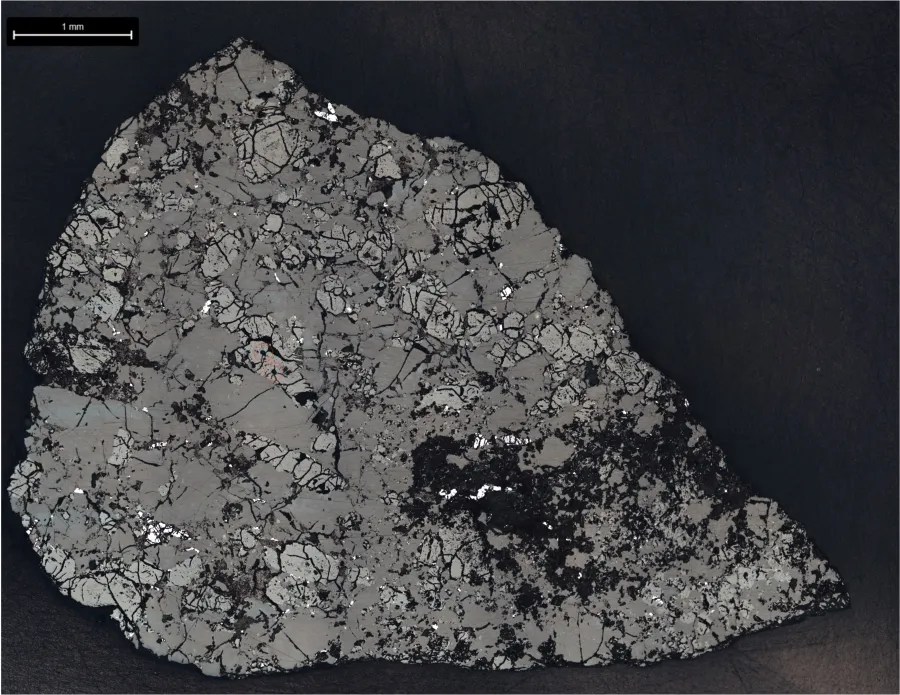
A meteorite found in 2022 in the Sahara in Mali formed in the Martian crust at least 4.1 billion years ago, according to scientists, making the reddish igneous rock perhaps the oldest of the 435 meteorites from Mars known on Earth. The researchers said the composition of the meteorite, called Teghaza 001, is providing insight into the environment early in the history of Earth’s planetary neighbor, with fresh evidence of liquid water on the surface that bolsters the notion that primordial Mars may have been conducive to microbial life.
—Universe Today: “The Vera Rubin Has Found Two More of the Milky Way’s Dim Satellites“
Massive galaxies like the Milky Way have a retinue of smaller, dim satellites on their outskirts. They’re hard to detect, and while astronomers have found about 65 of the Milky Way’s dwarf satellite galaxies, and about 40 globular clusters in its halo, they suspect there are many dwarf satellites and globular clusters yet to be found. Now the Vera Rubin Observatory has found two more. The Milky Way’s satellites are either small dim galaxies or globular clusters, and both are part of the assembly history of the Milky Way through mergers. These two detections by the Rubin, found in its Early Data Preview 2 (EDP2) released in July 2026, are almost certainly the beginning of many more discoveries of Milky Way satellites by the powerful observatory. One is a most likely a dim dwarf galaxy named Aquarius IV, and one is a globular cluster named Rubin-GC1.
—South China Morning Post: “China Aims for Manned Moon Landing Before 2030, With Two Taikonauts Set to Touch Down on Lunar Surface“
China plans to land Chinese astronauts on the Moon before 2030, with a crew of three, two of whom are expected to set foot on the lunar surface, the Global Times learned from the 7th Human Space Symposium, held in Beijing on Saturday. The country’s first manned lunar mission will employ a lunar-orbit rendezvous and docking profile, Wang Xiang, deputy chief designer of China’s manned space program and chief designer of the lunar exploration program, said at the symposium. The crew for China’s first crewed lunar exploration mission is planned to consist of three taikonauts, two of whom will land on the lunar surface, Wang added.

