A Day in Astronomy: Pioneer Venus

Image (Credit): Artist’s version of the Pioneer Venus Orbiter above Venus. (NASA)

On this day in 1978, NASA launched Pioneer Venus from Cape Canaveral, Florida. The mission had two components:

  • the Pioneer Venus Orbiter that remained in orbit around the planet until 1992 when it entered the Venusian atmosphere and burned up, and
  • the Pioneer Venus Multiprobe (known as Pioneer 13) that carried four probes later dropped into the Venusian atmosphere.

NASA described the descent of the four probes:

When the probes separated from the Multiprobe bus, they went “off the air” because they did not have sufficient on-board power or solar cells to replenish their batteries. Preprogrammed instructions were wired into them and their timers had been set before they separated from the bus. The on-board countdown timers were scheduled to bring each probe into operation again three hours before the probes began their descent through the Venusian atmosphere. On 9 December 1978, just 22 minutes before entry, the Large Probe began to transmit radio signals to Earth. Only 17 minutes before hurtling into the Venusian atmosphere at almost 42,000 km/hr (26,100 mph), all the Small Probes started transmitting.

All four probes were designed for a descent time of approximately 55 minutes before impacting the surface. None were designed to withstand the impact. However one Small Probe (the Day Probe) did survive and sent data from the surface for 67 minutes. Engineering data radioed back from the Day Probe showed that its internal temperature climbed steadily to a high of 126 degrees C (260 degrees F). Then its batteries were depleted, and its radio became silent.

A 2020 Nature Astronomy article noted that one of the probes may have detected signs of life in the Venusian atmosphere. The paper, Phosphine Gas in the Cloud Decks of Venus, has been controversial and was later modified to clarify some of the findings. However, a separate study in the Geophysical Research Letter, Venus’ Mass Spectra Show Signs of Disequilibria in the Middle Clouds, confirmed some of these finding and adding to the argument with the discovery of other chemicals that could also be linked to biological processes. The debate will continue as we learn more.

A Day in Astronomy: Lunar Orbiter 4

Image (Credit): An artist’s image of NASA’s Lunar Orbiter at the Moon. (NASA)

On this day in 1967, NASA launched Lunar Orbiter 4 to continue a survey of the Moon (also conducted by three previous Lunar Orbiter missions) in preparation of the Apollo Moon missions. While NASA lost contact with the spacecraft on July 17th, the mission was a success. On October 6th, the spacecraft crashed onto the Moon’s surface. A total of five such missions were conducted, which mapped 99 percent of the Moon.

The rest is history with the successful Apollo missions, still the only program to land humans on the Moon. We shall see who follows in our footsteps, though we will be back on the Moon soon enough as part of the Artemis Program.

You can read more about the Lunar Orbiter missions at this NASA history link. The conclusion on the Lunar Orbiter missions states:

On September 2 Homer E. Newello Associate Administrator for Space Science and Applications, certified that the fifth mission was an unqualified success according to prelaunch objectives. Deputy Administrator Robert C. Seamans, Jr., concurred on September 6. Both NASA officials also assessed the whole program as successful; five missions had been flown out of five planned. Indeed the final Orbiter had capped an impressive effort by the Office of Space Science and Applications to bring man closer to stepping down upon the lunar soil and understanding where it was that he would be landing in the near future…

Five Orbiters had enabled the Manned Space Flight Network to train personnel in tracking and to check out equipment and computer programs for the manned lunar missions beginning with Apollo 8 in December 1968 and including Apollo 10 through 17, of which all but Apollo 10 and 13 landed on the Moon. (Apollo 10 tested the complete spacecraft in lunar orbit and Apollo 13 aborted its landing mission because an onboard oxygen tank exploded in cislunar space.) The Office of Manned Space Flight could not have obtained the needed tracking experience at a timely date if NASA had not flown the five Lunar Orbiter spacecraft.

A Day in Astronomy: The Launch of Salyut 1

Image (Credit): Artist’s drawing of the Soviet Union’s Salyut 1 with a Soyuz spacecraft (upper left) approaching it. (NASA)

On this day in 1971, the Soviet Union launched Salyut 1, mankind’s first space station. The station was visited only once by a Soyuz 11 crew for 24 days, who had to cut their mission short do to technical problems, including an electrical fire. The crew died of asphyxia on the trip back to Earth.

While an earlier Soyuz 10 crew had attempted to dock with the Salyut 1, they were unsuccessful. This unsuccessful docking, followed by the death of the Soyuz 11 crew, led to a redesign of the Soyuz spacecraft. Unfortunately, the new spacecraft could not be launched in time to save the Salyut 1. The station burned up in the Earth’s atmosphere in October 1971.

The Salyut 1 was followed by the successful launch of five more stations, the last one being the Zvezda Service Module, launched in 2000. This module is still in orbit and part of the International Space Station.

Even with all of the issues, it was a great accomplishment for the Soviet Union. The United States did not have its own space station in orbit until the launch of Skylab 1 on May 14, 1973.

No one said space missions were easy or safe, as NASA has also learned over the years.

You can read more about the Soviet and Russian space stations at this NASA site.

A Day in Astronomy: The First Human in Outer Space

Image (Credit): Russian cosmonaut Yuri Gagarin before his first flight on April 12, 1961. (London Science Museum)

On this day in 1961, Russian cosmonaut Yuri Gagarin became the first human to go into outer space. He was launched into orbit aboard the Soviet Vostok 1 spacecraft. He orbited the Earth for 108 minutes before landing in Kazakstan. He did not come down in the capsule, but instead landed separately using a parachute.

Yuri Gagarin was later quoted as saying:

When I orbited the Earth in a spaceship, I saw for the first time how beautiful our planet is. Mankind, let us preserve and increase this beauty, and not destroy it!

It was his only flight into space. He died in 1968 in a training flight accident.

The following month, on May 5, 1961, Alan B. Shepard became the first American in space. He was aboard a Mercury capsule named Freedom 7. 

Image (Credit): Reentry capsule of the Vostok 1 with charring and its parachute on the ground after landing in Kazakhstan. (European Space Agency)

A Day In Astronomy: The Launch of the Mars Odyssey

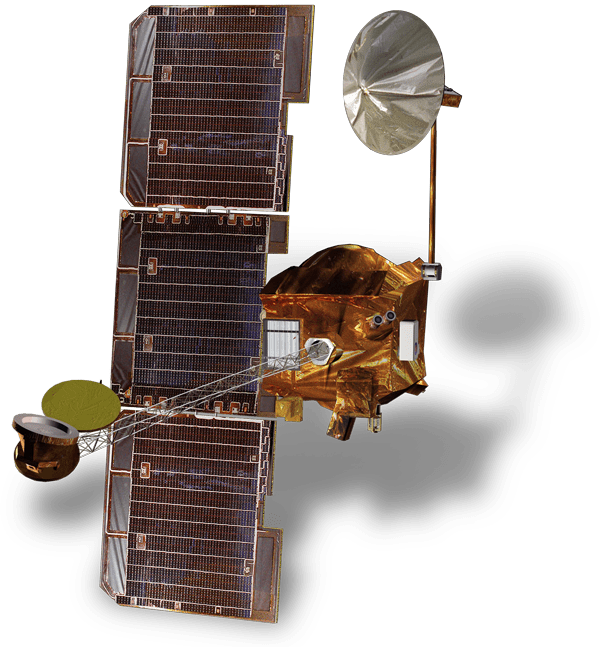
Image (Source): The Mars Odyssey orbiter. (NASA)

On this day in 2001, NASA’s Mars Odyssey orbiter was launched towards Mars to map and search the Red Planet for water. The mission itself took its name from Arthur C. Clarke’s novel 2001: A Space Odyssey.

The Mars Odyssey successfully discovered Martian water. Project Scientist Jeffrey Plaut of NASA’s Jet Propulsion Laboratory in Southern California, which leads the Odyssey mission, stated that “Before Odyssey, we didn’t know where this water was stored on the planet…We detected it for the first time from orbit and later confirmed it was there using the Phoenix lander.”

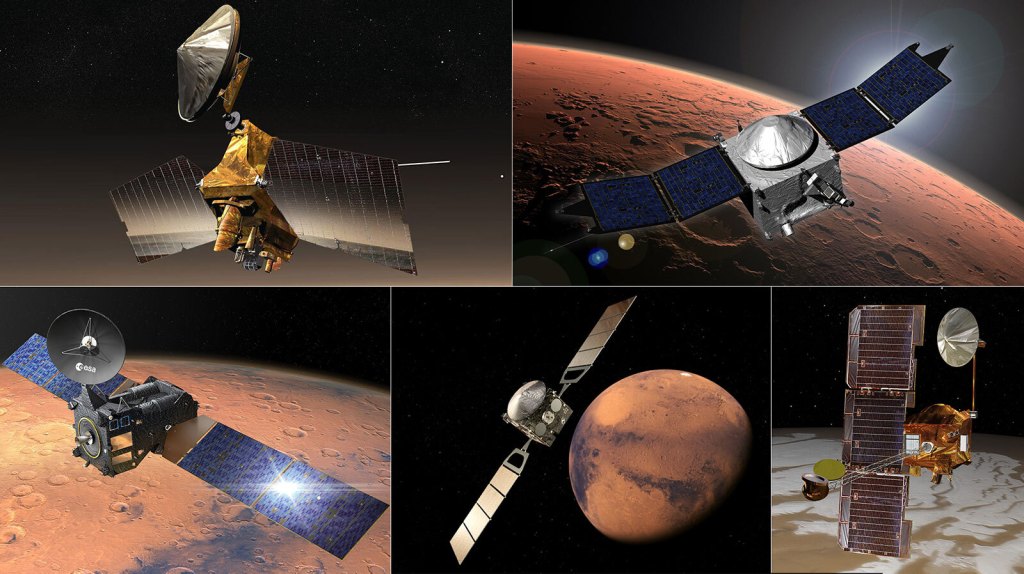
In addition to conducting its own studies, the Mars Odyssey was also used as a space satellite relaying data between Earth and Mars from other scientific missions, such as NASA’s Spirit and Opportunity rovers. The orbiter is part of what is called the Mars Relay Network, currently consisting of five orbiters (see below).

The Mars Odyssey is now the oldest oldest spacecraft still working at the Red Planet. It should be able to continue its work through 2025. You can find more information about the mission from this NASA site.

Image (Credit): Five spacecraft currently in orbit about the Red Planet make up the Mars Relay Network to transmit commands from Earth to surface missions and receive science data back from them. Clockwise from top left: NASA’s Mars Reconnaissance Orbiter (MRO), Mars Atmospheric and Volatile EvolutioN (MAVEN), Mars Odyssey, and the European Space Agency’s (ESA’s) Mars Express and Trace Gas Orbiter (TGO). (NASA/JPL-Caltech, ESA)