Space Stories: DART Damage, India Plans for Orbiting Crew, and SLIM Awakes on the Moon

Image (Credit): Illustration of how DART’s impact altered the orbit of Dimorphos about Didymos. (https://dart.jhuapl.edu/)

Here are some recent stories of interest.

NDTV: NASA’s Mission Not Only Altered Asteroid’s Path, But Its Shape Too, Says New Study

A recent study suggests NASA’s DART mission, designed to test asteroid deflection methods, may have revealed more than planned. While successfully altering the target asteroid’s trajectory, scientists now believe the impact also significantly changed its shape, hinting at a surprising composition. Previously thought to be a solid rock, Dimorphos, the impacted asteroid, may actually be a loose collection of debris. This conclusion stems from the unexpected level of deformation observed after the collision. Unlike a typical crater, the impact appears to have caused a broader, flatter dent, resembling an M&M candy.

Reuters: India Announces Four-member Crew for ‘Gaganyaan’ Space Mission

India on Tuesday introduced four crew members for its maiden ‘Gaganyaan’ space voyage, as it aims to become the world’s fourth country to send a crewed mission into space just months after a historic landing on the south pole of the moon. Gaganyaan, or “sky craft” in Hindi, is the first mission of its kind for India and will cost about 90.23 billion rupees ($1.1 billion). It involves the launch of a habitable space capsule over the next year to an orbit of 400 km (250 miles) and its return via a landing in the Indian Ocean.

SpaceNews.com: “Japan’s SLIM Moon Lander Stages Unexpected Revival After Lunar Night

Japan’s space agency made contact with its SLIM moon lander Sunday, despite the spacecraft not being expected to function after lunar night. Contact with the Smart Lander for Investigating Moon (SLIM) spacecraft was reestablished on Sunday, Feb. 25, the Japan Aerospace Exploration Agency (JAXA) announced via its dedicated SLIM account on X, formerly known as Twitter, early Feb. 26.

Space Stories: A Test of Space Suits, Water Detected on Asteroids, and China’s Growing Space Program

Image (Credit): Recent test of the space suit being built by Collins Aerospace. (Collins Aerospace)

Here are some recent stories of interest.

The Verge: One of NASA’s New Spacesuits Passes Microgravity Test

Collins Aerospace, a private company hired to create spacesuits for use outside the International Space Station (ISS), has tested its suit aboard a commercial microgravity flight, passing a milestone that lets engineers move forward toward critical design review…During the test, the plane executed “roller-coaster-like maneuvers” to induce weightlessness and allow someone wearing a prototype to see if it actually lets someone move around in it under those conditions.

Newsweek: NASA Data Detects Water on Asteroids for the First Time Ever

Water has been found on the surface of two asteroids for the first time, scientists said in a new paper. Two silicate-rich asteroids were detected by the retired Stratospheric Observatory for Infrared Astronomy (SOFIA) that were giving off a specific wavelength of light that indicated the presence of molecules of water, according to research published in The Planetary Science Journal. The discovery may have major implications for theories about how water initially made its way to our own planet. It could have been delivered via asteroid impact.

Astronomy.com: China is Embarking on a Science and Exploration Program of Staggering Scale

When China’s first lunar lander, Chang’e 3, touched down in Mare Imbrium on the Moon in 2013, it was the pinnacle of the country’s space endeavors. The robotic lander and its small Yutu rover companion were the first spacecraft to operate on the Moon since the 1970s, and provided new insights into our planet’s natural satellite…Since then, China’s space activities have exploded in range, frequency, and ambition. The country now rivals the U.S. for the most launches per year, with around 80 missions having been planned for 2023. The nation has its own modular space station, named Tiangong, which is expected to be continuously occupied by a rotating crew of three astronauts for at least a decade.

Sample Return: NASA Just Needed the Right Tool

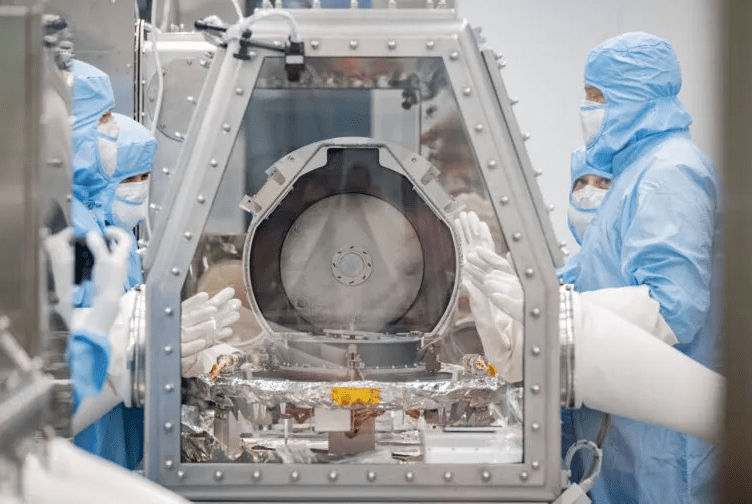
Image (Credit): The NASA and Lockheed Martin team observing the sample return canister. (NASA/Robert Markowitz)

It is amazing that we have the ability to launch a spacecraft that can chase an asteroid millions of miles away, but we lack a wrench here on Earth to open the sample container when some of that asteroid is sent home.

You may remember the problems NASA had last year opening the lid on the sample canister that Origins, Spectral Interpretation, Resource Identification, and Security–Regolith Explorer (OSIRIS-REx) returned from its encounter with the asteroid Bennu. Well, NASA finally opened up the canister.

NASA stated:

Curation processors paused disassembly of the TAGSAM head hardware in mid-October after they discovered that two of the 35 fasteners could not be removed with the tools approved for use inside the OSIRIS-REx glovebox. In response, two new multi-part tools were designed and fabricated to support further disassembly of the TAGSAM head. These tools include newly custom-fabricated bits made from a specific grade of surgical, non-magnetic stainless steel; the hardest metal approved for use in the pristine curation gloveboxes.

That’s a lengthy way to simply say we found the right tool. Now the rest of the asteroid sample can be cataloged and shared with the scientific community.

I am just glad the capsule did not contain an astronaut.

AstroForge Readies Secret Asteroid Mission

If you were the operator of an airline yet you refused to share the planned destination of your planes, I can assure you that the Federal Aviation Administration would have issues. Yet AstroForge is planning to do just that – set off into the wild blue (or black) yonder in a spacecraft named Odin towards an asteroid that it refuses to name. Needless to say, but I will say it, some people are not very happy.

The New York Times had a story on this adventure, which quoted Jonathan McDowell, an astronomer at the Harvard-Smithsonian Center for Astrophysics in Massachusetts:

I’m very much not in favor of having stuff swirling around the inner solar system without anyone knowing where it is…It seems like a bad precedent to set.

The Odin spacecraft’s goal is to observe the satellite(s) in question so that AstroForge can identify those worth revisiting as part of a mining mission. Here is the plan in the words of AstroForge:

get to deep space, perform a flyby of the asteroid target, and take high resolution images of the surface. It’s important to note that meeting just one of these objectives would be a groundbreaking achievement not just for AstroForge but for commercial space at-large.

While asteroid visits are not new, nor the idea of mining them, AstroForge would be the first commercial company to do so. The economics of such ventures are still being determined, but the company appears to have enough believers to fund such missions for now.

No specific date for the Odin launch has been set, but it is expected to occur in 2024.

Top Astronomy Stories in 2023

Image (Credit): Chart showing the planned travel of the JUICE spacecraft. (ESA, work performed by ATG under contract to ESA)

I wanted to start out the new year by first remembering all of the great missions from 2023. I also decided to group this work rather than focus on single missions.

Here is what I came up with:

NASA’s Moon Mission: We saw more progress towards the next steps in the Artemis program to put humans on the Moon, including NASA’s announcement of the four astronauts to lead the Artemis II mission, SpaceX’s tests of the Starship rocket, and the design of new spacesuits for the Artemis astronauts.

Other Attempts to Land on the Moon: We saw other nations also reaching for the Moon. While India had great success landing a rover on the lunar South Pole, both Russia and a commercial venture from Japan did not have similar luck. We also saw Japan trying it again late last year.

NASA Asteroid Missions: Asteroids were the big news this year, with Lucy encountering a surprise pair of asteroids, OSIRIS-REx bringing back a sample from the asteroid Bennu, and NASA launching the Psyche mission.

JWST Discoveries: This year we celebrated the anniversary of the James Webb Space Telescope (JWST), which has been better than ever imaged. It is helping to change our understanding of the origin of the universe while poking and prodding at exoplanets to review their secrets.

ESA Missions: The European Space Agency (ESA) has also been very busy in 2023. For instance, the launch of the Euclid mission to study dark matter and dark energy, as well as the JUICE mission to study Jupiter and its moons, will assist with our understanding of the big picture as well as our own neighborhood.

That’s an impressive record, and I look forward to even more great news in 2024.