Blue Origin Booster Mishap

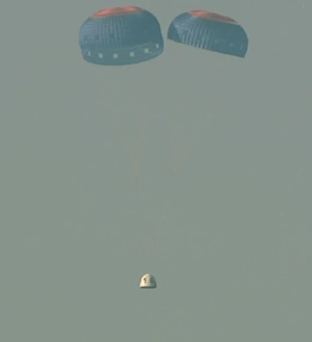
Image (Credit): Blue Origin’s NS-23 capsule returning to Earth after the mishap. (Blue Origin)

Delays and accidents are clear risks in the space industry, as we learned with the Artemis mission and now Blue Origin’s latest rocket launch. On Monday, a crewless New Shepard rocket launch (NS-23) went wrong, with the booster failing shortly after takeoff. Fortunately, the emergency system worked fine, indicating a crew would have returned safely in the capsule. In this case, the capsule was carrying a variety of experiments.

This same mission was scrubbed back on August 31st and September 1st due to weather issues. With this latest incident, future missions are on hold until the booster problem can be investigated by the Federal Aviation Administration. This was the first failure in the 23 New Shepard rocket missions launched to date.

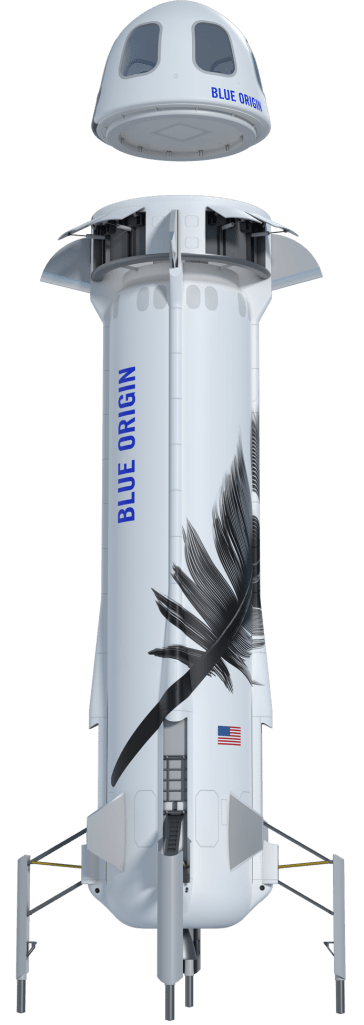
Image (Credit): Blue Origin’s New Shepard suborbital rocket system. (Blue Origin)

China Needs Reusable Rockets

Image (Credit): The July 24th launch of a Long March 5B rocket transporting China’s second module for its Tiangong space station. (CNS/AFP/Getty Images)

A few days ago debris from China’s Long March 5B rocket landed in the waters off the Philippine island of Palawan. The 1.8 million pounds of rocket brought a module to the Chinese space station. Such problems with Chinese rocket debris is a clear example that China needs to follow both SpaceX and Blue Origin and start using resusable rockets in the future.

NASA’s Administrator was not happy, tweeting:

The People’s Republic of China did not share specific trajectory information as their Long March 5B rocket fell back to Earth.

All spacefaring nations should follow established best practices, and do their part to share this type of information in advance to allow reliable predictions of potential debris impact risk, especially for heavy-lift vehicles, like the Long March 5B, which carry a significant risk of loss of life and property.

Doing so is critical to the responsible use of space and to ensure the safety of people here on Earth.

China has plans to develop reusable rockets for future heavy-lift missions to its space station and the Moon. This would certainly reduce the risk to parties below and hopefully add some efficiencies to the launch process.

Of course, China is not alone when it comes to falling space debris. SpaceX appears to be responsible for debris that landed in Australia last month (see below). While confirmation is still needed, the material appears to be from a SpaceX Dragon capsule.

Image (Credit): One of the panels of the debris found in Australia. (The Guardian/Brad Tucker)

Bernie Sanders Has Questions About Private Space Companies

Image (Credit): Senator Bernie Sanders. (Rollcall)

In a recent The Guardian newspaper editorial, Bernie Sanders had some questions about the role of private companies, such as Blue Origin and SpaceX, in the future of space exploration or, as he sees it, space profiteering. In his editorial, “Jeff Bezos is worth $160bn – yet Congress might bail out his space company,” he noted the following:

At this moment, if you can believe it, Congress is considering legislation to provide a $10bn bailout to Jeff Bezos’s Blue Origin space company for a contract to build a lunar lander. This legislation is taking place after Blue Origin lost a competitive bid to SpaceX, Musk’s company. Bezos is worth some $180bn.

He then cites the costs of Jeff Bezos’ yacht and homes while pointing out the plight of those living paycheck to paycheck. Of course, the same could be said about Elon Musk, rumored to be the wealthiest man in the world and now in the papers for buying another company unrelated to space (or the car industry).

First, this battle between Bernie and Bezos has been going on for some time, but the “bailout” in question was debunked by Verifythis.com last year, which stated:

Although NASA recently chose SpaceX over Blue Origin and one other company to receive funding for development of a human lunar lander, NASA stated in its decision that it wanted to fund two companies but lacked the budget to even fund one without negotiating the price down. The Senate bill is in response to that, allocating NASA enough funding to award a second contract. Blue Origin is the likely frontrunner for that contract, but it’s not guaranteed. Even if Blue Origin does win the contract, the allocated $10 billion to NASA isn’t just for this contract and therefore wouldn’t all go to Blue Origin.

Of course, the editorial is really a lead in to the real issue – who owes the minerals in space? Mr. Sanders highlights the worth of a single asteroid, stating “Just a single 3,000ft asteroid may contain platinum worth over $5tn.” It is a good point as we consider the next great race for minerals. Of course, maybe Uncle Sam can get some of it back via taxes, but it is not hard to believe space companies would incorporate in the Bahamas or somewhere similar to avoid such taxation.

Mr. Sanders is calling for a “rational space policy,” and wants Congress to be part of the process. Given the number of nations heading to the Moon and Mars, it is much bigger than the U.S. Congress. The United Nations will need to play a role here via the Outer Space Treaty, which NASA is attempting to update via the Artemis Accords. In addition, maybe Congress needs to update the rescind the 2015 U.S. Commercial Space Launch Competitiveness Act, which states in § 51303:

A United States citizen engaged in commercial recovery of an asteroid resource or a space resource under this chapter shall be entitled to any asteroid resource or space resource obtained, including to possess, own, transport, use, and sell the asteroid resource or space resource obtained in accordance with applicable law, including the international obligations of the United States.

By the way, NASA has already issued a press release regarding more lunar lander opportunities. You can find the press release here.

Prepare for Thousands More LEO Satellites

Image (Credit): Launch vehicles for Amazon’s Project Kuiper. (Amazon)

Watch out SpaceX, Amazon is getting into the Internet satellite business as well. More importantly, beware astronomers and orbiting spacecraft, because the skies are going to be really crazy, and China has not even started with its massive program.

This week, Amazon announced plans to more forward with Project Kuiper, which will involve about 83 rocket launches involving Arianespace, Blue Origin, and United Launch Alliance. The Project will place 3,236 satellites into low Earth orbit (LEO) over a five-year period.

This is how Amazon describes Project Kuiper:

Project Kuiper aims to provide high-speed, low-latency broadband to a wide range of customers, including individual households, schools, hospitals, businesses, government agencies, disaster relief operations, mobile operators, and other organizations working in places without reliable internet connectivity. Amazon is designing and developing the entire system in-house, combining a constellation of advanced LEO satellites with small, affordable customer terminals and a secure, resilient ground-based communications network. 

Of course, this is what SpaceX’s Starlink is already doing as it aims for 42,000 such satellites. In addition, Oneweb aims for about 600 such satellites (to be launched by SpaceX of all firms). And China is considering a similar system of 10,000 LEO satellites. This is just the list to date, which is quite a cluster of problems already.

So let me get this straight. We can get Dish TV cable services to every spot in the US using only 9 satellites, but we will need thousands and thousands of competing satellites crowding LEO and jeopardizing our space stations, weather and intelligence satellites, and astronomy efforts all for Internet services?

Why does it appear we are going backwards. I understand that the Dish satellites are about 22,000 miles away in geosynchronous orbits, but why can’t that be the model going forward rather than the billions of satellites that Mr. Musk thinks is possible? It strikes me as crazy to go down this path. All we need is one bad collision, and the cascading impact of that collision, to doom all of LEO.

We really need to think this through.

Do We Need Pete Davidson in Space?

Image (Credit): Pete Davidson in a Saturday Night Live skit. (NBC)

Okay, I can understand shooting actor William Shatner into space on a Blue Origin rocket given his work with Star Trek and his interest in space itself, but Pete Davidson from SNL fame? Really? Luckily, his part in the mission was scrubbed.

So who will go up into space tomorrow on Blue Origin’s New Shepard rocket? You may even ask if there will be a launch given the lack of media interest. And now we know why actors are key to the success of these private rocket missions unless they are doing something useful, like testing new scientific ideas or pushing to boundaries of space. Anything else is like listing the names of people flying to China on Delta Airlines.

I do not really care about celebrities in space (unless we leave them there), so I will provide the upcoming launches full crew manifest (in alphabetical order) without such hype:

Marty Allen

Marty Allen is a turnaround CEO and angel investor. During his tenure as CEO of Party America, he transformed the company from a broken California retail chain into a large nationwide retailer, leading the company through a bankruptcy restructuring and the acquisition of several competitors. He is also the former CEO of California Closet Company, leading the company to record sales and profitability. Marty also mentors CEOs through his board activities.

Sharon Hagle

Sharon Hagle founded SpaceKids Global in 2015, a nonprofit whose mission is to inspire students to excel in STEAM+ education with a focus on empowering young girls. SpaceKids hosts several annual challenges designed to inspire kids to pursue careers in the space industry, including national essay competitions and a partnership with the Girl Scouts of Citrus County. SpaceKids also participates in Club for the Future’s Postcards to Space program. To date, Sharon has reached nearly 100,000 students globally.

Marc Hagle

Marc Hagle is president and CEO of Tricor International, a residential and commercial property development corporation. Under his direction, the company has developed and owned more than 17.4 million square feet of properties across the United States, including shopping centers, warehouses, medical facilities, recreational facilities, drug stores, and office projects. Marc and his wife, Sharon, are avid philanthropists for numerous arts, sciences, health, and education-related charities.

Jim Kitchen

Jim Kitchen is a teacher, entrepreneur, and world explorer who has visited all 193 U.N.-recognized countries. He’s been a space dreamer since watching NASA’s Apollo rocket launches in Florida as a child. As a college student in the 1980s, he promoted low Earth orbit space trips for a startup. Since 2010, Jim has served on the faculty of University of North Carolina’s Kenan-Flagler Business School, teaching students to create world-changing for-profit and nonprofit ventures.

Gary Lai

Gary joined Blue Origin in 2004 and was among the first 20 employees. He is currently Senior Director and Chief Architect of New Shepard, responsible for all next generation designs, upgrades, and new product development for the New Shepard business. His prior positions include Senior Director of Design Engineering, System Architect, Crew Capsule Element Lead, NASA Commercial Crew Development Program Manager, Lead Systems Engineer, and Pathfinding Lead with responsibility for advanced research and development. Gary has been involved in product development, strategic planning, and business development for all Blue Origin product lines, including the New Glenn orbital launch vehicle, rocket engine programs, and Blue Moon.

Dr. George Nield

Dr. George Nield is the president of Commercial Space Technologies, LLC, which he founded to encourage, facilitate, and promote commercial space activities. He previously served as associate administrator for the Federal Aviation Administration Office of Commercial Space Transportation and was responsible for licensing and regulating all commercial launch activities. Earlier in his career, he held engineering roles at the Air Force Flight Test Center and the Orbital Sciences Corporation, and he was an assistant professor and research director at the U.S. Air Force Academy. Dr. Nield also served as the manager of the Flight Integration Office for NASA’s Space Shuttle Program.

Of course, I am not so interested in space tourism either, but I listed these names for fun this one time. If these flights lead to greater confidence at Blue Origin and something new that advances space travel or science, then I am fine. If these are just grandiose trips to the stars, then I am not so impressed.