Image (Credit): Newly-announced Artemis astronauts Commander Reid Wisemam, Pilot Victor Glover, Mission Specialist Jeremy Hansen, and Mission Specialist Christina Hammock Koch. (NASA)
Another step was taken today to get us closer to a Moon landing. Earlier today NASA announced the names of the four astronauts on the next Artemis II mission:
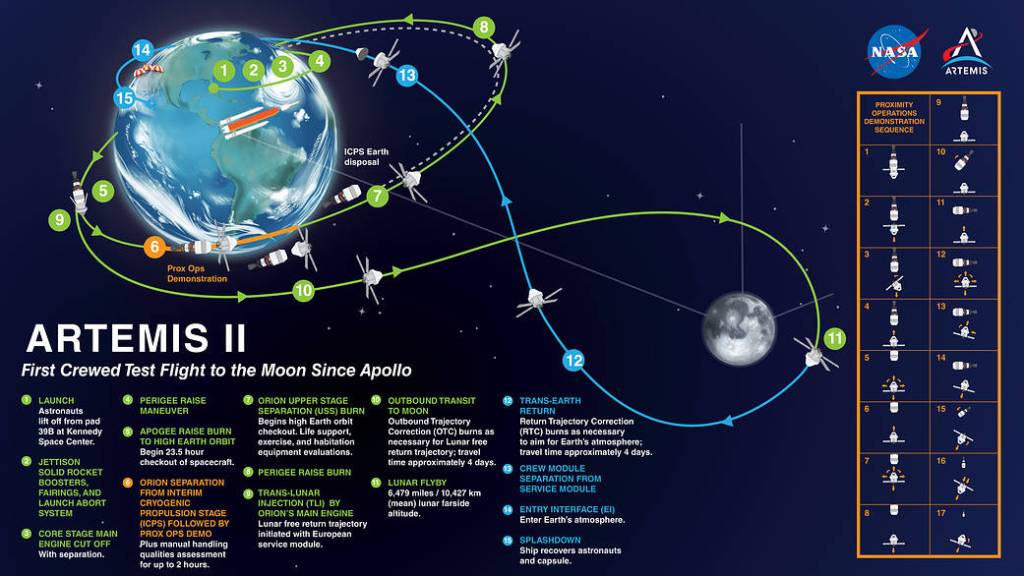
The Artemis II mission will require the four astronauts to take an Orion capsule around the Moon to test a variety of systems and ensure the safety of a later Moon landing as part of Artemis III. You can see a graphic of the Artemis II mission below.
At today’s ceremony announcing the crew, NASA Administrator Bill Nelson stated:
The Artemis II crew represents thousands of people working tirelessly to bring us to the stars. This is their crew, this is our crew, this is humanity’s crew…NASA astronauts Reid Wiseman, Victor Glover, and Christina Hammock Koch, and CSA astronaut Jeremy Hansen, each has their own story, but, together, they represent our creed: E pluribus unum – out of many, one. Together, we are ushering in a new era of exploration for a new generation of star sailors and dreamers – the Artemis Generation.
You can also watch NASA’s full announcement of the new crew here.
The interview is with Peter Visscher, Director of Canadensys West, which is building the rover after receiving a contract from Canadian Space Agency’s Lunar Exploration Accelerator Program. Here is a little more about the rover and the partners on the mission:
The 30-kg lunar rover will be sent to the Moon’s south pole region as early as 2026. The rover will be carrying multiple science payloads from Canada and the US. Canadensys Aerospace is leading a broad team of partners, including NASA Ames Research Center, NGC Aerospace, Maya Heat Transfer Technologies, Nokia, Bubble Technology Industries, Waves in Space, Simon Fraser University, Western University, the University of Winnipeg, l’Université de Sherbrooke, Leap Biosystems, Surrey Satellite Technology, and RF Collins. The team’s scientific investigators are among the leading lunar researchers in Canada and the US and are affiliated with the core team organizations as well as Arizona State University, Planetary Science Institute, and University of Alberta.
The rover will explore the Moon’s South Pole as it searches for water ice. Such ice has already been detected from orbit, but this mission will test the soil in the area where the water was detected. Water on the lunar surface will be of great benefit to future missions on the Moon and elsewhere – it represents not only water itself, but oxygen for breathing and hydrogen for fuel.
The objectives of the mission were recently laid out by the Canadian government:
travel on the surface of the Moon to see how the various systems perform;
showcase the possible applications, feasibility and performance of a new technology;
make scientific measurements that will help determine the amount of hydrogen present in the Moon soil, which is one of the best indicators of water ice while defining at which temperatures it is detected;
analyze the lunar soil to better understand the geology of the site; and
assess lunar surface radiation to find out how much radiation future astronauts will be exposed to.
The interview in the podcast gives you more background on the project as well as potential plans to provide the rover with its own name.
NASA is working on another rover that it plans to send to the Moon’s surface by 2024 – Volatiles Investigating Polar Exploration Rover (VIPER). I can cover that mission and other lunar missions looking for water in a later post.
It was only a matter of time. Canada wants to develop its own version of the US Space Force later this year. According to media reports, the Canadian Space Division would eventually employ about 270 people, versus about 16,000 in the US program.
The two nations are not alone. A quick check on Wikipedia shows space forces in numerous countries, from Italy to Peru, though the definition of “space force” is pretty wide.
This investigation determines that the Space Force’s establishment is hobbled by unclear goals and uncertain effects, contending that the Space Force lacks a clearly defined organizational culture and a clear strategic purpose, both core elements of organizational success, and that the decision to create the service is premature at best and irresponsible at worst.
Not a ringing endorsement, but maybe a sign that some more thinking needs to go into the role of these new organizations. Yet just as the air force was a natural break away from the army, the space force is a natural offspring of the air force. What comes after that? Maybe a Lunar Force or a Martian Force when we start to occupy space. I would love to see those recruitment videos.
Image (Credit): Image from a US Space Force recruitment video. (USSF)