Space Quote: A Space Detente with China?

“With geopolitical tensions between Washington and Beijing extending into space, it is only to be expected that policymakers are looking back to the Cold War for helpful lessons. Unfortunately, it is far too easy to learn the wrong lessons from space cooperation during and immediately after the Cold War. Certainly, space cooperation was not a silver bullet to superpower problems on Earth and in space. The pattern of space cooperation between the United States and Russia is an important reminder that space cooperation has generally been the product of improving relations rather than the catalyst for change.”

-Statement by Aaron Bateman in his Bulletin of the Atomic Scientists’ article, “The Prospects for United States–China Space Cooperation are Limited.” The article suggests some ways that the two space-faring nations can find common ground even if they are not working on the same space missions as the American and Russians did in the past and still do today.

Pic of the Week: New Crew Sent to the Tiangong Space Station

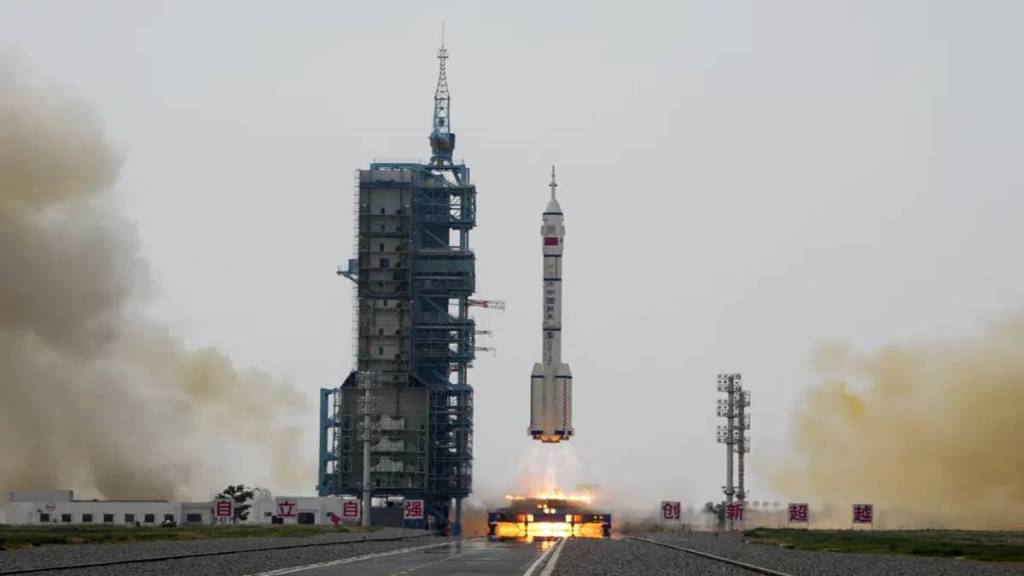
Image (Credit): Launch of China’s Shenzhou 16 spacecraft. (AP)

This week’s image shows China’s launch of the Shenzhou 16 spacecraft earlier this week atop a Long March 2-F rocket. The launch included a three-man crew, one being the first civilian astronaut in the Chinese crew rotation, who will relieve the current crew on the Tiangong Space Station.

Two Space Stations, Two Stories

Image (Credit): The three Chinese astronauts who left for the Tiangong space station this week. (VCG/VCG via Getty Images)

This week astronauts aboard the International Space Station (ISS) said goodbye to the second set of private astronauts who are part of the Axiom Space mission, while China sent its first non-military astronaut to its Tiangong space station. It is not surprising that China started out with military astronauts. NASA also recruited from the US military for its early astronauts, and still does today. Yet it is encouraging that China is already shifting to scientists.

So while China is following the expected trajectory towards more scientists, the ISS (and more particularly its US partners) is shifting towards greater tourism since Axiom missions are for quick flybys rather than deep research. For instance, the “astronauts” on the second Axiom mission were on the ISS for about a week. At least the second mission included a few scientists, whereas the first Axiom mission consisted of wealthy investors.

With commercial space stations in development, we can expect to see tourism as a key piece of the space industry, as we already see with SpaceX, Blue Origin, and Virgin Galactic. China is not far behind, indicating that it wants to find ways to be part of the space tourism industry as well.

Maintaining the right balance between the militarization of space, real science, and tourism will not be an easy balance, as we watch it all in play this week. I would rather see more tourists than military crews in space, but I am hoping we can find a way to keep the scientists fully engaged and the main players for now. Space mining and related industries will probably beat all of these other uses, but we are not at that stage just yet.

Space Stories: A Private Space Station, Chinese Space Plane Returns, and Russia Doubts Moon Landing

Image (Credit): Vast Space Haven-1 Space Station. (Vast Space)

Here are some recent stories of interest.

Digital Trends:SpaceX and Vast Aim to be First to Deploy Private Space Station

As the International Space Station nears the end of its life, SpaceX and Los Angeles-based startup Vast have unveiled a plan to launch the first commercial space station. SpaceX will use a Falcon 9 rocket to send the station’s main module, Haven-1, into low-Earth orbit as early as August 2025.

Space.com: “China’s Mysterious Space Plane Returns to Earth after 9-month Orbital Mission

The second orbital mission of China’s robotic space plane has come to a close. The mysterious reusable vehicle touched down Monday (May 8) at the Jiuquan Satellite Launch Center in northwest China, wrapping up a 276-day mission to Earth orbit, according to China’s state-run Xinhua news agency.

ARS Technica: “Former Head of Roscosmos Now Thinks NASA Did Not Land on the Moon

Dmitry Rogozin was fired as director general of Russia’s main space corporation, Roscosmos, nearly a year ago. He has spent much of the time since near the front lines of Russia’s invasion of Ukraine, sharing various hateful, threatening, and nationalistic sentiments on his Telegram account. Occasionally, however, the pugnacious politician still opines about space on his “Rogozin at the Front” social media account. He did so this weekend, calling into question whether the United States really did land astronauts on the Moon.

Space Stories: Russia Sticks with ISS, Czechs Join Artemis Accords, and China Plans for Sample Return from Far Side of Moon

Image (Credit): The International Space Station. (Roscosmos)

Here are some recent stories of interest.

Phys.org: “Russia Will Use International Space Station ‘Until 2028’

Russia said Wednesday it planned to use the International Space Station until 2028, an apparent reversal of an earlier announcement to quit the orbiting laboratory after 2024. On Wednesday, the head of Russian space agency Roscosmos, Yuri Borisov, said Moscow’s participation in the international space project had been extended. “By the decision of the government, the operation of the International Space Station has been extended until 2028,” Borisov told President Vladimir Putin during a televised meeting, referring to the Russian segment.

SpaceNews.com: “Czech Republic signs Artemis Accords

The Czech Republic became the 24th country to sign the Artemis Accords May 3, growing Europe’s presence in the U.S.-led agreement. In a brief ceremony at NASA Headquarters, Jan Lipavský, minister of foreign affairs for the Czech Republic, formally signed the accords in the presence of officials from NASA and the U.S. State Department. Representatives of several other countries who previously signed the Artemis Accords also attended…Neither U.S. nor Czech officials announced specific plans to cooperate on the Artemis lunar exploration campaign as a result of signing the accords, but suggested the signing opened the door for future discussions. 

Space.com: “China to Launch 1st-ever Sample Return Mission to Moon’s Far Side in 2024

China will attempt to collect the first samples from the far side of the moon next year with its Chang’e 6 mission. The complex, four-spacecraft mission will launch on a Long March 5 rocket from Wenchang in May 2024, according to Wu Yanhua, chief designer of China’s Deep Space Exploration Major Project, speaking at a deep-space exploration conference on April 25 in the Chinese city of Hefei.