Image (Credit): China’s Tiangong space station captured by a returning Shenzhou spacecraft. (CMSA)
China is getting ready to send a new crew to its Tiangong space station tomorrow. The Shenzhou-18 spacecraft will carry three new crew members to the station, replacing the crew that has been on the station since last October.
The current crew had to deal with space debris that damaged its solar panels and led to a power loss. Two spacewalks were recently conducted to make the necessary repairs. The arriving crew is coming with additional repair material, including “space debris protection reinforcements for extravehicular piping, cables and critical equipment,” according to China Daily.
Unfortunately, space debris is a constant hazard in orbit. The International Space Station (ISS) has dodged debris as well as repairing damaged areas. Of course, the ISS is also dropping space debris on Florida, but that’s a different story.
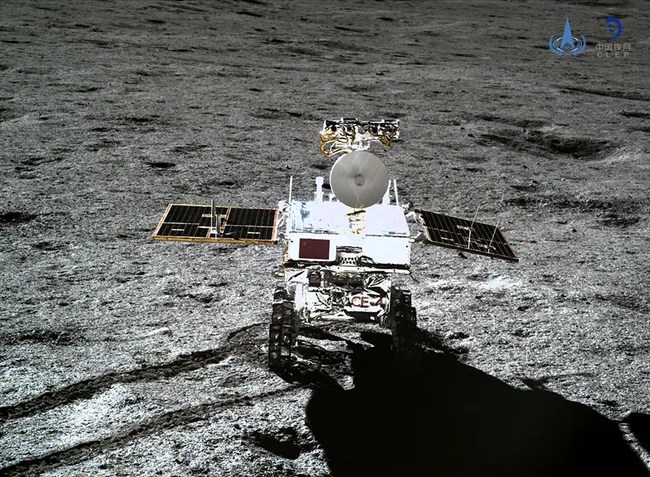
Image (Credit): China’s Yutu 2 rover, as seen by the Chang’e 4 lander, both of which landed on the lunar surface in January 2019. (CNSA)
“If the space agency holds to its notion of flying the Artemis II crew on a looping journey around the far side of the moon late next year, and landing the Artemis III crew in the south polar region in 2026 or 2027, the next boot prints on the moon will indeed be American. But don’t count on it.”
-Statement in a Time magazine article titled, “Why China Might Beat the U.S. Back to the Moon.” The article cites NASA’s delays and budget shortfall related to the Artemis mission. Interestingly, the article notes that the U.S. might have lacked the discipline to return to the Moon if China did not have similar plans. Finally, one key point to remember is that the U.S. beat the Chinese to the Moon by more than 50 years, so this is not really the same as the earlier space race with Russia. As a result, China is taking its time to do it right. We may need to keep that in mind as we face our own struggles.
Collins Aerospace, a private company hired to create spacesuits for use outside the International Space Station (ISS), has tested its suit aboard a commercial microgravity flight, passing a milestone that lets engineers move forward toward critical design review…During the test, the plane executed “roller-coaster-like maneuvers” to induce weightlessness and allow someone wearing a prototype to see if it actually lets someone move around in it under those conditions.
Water has been found on the surface of two asteroids for the first time, scientists said in a new paper. Two silicate-rich asteroids were detected by the retired Stratospheric Observatory for Infrared Astronomy (SOFIA) that were giving off a specific wavelength of light that indicated the presence of molecules of water, according to research published in The Planetary Science Journal.The discovery may have major implications for theories about how water initially made its way to our own planet. It could have been delivered via asteroid impact.
When China’s first lunar lander, Chang’e 3, touched down in Mare Imbrium on the Moon in 2013, it was the pinnacle of the country’s space endeavors. The robotic lander and its small Yutu rover companion were the first spacecraft to operate on the Moon since the 1970s, and provided new insights into our planet’s natural satellite…Since then, China’s space activities have exploded in range, frequency, and ambition. The country now rivals the U.S. for the most launches per year, with around 80 missions having been planned for 2023. The nation has its own modular space station, named Tiangong, which is expected to be continuously occupied by a rotating crew of three astronauts for at least a decade.
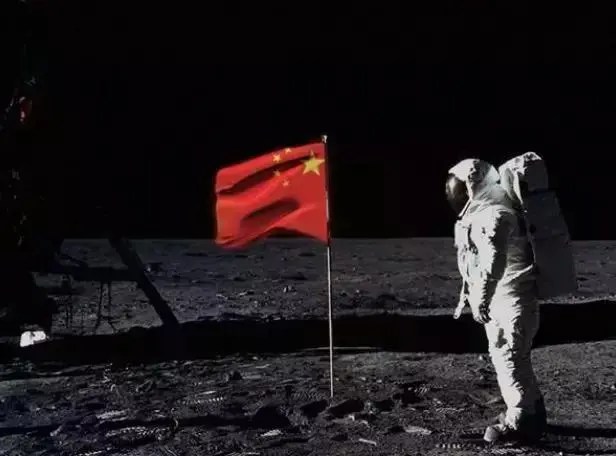
Image (Credit): A manufactured image, but it may be a reality soon enough. (Asia Times)
With the newly announced delays related to the Artemis lunar program, it is fair to ask whether the U.S. might fall behind the Chinese when it comes to a crewed lunar mission (of course, we won that battle 50 years ago, but you know that I mean).
All reports indicate that the Chinese wants to place humans on the Moon by 2030, but they are not expected to beat the Artemis timetable of a lunar landing in 2026. Of course, it is important that NASA stick to this timetable.
I do not have a concern that China is going to land before us…I think that China has a very aggressive plan. I think they would like to land before us, because that might give them some PR coup. But the fact is that I don’t think they will. I think it is true that their date that they announced keeps getting earlier. But specifically, with us landing in September of ’26, that will be the first landing.
Obstacles remain on what will prove to be a difficult mission even if it is a repeat. We already saw Russia’s failed attempt to simply land on the Moon last year, and the problems with last week’s NASA-funded commercial launch towards the Moon was worrying.
Nothing can be taken for granted in this new space race.
Image (Credit): JunoCam image of Jupiter’s moon Io during its close encounter. The image was taken at an altitude of about 1,500 miles. (NASA JPL and Southwest Research Institute)
NASA’s spacecraft Juno just had a super-close encounter with the most volcanic world in the solar system—but its stunning first image could be among its last after 56 orbits of Jupiter. On December 30, the bus-sized spacecraft—orbiting Jupiter since 2016—got very close to Io, the giant moon of Jupiter. It reached a mere 930 miles (1,500 kilometers) from the moon’s surface. However, the spacecraft’s camera has suffered radiation damage and may not last much longer.
India began 2024 with the launch of an X-ray astronomy satellite aboard the sixtieth flight of its Polar Satellite Launch Vehicle. The PSLV C58 mission lifted off at 9:10 AM local time (03:40 UTC) on Monday, Jan. 1, from the Satish Dhawan Space Centre. XPoSat, or X-ray Polarimeter Satellite, carries a pair of instruments that will be used to study X-ray emissions from astronomical sources. After deploying XPoSat, PSLV C58’s upper stage has remained in orbit as the third flight of the PSLV Orbital Experimental Module (POEM-3), serving as a free-flying platform hosting a range of attached payloads.
The first satellite for a second planned Chinese low Earth orbit communications megaconstellation has been produced in new facilities in Shanghai. A new generation flat-panel satellite rolled off the assembly at the G60 digital satellite production factory in Shanghai’s Songjiang District Tuesday, Dec. 27, according to Chinese press reports. The satellite is the first for the G60 Starlink low Earth orbit communications megaconstellation. An initial 108 satellites of a total of around 12,000 G60 Starlink satellites are to be launched across 2024.