Good Article: The Sad State of Russia’s Space Program

Image (Credit):  A destroyed Russian tank in the village of Dmytrivka, Ukraine. (CNN/Alex Chan Tsz Yuk/SOPA Images/Sipa/Reuters)

Wired magazine’s latest article, “Russia’s Space Program Is in Big Trouble,” summarizes a sad trend since Russia’s invasion of Ukraine. With all of the nation’s attention on an unnecessary war, the space program, like many things nowadays in Russia, has taken a back seat.

Problems can be seen with the spacecraft – two Russian capsules at the International Space Station (ISS) sprung leaks – as well as ground control. Assets at Russia’s spaceport in Kazakhstan are being seized, while corruption and other problems are delaying a new spaceport within Russia’s borders.

Russia also lacks a partner for a new space station after the ISS, and its mission to the Moon with China look’s tenuous. Does the country have a plan for the future beyond militarizing space?

The article concludes with these words:

The Soviet Union may have put the first human into space—but now, 60 years later, Russia faces a near-future in which it is no longer able to do that. 

No Pyrrhic victory in Ukraine will change this.

Extra: The Wall Street Journal also had a good article about the situation in Russia. The article, “Russia’s Economy is Starting to Come Undone,” includes an interview with Oleg Mansurov, who hoped to create the next SpaceX with his company SR Space. However, the situation in Ukraine has caused his investors to flee. As a result, he is staying afloat as an IT company for now. He notes:

We became more focused not on the development of a long-term product that would make some kind of qualitative leap but on simply becoming a classic business and generating revenue…We understood we just had to survive.
Space Stories: Stalled Martian Rover, Early Mega-Galaxies, and Soviet Space Debris

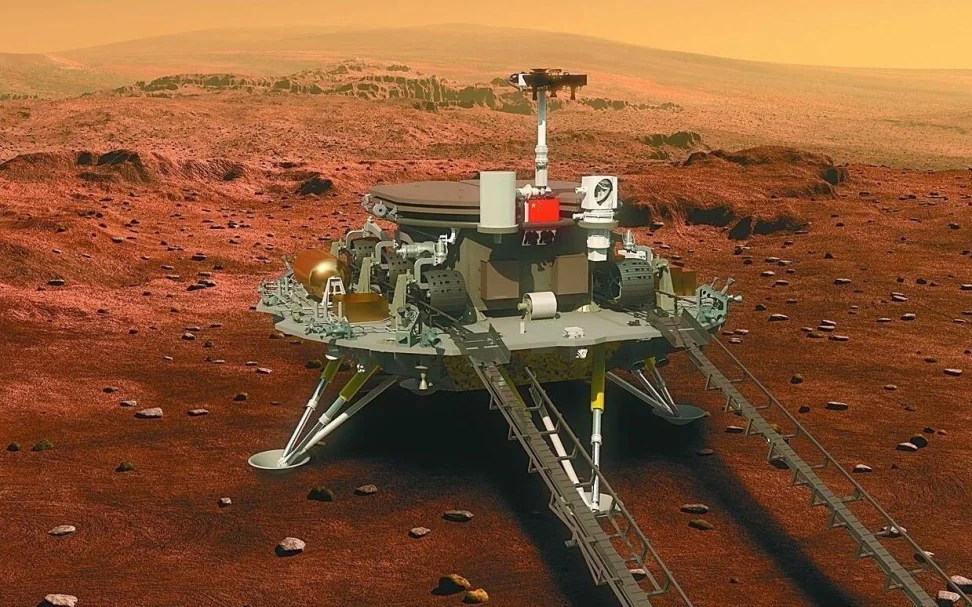
Image (Credit): Artist’s rendering of China’s Zhurong rover about to roll off the lander and drive onto Mars. (WEIBO)

Here are some recent stories of interest.

SpaceNews: “NASA Mars Orbiter Reveals China’s Zhurong Rover Has Not Moved for Months

Images from NASA’s Mars Reconnaissance Orbiter reveal that China’s Zhurong rover remains stationary on the Red Planet as China remains silent on the status of its spacecraft. The High Resolution Imaging Science Experiment (HiRISE) camera aboard the Mars Reconnaissance Orbiter (MRO) captured images of the rover on March 11, 2022, a second on Sept. 8, 2022 and finally Feb. 7, 2023. The images were published Feb. 21 by the HiRISE Operations Center.

Los Angeles Times: “Space Telescope Spots Massive Galaxies Near Cosmic Dawn and Blows Astronomers’ Minds

Astronomers have discovered what appear to be massive galaxies dating back to within 600 million years of the big bang, suggesting the early universe may have had a stellar fast-track that produced these “monsters.” While the new James Webb Space Telescope has spotted even older galaxies, dating to within a mere 300 million years of the beginning of the universe, it’s the size and maturity of these six apparent mega-galaxies that stunned scientists. They reported their findings Wednesday in the journal Nature.

Newsweek: “Russian Rocket Crashes Back Into Russia After 42 Years

A decades-old Soviet era piece of space junk has crashed back to Earth after over 40 years in orbit, improbably crash landing back in its home country, Russia. The abandoned Soviet Vostok-2M Blok E rocket stage, weighing more than 3,000 pounds, “made an uncontrolled reentry over Novaya Zemlya at 1016 UTC Feb 20 after 42.7 years in orbit,” tweeted Jonathan McDowell, an astrophysicist and group leader at the Chandra X-ray Center Science Data Systems.

Space Stories: Black Holes & Dark Energy, New Forms of Ice, and Dark Dwarf Galaxies

Image (Credit): Ship from the Disney film The Black Hole. (Disney)

Here are some recent stories of interest.

University of Hawaii: “First Observational Evidence Linking Black Holes to Dark Energy

Searching through existing data spanning 9 billion years, a team of researchers led by scientists at University of Hawaiʻi at Mānoa has uncovered the first evidence of “cosmological coupling” –a newly predicted phenomenon in Einstein’s theory of gravity, possible only when black holes are placed inside an evolving universe.

UH Mānoa astrophysicists Duncan Farrah, a faculty member at the Institute for Astronomy and the Department of Physics and Astronomy, and Kevin Croker, a professor of physics and astronomy led this ambitious study, combining Hawaiʻi’s expertise in galaxy evolution and gravity theory with the observation and analysis experience of researchers across nine countries to provide the first insight into what might exist inside real black holes.

Astronomy.com: “Scientists Create New Form of Ice that Might Exist on Ocean Moons

Chemists have discovered a new form of ice, and their work may have major consequences for our understanding of the outer solar system. We usually encounter three forms of water on the surface of Earth: solid, liquid, and vapor. On our planet, solid ice mainly comes in one variety, where water molecules arrange themselves into an orderly and repeated crystalline structure. But scientists have discovered 19 other varieties of water-ice that may appear throughout the universe.

Phys.org: “Chinese Astronomers Discover an Isolated Dark Dwarf Galaxy

Using the Five-hundred-meter Aperture Spherical radio Telescope (FAST), Chinese astronomers have detected a new galaxy, which received designation FAST J0139+4328. The newfound galaxy is isolated, has a relatively low stellar mass, and is dominated by dark matter. The discovery was detailed in a paper published February 6 on the arXiv pre-print server.

The White House Admits UFO but Denies ET

Image (Credit): White House briefing podium. (TVNewsCheck)

With a third unidentified object (aka UFO) shot down from the northern skies, the White House thought it was necessary to set the record straight earlier today. According to Politico, White House press secretary Karine Jean-Pierre made the administration’s position very clear:

I know there have been questions and concerns about this, but there is no — again no indication — of aliens or extraterrestrial activity with these recent takedowns…I wanted to make sure that the American people knew that, all of you knew that and it was important for us to say that from here because we’ve been hearing a lot about it.

It seems Gen. Glen VanHerck, commander of the North American Aerospace Defense Command and U.S. Northern Command, was not as quick denying an extraterrestrial origin during a Sunday interview, stating:

I’ll let the intel community and the counterintelligence community figure that out. I haven’t ruled out anything.

We have enough problems with the Russians and Chinese without some pesky aliens getting in the way. Talk about timing!

Rest assured that the White House is on top of it.

Update: I just hope that we are not shooting down our own space objects. In a February 14th article, The New York Times reported that the National Weather Service alone launches about 60,000 high-flying balloons annually. When you add NASA balloons and others from U.S. departments, you can only hope that the left hand knows what the right hand is doing. Internationally, we may need the World Meteorological Organization and other international bodies to help sort out the clutter in the lower atmosphere.

SpaceX Agrees to Work with Scientists to Reduce Impact of its Satellites

Image (Credit): Artist’s rendering of a Starlink satellite in orbit. (SpaceX)

Earlier this month, the National Science Foundation (NSF) and SpaceX came to an agreement to “mitigate potential interference” from its Starlink satellites. These satellites have been impacting ground-based radio, optical, and infrared astronomy facilities.

Basically, SpaceX agreed to continue working on recommendations and best practices from the scientific community, ensure the second generation of Starlink satellites are darker and less intrusive in the night sky, continue to assist with studies on the satellites impact on astronomy facilities, and improve overall coordination with these scientific facilities.

It is a tall order, but any company pumping thousands of satellites into the night sky should have some responsibilities to others using that same sky. SpaceX is just the first of many companies with big plans for the night sky, so maybe this will set a precedent for the satellites that follow, or at least the U.S. satellites. I am note sure we can do anything about the Chinese and others, but the United Nations cans certainly create similar standards at the international level.

In the agreement, the NSF stated:

NSF and SpaceX have collaborated from the beginning on how best to meet the goals of protecting astronomy while also providing maximum internet access for communities across the United States. The mitigation steps taken can and should serve as a model for coordination among satellite operators and the astronomy community within the United States and beyond.

Let’s hope the NSF is right.