More Space Travel Offers from China and NASA

Image (Credit): Artist’s impression of the Chinese Space Station. (China Manned Space Program)

The China Global Television Network recently reported that China is looking into offering space rides to commercial passengers by 2025, including suborbital flights, cargo flights, and trips to Chinese Space Station. For instance, suborbital flights are expected to be priced at 2 and 3 million yuan (or $287,200 to $430,800).

Given the growing U.S. space industry with its own range of space flight options, it was only a matter of time that China would enter this commercial space race. Russia has been in the game the longest, having sold seats to U.S. astronauts hoping to reach the International Space Station (ISS) following the demise of the space shuttle.

Not to be outdone, NASA has also announced plans to take commercial passengers to the ISS at $55 million per seat. According to Tech Times, NASA is seeking commercial partners for two such flights per year starting as early as 2023. We have already discussed the Axiom Mission 1 (or AX-1 mission) to the ISS earlier this year at about the same price, so this is not a new idea. I guess the Axiom Mission 1 went well enough for NASA to see this as a regular operation.

A variety of space travel options from a variety of countries and commercial suppliers shows that playing in space can be both fun and profitable. Just ask Captain Kirk.

That is fine, as long as the tourists do not get in the way of the real work that is being conducted. With the taxpayers still footing most of the space-faring bill, we do not want space travel to be seen as only a luxury for the wealthy (similar to electric vehicles in the U.S., up to now). Space and related space travel should be seen as something belonging to everyone.

The State of the Space Industry

Credit: The Space Foundation

A recent report by the Space Foundation shared the following figures:

  • The global space economy hit $469 billion in 2021;
  • The space sector saw 9 percent revenue growth since 2020; and
  • 1,022 spacecraft placed in orbit during the first six months of 2022.

In a troubling time around the globe, those are some pretty positive numbers. Just in terms of launched spacecraft, we can also see the commercial sector is playing a large role:

The [second quarter] edition also looks at the record pace of successful launches from Jan. 1 to June 30, with 72 rockets inserting 1,022 identified spacecraft into space. That is more spacecraft attaining orbit in just six months than were launched in the first 52 years of the Space Age. Most of those new satellites came from the commercial sector, which launched 958 spacecraft in the first half of 2022.

It is clearly not just a government space game, though the report also notes that government spending increased since 2020 around the globe, such as the U.S. (18 percent), China (23 percent), and India (36 percent).

As you can also see from the graphic above, 90 nations are now operating in space. We cannot pretend that all of this is for space exploration. While much of it relates to defense and commercial spacecraft looking downward, it still leaves plenty of spacecraft to explore our awesome universe.

Blue Origin Booster Mishap

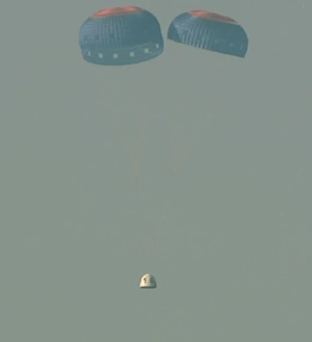
Image (Credit): Blue Origin’s NS-23 capsule returning to Earth after the mishap. (Blue Origin)

Delays and accidents are clear risks in the space industry, as we learned with the Artemis mission and now Blue Origin’s latest rocket launch. On Monday, a crewless New Shepard rocket launch (NS-23) went wrong, with the booster failing shortly after takeoff. Fortunately, the emergency system worked fine, indicating a crew would have returned safely in the capsule. In this case, the capsule was carrying a variety of experiments.

This same mission was scrubbed back on August 31st and September 1st due to weather issues. With this latest incident, future missions are on hold until the booster problem can be investigated by the Federal Aviation Administration. This was the first failure in the 23 New Shepard rocket missions launched to date.

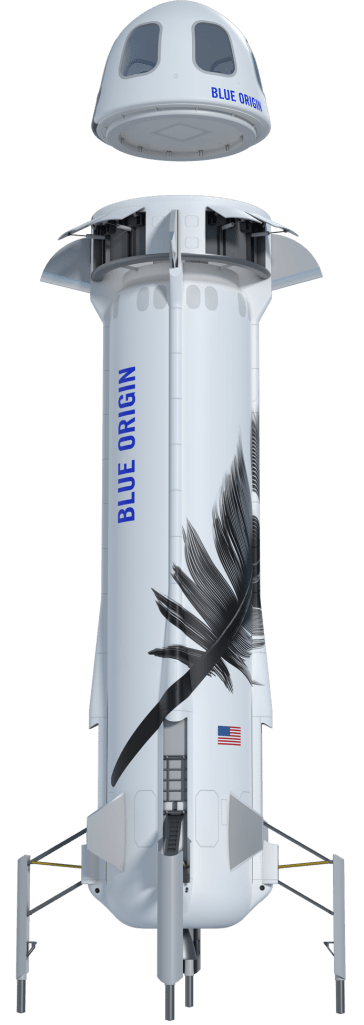
Image (Credit): Blue Origin’s New Shepard suborbital rocket system. (Blue Origin)

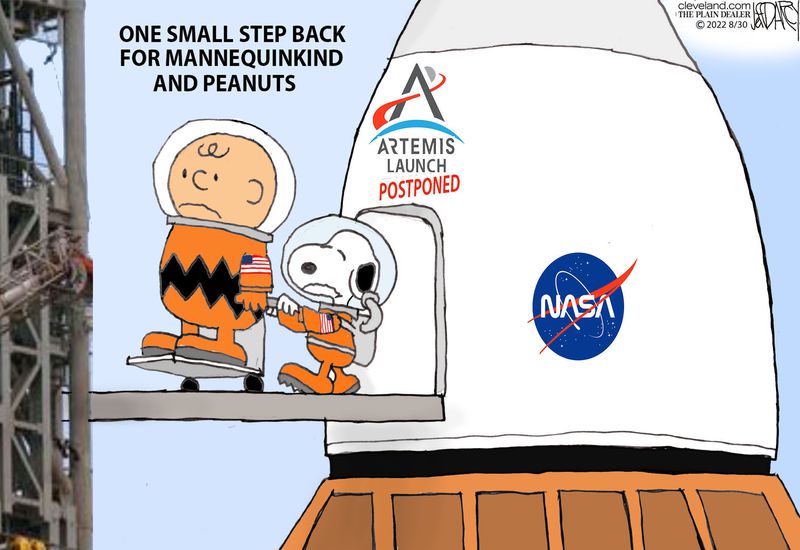
Artemis I: Still Looking for a Window

Credit: The Plain Dealer

According to Artemis blog, NASA is looking at a new Artemis I launch date of either September 23 or September 27. The blog states NASA has requested the following launch periods: 

  • Sept 23: Two-hour launch window opens at 6:47 a.m. EDT; landing on Oct. 18 
  • Sept. 27: 70-minute launch window opens at 11:37 a.m.; landing on Nov. 5 

Someone needs to update NASA’s Artemis I web-page, which as of today still shows a September 3, 2022 launch date.

Success is key for NASA to keep the momentum. Before the planned September 3rd launch, The Economist magazine (paper version) had an article titled “A Flying Turkey,” with the subtitle “The Space Launch System is yesterday’s rocket, powered by yesterday’s technology and brought about by yesterday’s thinking.” In addition to listing the Frankenstein approach used to cobble together a mission that makes reusable components non-reusable, it highlighted the ugly politics out of Alabama under Senator Shelby, calling the rocket system the “Senate Launch System.” The only endearing qualities of the Artemis missions appeared to be the commercial components under the last Artemis phase utilizing commercial partners.

This criticism is not new, but it will continue while NASA struggles to get Artemis I underway. We have already skipped out on the Moon for the last 50 years. Let’s get our heads back in the game!

A Fitting Tribute to Nichelle Nichols

Credit: Celestis

United Launch Alliance has announced that it will be sending the remains of Nichelle Nichols, also known as Star Trek’s Lt. Uhura, into space on a Vulcan Centaur rocket later this year in conjunction with the Celestis memorial program. About 150 memorial capsules in all with be part of what is named the “Enterprise Flight” (see the mission logo above). Others joining Ms. Nichols’ capsule include capsules for Star Trek creator Gene Roddenberry and his wife, as well as James Doohan, who played Scotty on the original Star Trek series.

The Enterprise Flight will launch from Cape Canaveral in Florida, with the capsules going more that 250 million miles into space. The Celestis website notes that more missions are being planned and memorial prices start at $2,495. However, if you want to be on the same flight as Lt. Uhura, prices start at $12,500 and you need to make your reservation by September 15th.

Mr. Roddenberry and others have been similarly honored as part of NASA’s space program. For instance, back in 1992 the remains of Gene Roddenberry were carried into space on Space Shuttle Columbia and later returned to Earth. It is not clear whether these same remains are now part of the Celestis mission. And let’s not forget the Carl Sagan Memorial Station on Mars, named back in 1997 (see below).

Image (Credit): NASA Mars Pathfinder mission site on Mars named the Carl Sagan Memorial Station. (NASA)