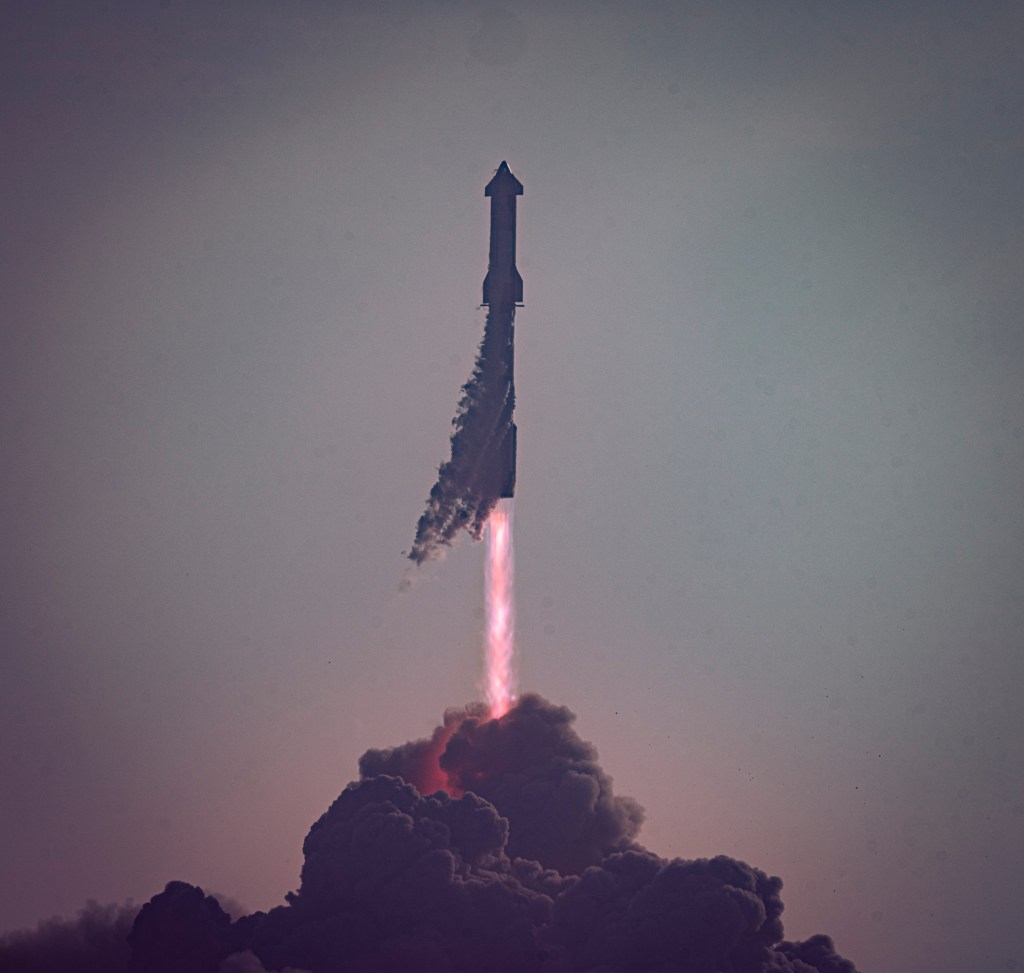
Image (Credit): April 20, 2023 launch of the Starship. (SpaceX)
We know that the April 20th Starship launch did a fair amount of damage to the Boca Chica, Texas launch site, so no one expected a second attempt in 30 days.
Now SpaceX is proposing a second launch as early as June 15, but asked the Federal Communications Commission (FCC) for a 6-month window just to be safe. Why the FCC? The Observerreports that the rocket is being billed as a satellite launcher for now.
We are still awaiting the Federal Aviation Administration’s (FAA) “mishap” investigation report on Starship’s earlier failure mid flight. All Starship launches have been halted until the investigation is complete.
SpaceX will also need some time to repair the launch facility. Hopefully, it plans to water-cool the engine blast this time. Once is folly, but twice is mismanagement.
NASA has pulled the plug on its Lunar Flashlight project, which was designed to look for sources of ice on our nearest neighbor. The agency spent the last few months trying, and failing, to get the craft to generate the necessary amount of thrust to get the small satellite to its intended destination. Officials say that the issue was likely caused by debris buildup in the fuel lines, which prevented the CubeSat from working to its full potential.
NASA’s Mars Perseverance rover has taken new images that reveal that some of the red planet’s ancient rivers were much wilder than scientists previously thought. “It’s the first time we’re seeing environments like this on Mars,” Katie Stack Morgan, Perseverance’s deputy project scientist, said in a NASA release. Scientists studying rock formations, features, and valleys on Mars, so far, have found evidence to suggest Mars was once covered by water.
Rocket Lab USA, Inc., a leading launch and space systems company, is preparing for the second of two dedicated Electron launches to deploy a constellation of storm monitoring satellites for NASA. The launch, called ‘Coming To A Storm Near You,’ is scheduled for lift-off no earlier than 17:30 on May 22nd NZST from Rocket Lab Launch Complex 1 on New Zealand’s Mahia Peninsula. The launch follows on from the successful ‘Rocket Like a Hurricane’ Electron launch on May 8th 2023, which deployed the first two CubeSats of NASA’s TROPICS constellation. The ‘Coming To A Storm Near You’ launch will deploy the final two TROPICS CubeSats, completing the constellation.
As the International Space Station nears the end of its life, SpaceX and Los Angeles-based startup Vast have unveiled a plan to launch the first commercial space station. SpaceX will use a Falcon 9 rocket to send the station’s main module, Haven-1, into low-Earth orbit as early as August 2025.
The second orbital mission of China’s robotic space plane has come to a close. The mysterious reusable vehicle touched down Monday (May 8) at the Jiuquan Satellite Launch Center in northwest China, wrapping up a 276-day mission to Earth orbit, according to China’s state-run Xinhua news agency.
Dmitry Rogozin was fired as director general of Russia’s main space corporation, Roscosmos, nearly a year ago. He has spent much of the time since near the front lines of Russia’s invasion of Ukraine, sharing various hateful, threatening, and nationalistic sentiments on his Telegram account. Occasionally, however, the pugnacious politician still opines about space on his “Rogozin at the Front” social media account. He did so this weekend, calling into question whether the United States really did land astronauts on the Moon.
The harm from the full launches will undoubtedly be greater than what was disclosed to the public. These damages may show up as shattered windows and the corpses of hundreds of dead shorebirds; immediate and obvious. Or they may not be entirely clear until years from now when SpaceX eventually closes shop on the Texas coast for greener pastures. The scars on the land, the people, and the wildlife won’t just disappear. They’ll linger, and hopefully, by then people will be willing to listen to the story.
He was right on the mark considering the mess left behind by the Starship after its test launch. While Elon Musk wanted to downplay the damage, the launch debris has led to a lawsuit against the Federal Aviation Administration (FAA) for allowing the launch to take place at all. The issue seems to be an FAA that probably trusted SpaceX too much on the Texas launch facility, which was initially procured for the smaller Falcon 9 rocket launches rather than the Starship monster that is tearing up the pad.
This is not good for SpaceX, nor is it good for the commercial space industry. Mr. Musk has already caused enough problems in other industries without tarnishing the commercial space industry with a “devil may care” attitude.
As the podcast story notes, he stands to divide the public on space programs. The choice does not need to be protecting the environment or traveling to space. We can do both, and we need some grown-ups at SpaceX to understand this.
Image (Credit): Crater at the Starship launchpad after the April 20th test. (LabPadre/YouTube)
“The debris is really just basically sand and rock, so it’s not toxic at all or anything…It’s just like a sandstorm, essentially. Basically a human-made sandstorm. But we don’t want to do that again.”
–Statement by SpaceX’s Elon Musk last Saturday regarding the April 20th launch of the Starship and the debris it scattered for miles around the launch site. Mr. Musk now says he should have waited until a “flame trench” water system had been installed to absorb the heat from the launch. Instead, the launch acted like a blowtorch on the concrete, destroying the pad and flinging debris as far as 6.5 miles from the launch site. Mr. Musk has many new ideas, such as reusable rockets, that make a lot of sense. But ignoring the knowledge gained from past missions, such as the need for a flame trench, was not very smart on his part.