Podcast: Lori Garver on NASA and Commercial Space

Credit: Amazon

This week’s StarTalk podcast with Neil deGrasse Tyson included an interview with former Deputy Administrator of NASA, Lori Garver. She is author of a new book, Escaping Gravity: My Quest to Transform NASA and Launch a New Space Age, which has a number of reviewer quotes, including the one from Elon Musk below.

In addition to the dialog about her time with NASA and the growing role of commercial space providers, the dialogue also gets into specific projects, including potential plans to mine asteroids. One asteroid in particular, Psyche (located in the asteroid belt), was cited as an asteroid of special interest because it contains what some believe to be the core of a failed planet, which means plenty of expensive metals.

NASA currently has plans to launch a spacecraft later this year to visit Psyche. The objectives are to:

  • Determine whether Psyche is a core, or if it is unmelted material.
  • Determine the relative ages of regions of Psyche’s surface.
  • Determine whether small metal bodies incorporate the same light elements as are expected in the Earth’s high-pressure core.
  • Determine whether Psyche was formed under conditions more oxidizing or more reducing than Earth’s core.
  • Characterize Psyche’s topography.

I recommend you listen to the full podcast story and also stayed tuned for the upcoming asteroid adventure.

Image (Credit): Quote regarding Ms. Garver’s latest book. (Amazon)

Update: The Psyche mission has been delayed. NASA noted:

Due to the late delivery of the spacecraft’s flight software and testing equipment, NASA does not have sufficient time to complete the testing needed ahead of its remaining launch period this year, which ends on Oct. 11.

A launch is possible as early as next year, but NASA is now going over all the options.
Astra Rocket Failure Impacts TROPICS Mission

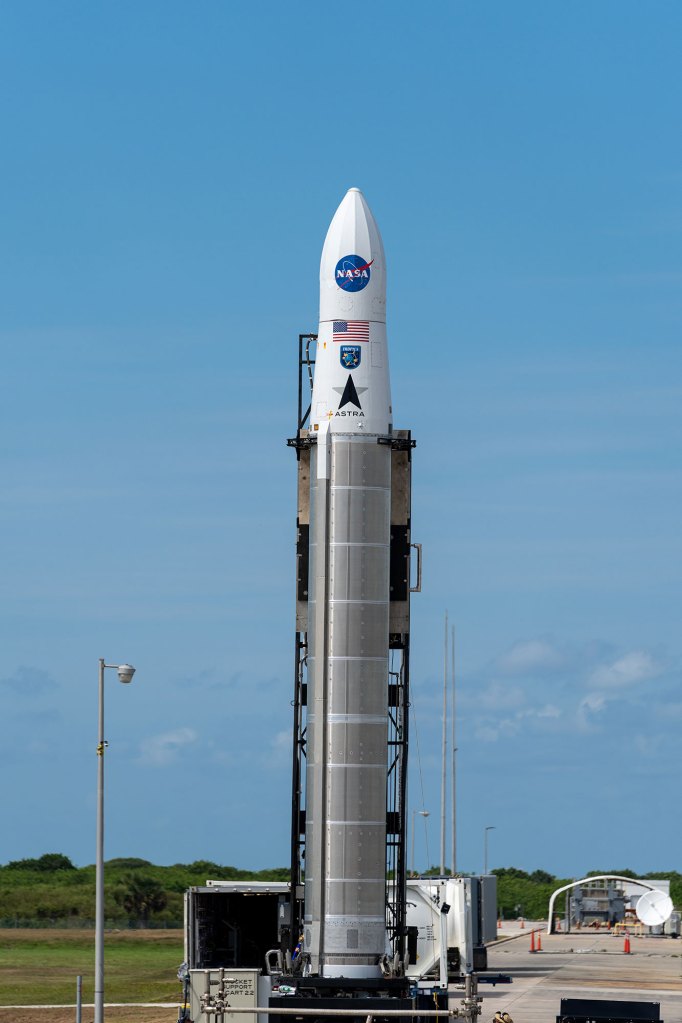
Image (Credit): Astra rocket for the TROPICS satellites. (Astra)

This weekend we witnessed another example that space operations are risky. On Sunday, Astra’s Rocket LV0010 launched from Cape Canaveral but was unable to place two satellites into orbit. The satellites were part of NASA’s TROPICS-1 mission. The main issue was the engine on the upper portion of the rocket.

As described by Astra on its website, the launch of the Time-Resolved Observations of Precipitation structure and storm Intensity with a Constellation of Smallsats (TROPICS) mission was awarded to Astra in February of this year and “consists of a constellation of six small satellites that will observe tropical cyclones, aiming to improve the scientific community’s understanding of these dangerous weather events.” This was the first of three such launches, leaving four satellites untouched and ready to go once Astra, NASA, and the Federal Aviation Administration figure out what happened this weekend.

This is not the first NASA mishap. Back in February, Rocket LV0008 (also launched from Cape Canaveral) suffered an in-flight anomaly during stage separation. As a result, NASA’s Educational Launch of Nanosatellites (ELaNa 41) mission to place CubeSats into orbit failed. CubeSats are miniature satellites designed to provide a low-cost plat­form for NASA missions.

Astra is a relatively new entrant to in the commercial space industry having been founded in 2016. Let’s hope the lessons learned from this mishap and persistence will allow the company to thrive in this competitive and risky industry.

The Chinese Elon Musk?

Credit: Geely Auto

Have you read about the Chinese car company with space ambitions? In a June 2 press release, we learn that a unit of the Chinese automaker Geely (owner of Volvo, Polestar, and Group Lotus) already sent 9 communications satellites into orbit this year, with plans for a total of 240 such satellites in a constellation that will assist car drivers with autonomous driving.

Of course, automaker Elon Musk is also launching satellites into space as part of the Starlink program, but that is about the end of the similarities for now. In addition to planning to launch fewer satellites with a more restricted mission, Geely will depend upon Chinese government rockets to launch these satellites. Mr. Musk has his own SpaceX rockets to assist Starlink.

That does not mean Geely lacks in ambition elsewhere. In the same press release, Geely stated:

With the successful launch and operation of Geespace’s first satellites, the company will become one of the world’s first providers of combined commercial Precise Point Positioning and Real-Time Kinematic services (PPP-RTK)…

Tony Wang, CEO and Chief Scientist of Geespace said: “Many favourable factors such as policy support and market demand is accelerating the growth of the commercial aerospace sector...new opportunities to develop have been opened in various sectors including smart mobility, consumer electronics, unmanned systems, smart cities, and environmental protection.”

And while Geely is not building rockets at this time, it is building satellites:

Early in September 2021, Geely’s Intelligent Satellite Production and Testing Centre began mass production of commercial satellites with an annual production capacity of 500 units. Through intelligent modular manufacturing, Geespace is able to produce high-quality, easily customizable satellites to meet the growing global demand for commercial satellites. The GeeSAT-1 is only the first of many new satellite models from Geespace and its successful launch into orbit is just the first of many to come.

Watch out, Elon!

A New Suit for the Moon Mission

Image (Credit): Space suits in the television series Lost in Space. (Netflix)

U.S. companies Axiom Space and Collins Aerospace have been tasked to build new suits for NASA’s astronauts. The suits will be worn as part of the Artemis Program returning astronauts to the Moon. First, the new suits will be tested and used on the International Space Station (ISS).

While both companies are still in the early stages of developing the next space suite, the $3.5 billion Extravehicular Activity Services (xEVAS) Contract will support this development and production.

In a press release, Mark Kirasich, deputy associate administrator of NASA’s Artemis Campaign Development Division, stated:

Our commercial partnerships will help realize our human exploration goals…We look forward to using these services for NASA’s continued presence in low-Earth orbit and our upcoming achievement of returning American astronauts to the Moon’s surface. We are confident our collaboration with industry and leveraging NASA’s expertise gained through over 60 years of space exploration will enable us to achieve these goals together.

You may recognize the name Axiom Space. It was the company that worked with SpaceX to put private citizens on the ISS with its Axiom Mission 1 (Ax-1). It is also developing the world’s first commercial space station, the Axiom Station.

Collins Aerospace, part of Raytheon Technologies, has plenty of experience with space suits. The company designed the spacesuit used by the Apollo mission astronauts who landed on the moon. It also designed the space suits currently in use for missions outside the ISS.

In Case You Missed It: Public Views on the Space Program

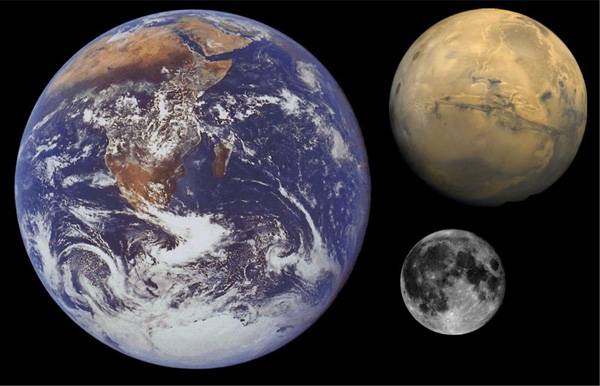
Image (Credit): Size of the Earth compared to Mars and the Moon. (hyperphysics.phy-astr.gsu.edu/)

Back in July 2019, the Pew Research Institute issued the results of earlier surveys about the US space program. Let’s look at the answers to six of the questions:

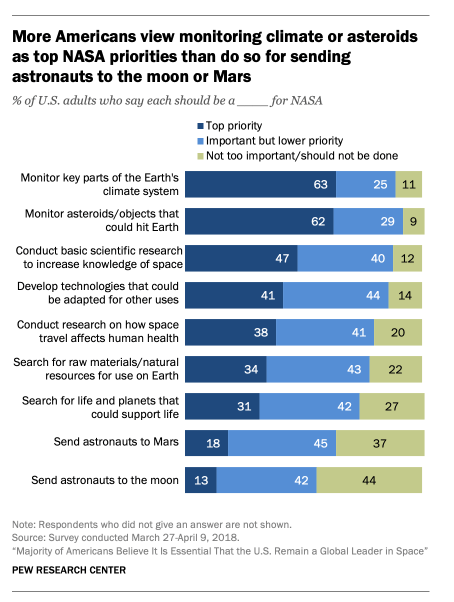
  1. Most Americans think sending astronauts to Mars or the Moon should be a lower priority for NASA – or say it should not be done at all (see graphic below).
  2. Americans see priorities other than a Moon or Mars landing as more pressing for NASA.
  3. Half of Americans think space travel will become routine during the next 50 years of space exploration.
  4. A majority of Americans say the U.S. must remain a global leader in space exploration, and that NASA’s continued involvement is essential.
  5. Americans have little confidence that private space companies will minimize space debris. 
  6. Americans are not enthusiastic about the idea of creating a military Space Force.

NASA may not be listening given that a trip back to the Moon was the lowest priority of Americans and yet is it the largest program currently in the U.S. space program, with a Moon satellite and trip to Mars as part of future plans. As far as minimizing space debris, the public seemed right on the mark regarding private space companies. If Elon Musk is any indicator, the commercial sector will not be deterred as it adds thousands of new satellites and related debris. And the ship has sailed on the Space Force question with the creation of the US Space Force in December 2019.

This would not be the first time Washington, DC goes down its own path regardless of public sentiment.

Image (Credit): Second question on the Pew survey on the space program. (Pew Research Institute)