Podcast: Two Worlds Collide in This Episode

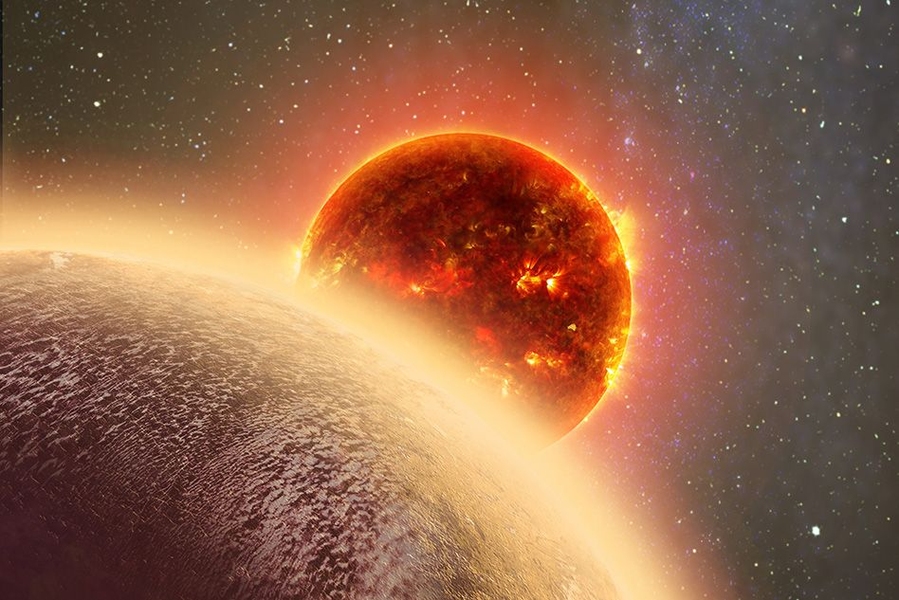
Image (Credit): Artist’s rending of exoplanet GJ 1132b. (MIT News)

If you are looking for a fun podcast this week, you cannot go wrong with Neil DeGrasse Tyson’s Startalk podcast when it hosts Cool Worlds‘ creator David Kipping. The episode, Cosmic Queries – Cool Worlds with David Kipping, covers questions related to exoplanets, exomoons, and more. It is fun to hear the two scientists play off each other.

You will also learn from this podcast that Cool Worlds should be releasing its own podcast in the near future. Its Youtube videos are already a great source of information, so I expect more of the same in these podcasts.

At the end of the podcast, Professor Kipping also mentioned a few upcoming space missions related to exoplanets, including the European PLAnetary Transits and Oscillations of stars (Plato) mission in 2026. You can learn more about the mission from this European Space Agency factsheet, which notes:

Does a second Earth exist in the Universe? Planet hunter Plato will focus on the properties of rocky planets orbiting Sun-like stars. In particular, Plato will discover and characterise planets in orbits up to the habitable zone – the ‘goldilocks’ region around a star where the temperature is just right for liquid water to exist on a planet’s surface.

Plato will characterise hundreds of rocky (including Earth twins), icy or giant planets by providing exquisite measurements of their radii (3% precision), masses (better than 10% precision) and ages (10% precision). This will revolutionise our understanding of planet formation and the evolution of planetary systems, as well as the potential habitability of these diverse worlds.

As well as looking at these planets, Plato will analyse their host stars. Using data from the mission, scientists hope to perform stellar seismology, gathering evidence of ‘starquakes’ in the imaged stars. This will give insight into the characteristics and evolution of the stars, improving our understanding of entire planetary systems.

It’s a fun, fact-filled show worth your time.

Study Findings: Direct Imaging and Astrometric Detection of a Gas Giant Planet Orbiting an Accelerating Star

Image (Credit): Artist’s rendering of Gaia mapping the stars of the Milky Way. (European Space Agency)

Science abstract:

Direct imaging of gas giant exoplanets provides information on their atmospheres and the architectures of planetary systems. However, few planets have been detected in blind surveys with direct imaging. Using astrometry from the Gaia and Hipparcos spacecraft, we identified dynamical evidence for a gas giant planet around the nearby star HIP 99770. We confirmed the detection of this planet with direct imaging using the Subaru Coronagraphic Extreme Adaptive Optics instrument. The planet, HIP 99770 b, orbits 17 astronomical units from its host star, receiving an amount of light similar to that reaching Jupiter. Its dynamical mass is 13.9 to 16.1 Jupiter masses. The planet-to-star mass ratio [(7 to 8) × 10−3] is similar to that of other directly imaged planets. The planet’s atmospheric spectrum indicates an older, less cloudy analog of the previously imaged exoplanets around HR 8799.

Citation: Thayne Currie, G. Mirek Brandt, Timothy D. Brandt, Brianna Lacy, Adam Burrows, Olivier Guyon, Motohide Tamura, Ranger Y. Liu, Sabina Sagynbayeva, Taylor Tobin, Jeffrey Chilcote, Tyler Groff, Christian Marois, William Thompson, Simon J. Murphy, Masayuki Kuzuhara, Kellen Lawson, Julien Lozi, Vincent Deo, Sebastien Vievard, Nour Skaf, Taichi Uyama, Nemanja Jovanovic, Frantz Martinache, N. Jeremy Kasdin, Tomoyuki Kudo, Michael McElwain, Markus Janson, John Wisniewski, Klaus Hodapp, Jun Nishikawa, Krzysztof Hełminiak, Jungmi Kwon, Masahiko Hayashi. Direct imaging and astrometric detection of a gas giant planet orbiting an accelerating star. Science (2023).
https://doi.org/10.1126/science.abo6192

Study-related stories:

The Juice Mission has Started

Image (Credit): The successful launch of the ESA’s Juice mission from Kourou, French Guiana on April 14, 2023. (ESA/M. Pédoussaut and ESA/CNES/Arianespace/Optique Vidéo du CSG/JM Guillon)

Earlier today, the European Space Agency’s (ESA) Jupiter Icy Moons Explorer (Juice)  mission successfully launched from French Guiana. It is the start of a long trip to the Jovian planet and its moons. The spacecraft will not reach Jupiter until July 2031. You can watch of video of the launch here. ESA has numerous other videos on the mission here.

ESA Director General Josef Aschbacher stated:

ESA, with its international partners, is on its way to Jupiter…Juice’s spectacular launch carries with it the vision and ambition of those who conceived the mission decades ago, the skill and passion of everyone who has built this incredible machine, the drive of our flight operations team, and the curiosity of the global science community. Together, we will keep pushing the boundaries of science and exploration in order to answer humankind’s biggest questions.

It is another great step forward in the exploration of our home solar system as we scan the skies for other more distant systems.

Image (Credit): Juice mission patch. (ESA)

Volunteers Wanted to Help Classify Stars

Image (Credit): Artist’s rendering of the Gaia probe floating at a Lagrangian point beyond the Earth-Moon system, also called L2. (ESA/D. Ducros, 2013)

The European Space Agency (ESA) is looking for amateur astronomers to assist with its review of data from its Gaia Mission. What is the Gaia Mission you ask? The ESA site explains this and much more:

The mission was launched in late 2013 and now lies some 1.5 million km from Earth. With its two powerful telescopes and three science instruments, Gaia is creating the largest and most precise 3D map of the Milky Way. It does so by determining the position of its target stars and registering how they change throughout time.

So far, Gaia has measured 1.8 billion stars with unprecedented precision, the richest star catalogue to date. Gaia’s third major data release, published in 2022, includes 10.5 million variable sources over the entire sky, identified using machine learning methods in a supervised classification scheme.

That’s a lot of data. ESA is now looking for assistance classifying the variable stars, which are the stars that change in brightness over time. This is being done under an ESA-funded citizen science project call the Gaia Vari.

As of today, the project already has over 520 volunteers. You can be one more.

Go here to learn more and be part of the fun.

Space Mission: ESA’s Juice Mission

Image (Credit): Upper stage of the Ariane 5 rocket that will launch ESA’s Juice mission. (ESA)

On April 13th, the European Space Agency (ESA) will launch its Jupiter Icy Moons Explorer (Juice) mission from French Guiana. The purpose of the mission is to conduct a detailed study of Jupiter as well as three of its moons (and their oceans) – Ganymede, Callisto and Europa. The spacecraft will eventually go into orbit around Ganymede, which will be the first orbit of a moon in our solar system other than Earth’s Moon.

The key milestones for the mission are listed below and shown in greater detail within the graphic as well:

February 2023: Juice arrives in French Guiana

April 13, 2023: Launch on Ariane-5 rocket

July 2031: Arrival at Jupiter

-July 2031 – November 2034: 35 icy moon flybys

December 2034: Arrival at Ganymede

Image (Credit): Juice mission milestones. (ESA JUICE Launch Kit)

In addition to ESA/European scientific instruments and equipment, the spacecraft will also carry items from NASA, the Japan Aerospace Exploration Agency, and the Israel Space Agency.

The delayed arrival at Jupiter relates to the need for multiple flybys cover this great distance. In The Financial Times, Justin Byrne, head of science for lead contractor Airbus, stated, “Ariane-5 is a very powerful rocket but it can only give us about half the energy we need to get to Jupiter…We get the rest by doing planetary fly-bys, each one giving us a gravitational assist through a slingshot manoeuvre.”

The ESA put together a useful Launch Kit that answers any question you may have about the Juice mission, as well as related missions.