Pic of the Week: The Cartwheel Galaxy

Image (Credit): The Cartwheel Galaxy, located about 500 million light-years away, as captured by the JWST. (NASA, ESA, CSA, STScI)

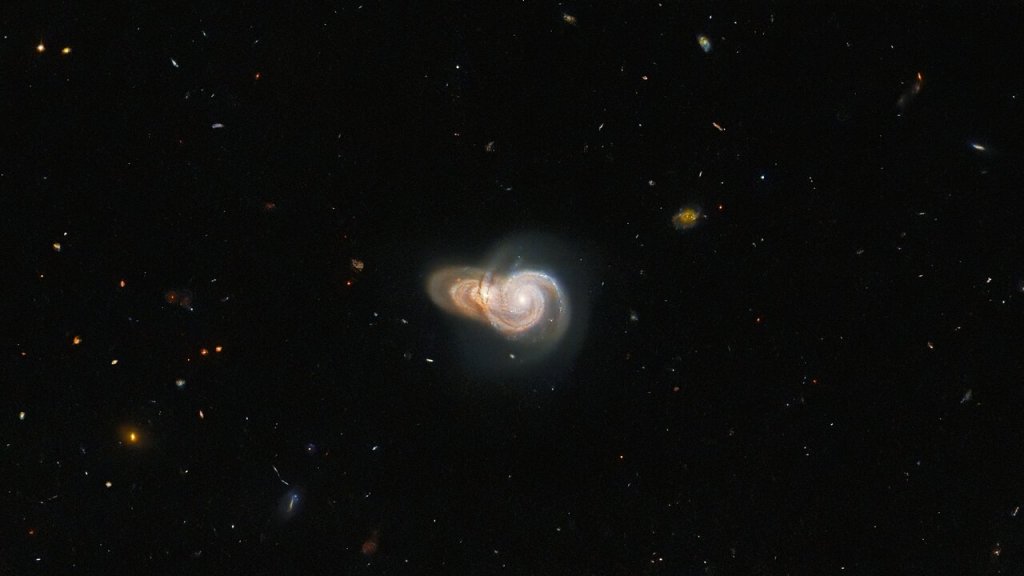
This week’s picture is one of the latest images from the James Webb Space Telescope (JWST). It shows the Cartwheel Galaxy, which is about 500 million light-years away. The Hubble’s view of this same galaxy is provided below.

Here is a little more from NASA:

NASA’s James Webb Space Telescope has peered into the chaos of the Cartwheel Galaxy, revealing new details about star formation and the galaxy’s central black hole. Webb’s powerful infrared gaze produced this detailed image of the Cartwheel and two smaller companion galaxies against a backdrop of many other galaxies. This image provides a new view of how the Cartwheel Galaxy has changed over billions of years.

The Cartwheel Galaxy, located about 500 million light-years away in the Sculptor constellation, is a rare sight. Its appearance, much like that of the wheel of a wagon, is the result of an intense event – a high-speed collision between a large spiral galaxy and a smaller galaxy not visible in this image. Collisions of galactic proportions cause a cascade of different, smaller events between the galaxies involved; the Cartwheel is no exception.

The collision most notably affected the galaxy’s shape and structure. The Cartwheel Galaxy sports two rings — a bright inner ring and a surrounding, colorful ring. These two rings expand outwards from the center of the collision, like ripples in a pond after a stone is tossed into it. Because of these distinctive features, astronomers call this a “ring galaxy,” a structure less common than spiral galaxies like our Milky Way.

The bright core contains a tremendous amount of hot dust with the brightest areas being the home to gigantic young star clusters. On the other hand, the outer ring, which has expanded for about 440 million years, is dominated by star formation and supernovas. As this ring expands, it plows into surrounding gas and triggers star formation.

Image (Credit): An image of the Cartwheel Galaxy taken with the NASA/ESA Hubble Space Telescope. (ESA/Hubble & NASA)

In Case You Missed It: Hubble Finds Water on an Exoplanet

Image (Credit): Recent JWST analysis of exoplanet WASP-96 b. (NASA, ESA, CSA, and STScI)

The recent James Webb Space Telescope (JWST) images included hot gas giant exoplanet WASP-96 b, with NASA noting that the space telescope “…has captured the distinct signature of water, along with evidence for clouds and haze, in the atmosphere surrounding a hot, puffy gas giant planet orbiting a distant Sun-like star.”

The same NASA article also noted that the Hubble Space Telescope had found the first evidence of water on a exoplanet back in 2013. So I thought I would dig out that earlier from the European Space Agency, titled “Hubble Finds Water Vapour on Habitable-Zone Exoplanet for the First Time“:

With data from the NASA/ESA Hubble Space Telescope, water vapour has been detected in the atmosphere of a super-Earth within the habitable zone by University College London (UCL) researchers in a world first. K2-18b, which is eight times the mass of Earth, is now the only planet orbiting a star outside the Solar System, or exoplanet, known to have both water and temperatures that could support life.

The parent star, K2-18, is 110 light years from Earth in the constellation of Leo. Maybe we can convince the ESA and others to take another look with the JWST, assuming it is not already on the list of many upcoming projects.

JWST: An Impressive List of Priorities

Image (Credit): Stephan’s Quintet, representing a grouping of five galaxies, as captured by the JWST. (NASA, ESA, CSA, and STScI)

I think we are all eager for more amazing photos from the James Webb Space Telescope, but we need to remember that the space telescope has a long list of priorities and these were not simply random images. An international committee with representatives from NASA, the European Space Agency (ESA), the Canadian Space Agency (CSA), and the Space Telescope Science Institute (STScI) decided on the future work of the space telescope.

The committee has shared these five missions represented by the images already released to the public, indicating the JWST has been pretty busy already:

  • Carina Nebula: The Carina Nebula is one of the largest and brightest nebulae in the sky, located approximately 7,600 light-years away in the southern constellation Carina. Nebulae are stellar nurseries where stars form. The Carina Nebula is home to many massive stars several times larger than the Sun.
  • WASP-96b (spectrum): WASP-96b is a giant planet outside our solar system, composed mainly of gas. The planet, located nearly 1,150 light-years from Earth, orbits its star every 3.4 days. It has about half the mass of Jupiter, and its discovery was announced in 2014.
  • Southern Ring Nebula: The Southern Ring, or “Eight-Burst” nebula, is a planetary nebula – an expanding cloud of gas surrounding a dying star. It is nearly half a light-year in diameter and is located approximately 2,000 light-years away from Earth.
  • Stephan’s Quintet: About 290 million light-years away, Stephan’s Quintet is located in the constellation Pegasus. It is notable for being the first compact galaxy group ever discovered in 1787. Four of the five galaxies within the quintet are locked in a cosmic dance of repeated close encounters.
  • SMACS 0723: Massive foreground galaxy clusters magnify and distort the light of objects behind them, permitting a deep field view into both the extremely distant and intrinsically faint galaxy populations.

So what else is planned? NASA believes the JWST can stay in operation for the next 5 to 10 years, so it has a fair amount of time to allocate to scientists. This link takes you to the 266 approved projects for the telescope’s first year, representing approximately 6,000 hours of JWST prime time and up to 1,231 hours of parallel time. For instance, during the first year you have “Exoplanets and Disks” projects such as:

  • Icy Kuiper Belts in Exoplanetary Systems;
  • Unlocking the Mysteries of the Archetype Sub-Neptune GJ1214b with a Full-Orbit Phase Curve;
  • A Search for the Giant Planets that Drive White Dwarf Accretion;
  • Tell Me How I’m Supposed To Breathe With No Air: Measuring the Prevalence and Diversity of M-Dwarf Planet Atmospheres; and
  • Diamonds are Forever: Probing the Carbon Budget and Formation History of the Ultra-Puffy Hot Jupiter WASP-127b.

That is just a sample, but you can see from some of that titles that the scientists are having fun. Expect hundreds of new discoveries this year resulting from these observations.

European/Russian Rover Coordination Now Dead

Image (Credit): Drawing of the ESA’s ExoMars martian rover called the Rosalind Franklin. (ESA)

The European Space Agency (ESA) has decided to terminate cooperation with Russia on the ExoMars rover mission. The joint mission, planned for September 2022, was suspended earlier this year after Russia invaded Ukraine. The ESA has now cut all links on the project and hopes to work with NASA on some aspects of the mission.

The rover, named the Rosalind Franklin, would be the first European rover to visit Mars. It is designed to explore the surface of Mars as well as collect and analyse samples. The plan is to land the rover at a site with high potential for finding well-preserved organic material, particularly from the very early history of the planet.

Both Covid and the war in Ukraine have delayed the rover mission, but the ESA will see it through, alone if necessary, but hopefully with others. Maybe Russia can be a partner again in the future, but it will need new leadership that knows how to play well with others.

JWST: An Early Image of Galaxies

Image (Credit): Galaxy cluster SMACS 0723. (NASA, ESA, CSA, and STScI)

Earlier today, President Biden released one of the first images (shown above) from the James Webb Space Telescope (JWSP). A full release is scheduled for tomorrow at this location: https://www.nasa.gov/webbfirstimages.

The image shows galaxy cluster SMACS 0723, which represents thousands of galaxies in a patch of sky approximately the size of a grain of sand held at arm’s length by someone on the ground.

Here is a little more from NASA on what we are seeing:

The image shows the galaxy cluster SMACS 0723 as it appeared 4.6 billion years ago. The combined mass of this galaxy cluster acts as a gravitational lens, magnifying much more distant galaxies behind it. Webb’s NIRCam has brought those distant galaxies into sharp focus – they have tiny, faint structures that have never been seen before, including star clusters and diffuse features. Researchers will soon begin to learn more about the galaxies’ masses, ages, histories, and compositions, as Webb seeks the earliest galaxies in the universe.

It’s certainly a good start. Stay tuned for more.