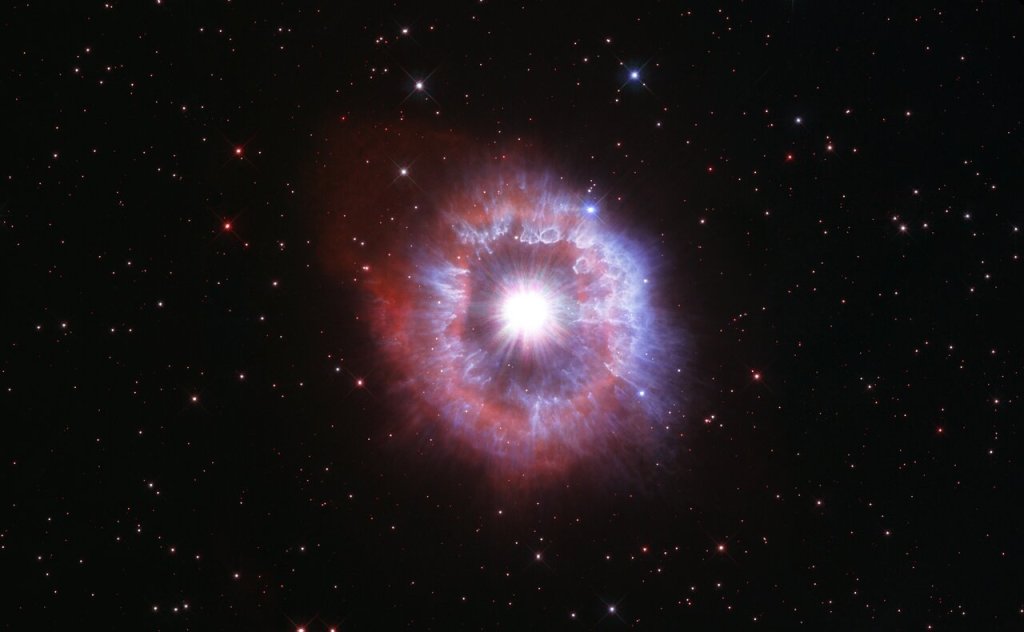
The giant star…is waging a tug-of-war between gravity and radiation to avoid self-destruction. The star, called AG Carinae, is surrounded by an expanding shell of gas and dust — a nebula — that is shaped by the powerful winds of the star. The nebula is about five light-years wide, which equals the distance from here to our nearest star, Alpha Centauri.
The huge structure was created from one or more giant eruptions several thousand years ago. The star’s outer layers were blown into space, the expelled material amounting to roughly 10 times the mass of our Sun. These outbursts are typical in the life of a rare breed of star called a Luminous Blue Variable (LBV), a brief unstable phase in the short life of an ultra-bright, glamorous star that lives fast and dies young. These stars are among the most massive and brightest stars known. They live for only a few million years, compared to the roughly 10-billion-year lifetime of our own Sun. AG Carinae is a few million years old and resides 20,000 light-years away inside our Milky Way galaxy. The star’s expected lifetime is between 5 million and 6 million years.
With all the previous posts about NASA’s Artemis mission, I should have outlined the three stages ahead as we return to the Moon:
Artemis I: This stage involves an uncrewed flight test around the Moon. The new Space Launch System carrying the empty Orion spacecraft will launch from NASA’s Kennedy Space Center in Florida. The mission will last from four to six weeks. The European Space Agency has supplied a key piece for this mission – a service module, which will supply the spacecraft’s main propulsion system and power (and also house air and water for astronauts on future missions).
Artemis II: This next stage will confirm all of the Orion spacecraft’s systems operate as designed with crew aboard in the actual environment of deep space as the spacecraft circles the Moon. The mission is expected to last just over 10 days
Artemis III: This third and final stage will land a crew on the surface of the Moon. NASA has awarded Human Landing System contracts to Blue Origin, Dynetics, and SpaceX. This final stage will be followed by annual crewed missions to the Moon.
The ultimate goal of Artemis is to establish a presence on the Moon as well as build an orbiting Gateway that can serve as a multi-purpose outpost providing essential support for long-term human return to the lunar surface. The Gateway will also serve as a staging points for deep space exploration, such as travel to Mars.
This is a broad and hopeful mission. The only thing that seems a bit odd is the website mission statement for Artemis:
With Artemis missions, NASA will land the first woman and first person of color on the Moon, using innovative technologies to explore more of the lunar surface than ever before. We will collaborate with commercial and international partners and establish the first long-term presence on the Moon. Then, we will use what we learn on and around the Moon to take the next giant leap: sending the first astronauts to Mars.
I think the first focus of this multi-billion dollar lunar mission should be space exploration, which should also include a diverse crew. Maybe it is better to stick to the more universal statement in the earlier Artemis Plan:
Under the Artemis program, humanity will explore regions of the Moon never visited before, uniting people around the unknown, the never seen, and the once impossible. We will return to the Moonrobotically beginning next year, send astronauts to the surface within four years, and build a longterm presence on the Moon by the end of the decade…we will use the Moon as the stepping stone for our next greatest leap—human exploration of Mars.
You say potato and I say spuds.
Source/Credit: Artemis I mission map from NASA.
Note: NASA’s Artemis page was somewhat out of date when I posted this summary. For instance, in April 2021, SpaceX was chosen to provide the lunar lander.
Update: On March 31st, NASA announced it was looking for “…other U.S. companies to provide new lander development and demonstration missions from lunar orbit to the surface of the Moon.”
Source/Credit: Venus from Mattias Malmer/NASA/JPL..
NBC news reports that a privately-funding space probe could visit Venus as early as next year as phase one of a three-part mission. The goal of the Venus Life Finder Mission, involving MIT alumni and Rocket Lab, is to search for signs of life or microbial-type life. This effort is another encouraging sign of increased interest in scientific missions throughout the solar system.
An earlier press release on the Venus Life Finder site stated:
The Venus Life Finder Missions are a series of focused astrobiology mission concepts to search for habitability, signs of life, and life itself in the Venus atmosphere. While people have speculated on life in the Venus clouds for decades, we are now able to act with cost-effective and highly-focused missions. A major motivation are unexplained atmospheric chemical anomalies, including the “mysterious UV-absorber”, tens of ppm O2, SO2 and H2O vertical abundance profiles, the possible presence of PH3 and NH3, and the unknown composition of Mode 3 cloud particles. These anomalies, which have lingered for decades, might be tied to habitability and life’s activities or be indicative of unknown chemistry itself worth exploring. Our proposed series of VLF missions aim to study Venus’ cloud particles and to continue where the pioneering in situ probe missions from nearly four decades ago left off. The world is poised on the brink of a revolution in space science. Our goal is not to supplant any other efforts but to take advantage of an opportunity for high-risk, high-reward science, which stands to possibly answer one of the greatest scientific mysteries of all, and in the process pioneer a new model of private/public partnership in space exploration.
It has been more than a decade since a government has sent a mission to Venus. The last US mission to Venus was the Magellan launched in May 1989, which started to orbit Venus in 1990 and continued to do so for four years. The European Space Agency sent the Venus Express to the planet in November 2005, while Japan sent the Akatsuki in May 2010.
Interest continues among government parties. For example, just last year NASA announced two new missions to Venus:
— DAVINCI+ (Deep Atmosphere Venus Investigation of Noble gases, Chemistry, and Imaging) to measure the composition of Venus’ atmosphere to understand how it formed and evolved, as well as determine whether the planet ever had an ocean. The mission consists of a descent sphere that will plunge through the planet’s thick atmosphere, making precise measurements of noble gases and other elements to understand why Venus’ atmosphere is a runaway hothouse compared the Earth’s. It will also will return the first high resolution pictures of the unique geological features on Venus known as “tesserae,” which may be comparable to Earth’s continents, suggesting that Venus has plate tectonics.
— VERITAS (Venus Emissivity, Radio Science, InSAR, Topography, and Spectroscopy) to map Venus’ surface to determine the planet’s geologic history and understand why it developed so differently than Earth. In addition, it will map infrared emissions from Venus’ surface to map its rock type, which is largely unknown, and determine whether active volcanoes are releasing water vapor into the atmosphere.
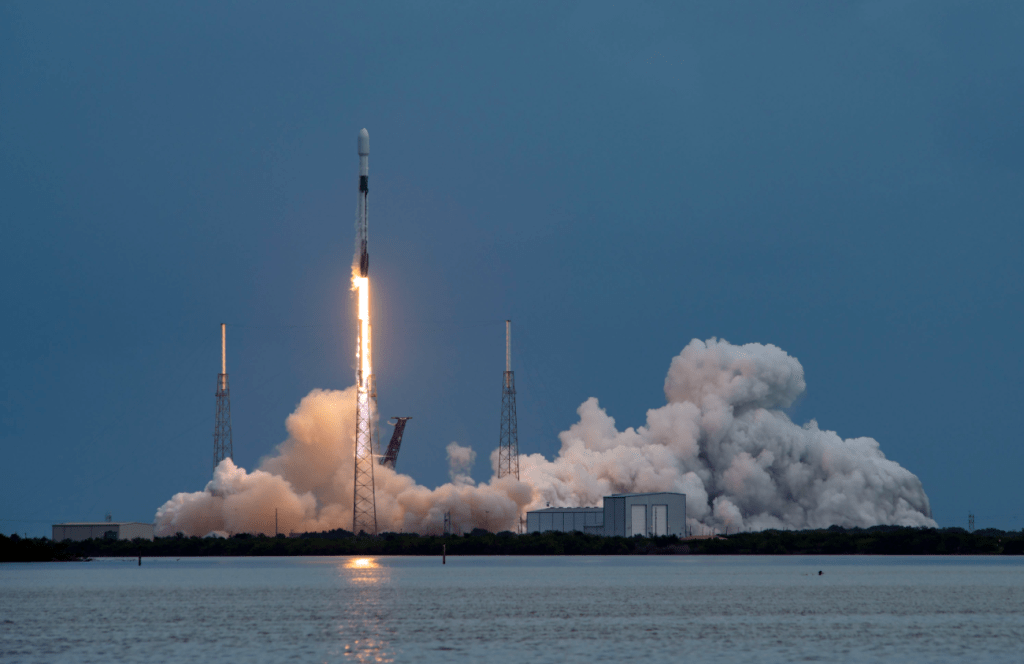
You may have remembered my earlier post showing all of the items already in orbit around the Earth. Well, it appears Elon Musk believes we can handle billions of satellites in low Earth orbit (LEO). And while the current number of orbiting satellites is only in the thousands, Mr. Musk’s SpaceX has already placed 1,700 Starlink satellites in LEO, with plans for a total of 42,000 such satellites under the program.
Not everyone agrees with unchecked growth. Josef Aschbacher, the European Space Agency’s (ESA) director-general, stated, “You have one person owning half of the active satellites in the world. That’s quite amazing. De facto, he is making the rules.” I agree with the ESA about the need for some rules in this area given the rapid growth. And we may need to look a little deeper into that “billions” number. Mr. Musk has been known to overstate things.
Mr. Musk is part of the move fast and break things club. Yet that can lead to problems when the things breaking up are expensive satellites leaving debris in their wake. We may need to find a better way.
Source: October 24, 2021 launch of SpaceX’s Falcon 9 rocket carrying 60 Starlink satellites to orbit from Space Launch Complex 40 at Cape Canaveral Air Force Station in Florida. See the SpaceX press release, which contains this image.
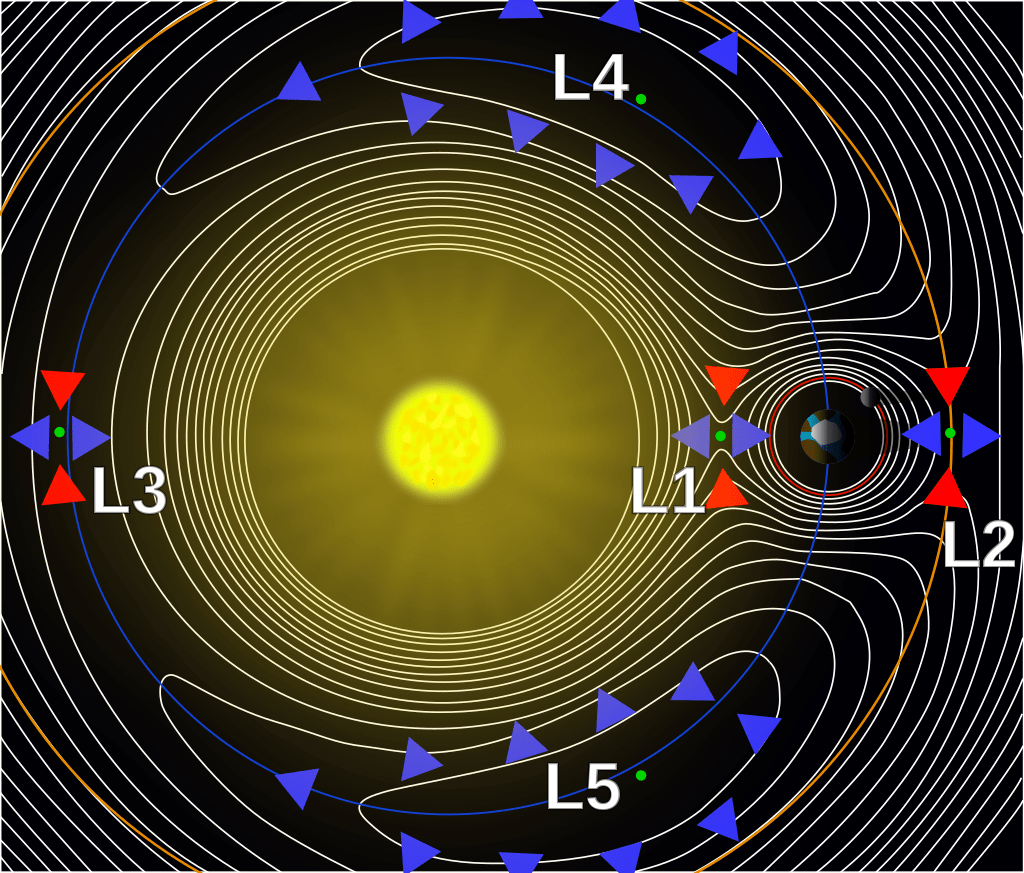
Now that the James Webb Space Telescope (JWSP) has deployed its 21-foot, gold-coated primary mirror, it is in good shape as it heads for the Sun-Earth’s second Lagrange point, known as L2, which is nearly 1 million miles from Earth. However, it will not be the first spacecraft to park in this spot to conduct a scientific mission.
I looked around to get a good inventory of what was operating, and will be operating, at L2 when JWST arrives and found the best listing on Wikipedia. Here is the inventory:
From 2003 to 2004: NASA’s WIND studied radio waves and plasma that occur in the solar wind and in the Earth’s magnetosphere (now in L1).
From 2009 to 2013: The European Space Agency’s (ESA) Herschel Space Observatory sifted through star-forming clouds to trace the path by which potentially life-forming molecules, such as water, form.
From 2009 to 2013: The ESA’s Planck spacecraft observatory mapped the anisotropies of the cosmic microwave background at microwave and infrared frequencies, with high sensitivity and small angular resolution.
From 2011 to 2012: Chinese National Space Programs’s Chang’e 2 tested the Chinese tracking and control network (after first serving as a lunar probe).
Current missions at L2:
Since 2014: The ESA Gaia probe has been measuring the positions, distances and motions of stars, with a mission to construct a 3D space catalog containing approximately 1 billion astronomical objects (stars, planets, comets, asteroids, quasars, and more).
Since 2019: The joint Russian-German high-energy astrophysics observatory Spektr-RG has been conducting a seven-year X-ray survey, the first in the medium X-ray band less than 10 keV energies, and the first to map an estimated 100,000 galaxy clusters.
Of course, there are future missions planned for L2, and plenty of craft operating in L1, L4, and L5. That will be a story or two for another time.