Pic of the Week: Swan Song for Stars

Image (Credit): A planetary nebula named Kohoutek 4-55. (ESA/Hubble & NASA, K. Noll)

This image is from the ESA/Hubble Picture of the Week website. It shows a colorful planetary nebula called Kohoutek 4-55, which is about 4600 light-years away.

The ESA/Hubble website defines what you are seeing in this way:

A planetary nebula, a glowing shell of material thrown off by a star. A small central region of greenish clouds is encircled by a glowing, jagged ring, like a hole torn in fabric. A band of silvery-blue clouds outside this is again encircled by a larger, fainter yellow ring of gas. Puffy, smoky clouds of orange and red gas billow out from there into a large oval nebula, fading into the dark background of space.

Pic of the Week: Deep Field South

Image (Credit): The Deep Field South captured by the ESA’s Euclid space telescope. (ESA/Euclid/Euclid Consortium/NASA, image processing by J.-C. Cuillandre, E. Bertin, G. Anselmi/Handout via REUTERS)

Last week, the European Space Agency released images from the Euclid space telescope, which was launched on July 1, 2023. The goal of the space telescope’s mission is to catalog more than 1.5 billion galaxies over a six year period.

The image above shows a part of the sky called the Deep Field South. One of the galaxy clusters near the center of the image is located almost 6 billion light-years away. At the center bottom of the image you can also clearly see a beautiful spiral galaxy.

Pic of the Week: Very Different Neighborhoods

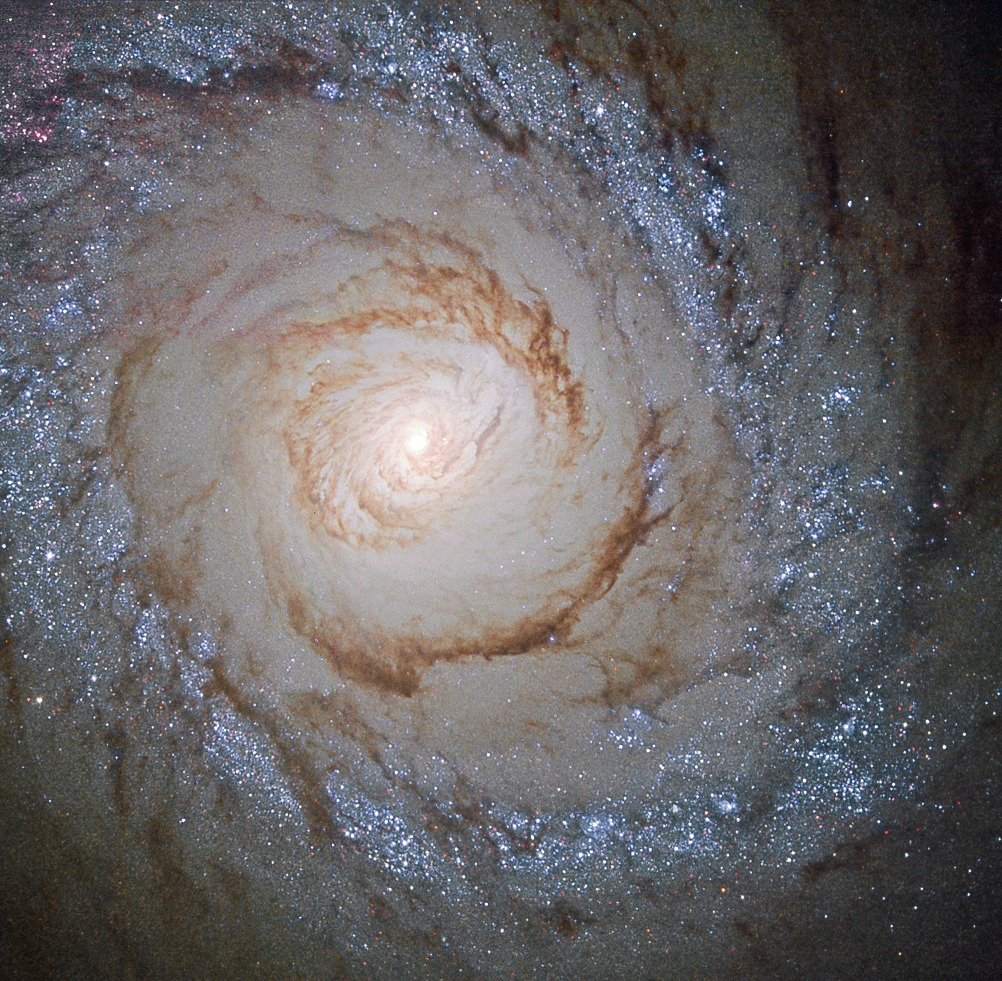
Image (Credit): Hubble Space Telescope image of a sparkling spiral galaxy paired with a prominent star, both in the constellation Virgo. (ESA/Hubble & NASA, S. J. Smartt, C. Kilpatrick)

This week’s image is from the NASA/ESA Hubble Space Telescope. It shows what appears to be two close neighbors – a star and a galaxy – but looks can be deceiving.

Here is more from NASA about this image:

This NASA/ESA Hubble Space Telescope image features a sparkling spiral galaxy paired with a prominent star, both in the constellation Virgo. While the galaxy and the star appear to be close to one another, even overlapping, they’re actually a great distance apart. The star, marked with four long diffraction spikes, is in our own galaxy. It’s just 7,109 light-years away from Earth. The galaxy, named NGC 4900, lies about 45 million light-years from Earth.

This image combines data from two of Hubble’s instruments: the Advanced Camera for Surveys, installed in 2002 and still in operation today, and the older Wide Field and Planetary Camera 2, which was in use from 1993 to 2009. The data used here were taken more than 20 years apart for two different observing programs — a real testament to Hubble’s long scientific lifetime.

Space Stories: Upcoming ESA Exoplanet Mission, Evidence of Early Water in the Universe, and a New Nearby Dwarf Galaxy

Here are some recent stories of interest.

German Aerospace Center: PLATO Mission to Launch in Late 2026 Onboard Ariane 6

On 29 January 2025, the European Space Agency (ESA)’s Director of Science, Carole Mundell; ESA’s Director of Space Transportation, Toni Tolker-Nielsen; and Arianespace’s Chief Commercial Officer, Steven Rutgers, signed the launch contract for the ESA PLATO science mission...PLATO stands for PLAnetary Transits and Oscillations of stars…PLATO’s goal is to detect Earth-like planets that orbit Sun-like stars in the Milky Way and may even have conditions suitable for life.

ScienceNews: The Universe’s First Supernovas Probably Produced Water

The first generation of stars in the universe could have produced significant amounts of water upon their deaths, just 100 million to 200 million years after the Big Bang. Signatures of water have previously been observed some 780 million years after the Big Bang. But now, computer simulations suggest that this essential condition for life existed far earlier than astronomers thought, researchers report March 3 in Nature Astronomy.

Phys.org: New Dwarf Galaxy Discovered in the Halo of Andromeda Galaxy

An international team of astronomers reports the discovery of a new dwarf galaxy, which they have named Pegasus VII. The newfound galaxy, which lies about 2.4 million light years away, was identified in the Ultraviolet Near-Infrared Optical Northern Survey (UNIONS). The discovery was detailed in a research paper published Feb. 13 on the arXiv preprint server. Dwarf galaxies are low-luminosity and low-mass stellar systems, usually containing a few billion stars. Their formation and activity are thought to be heavily influenced by interactions with larger galaxies.

Space Quote: More on the ISS “Stranded” Story

Image (Credit): European Space Agency astronaut Andreas Mogensen (Twitter/X)

“You know as well as I do, that Butch and Suni are returning with Crew-9, as has been the plan since last September. Even now, you are not sending up a rescue ship to bring them home. They are returning on the Dragon capsule that has been on ISS since last September.”

Comments by Andreas Mogensen, a Danish astronaut who commanded the ISS between September 2023 to early 2024, in response to Elon Musk’s constant tweets about his efforts to “rescue” the two Starliner astronauts on the International Space Station (ISS). NASA already resolved the issue, yet Mr. Musk seems to need the attention given that otherwise the media keeps ignoring his actions (such as harassing federal employees, including those at NASA).