Pic of the Week: Peeking into Perseus

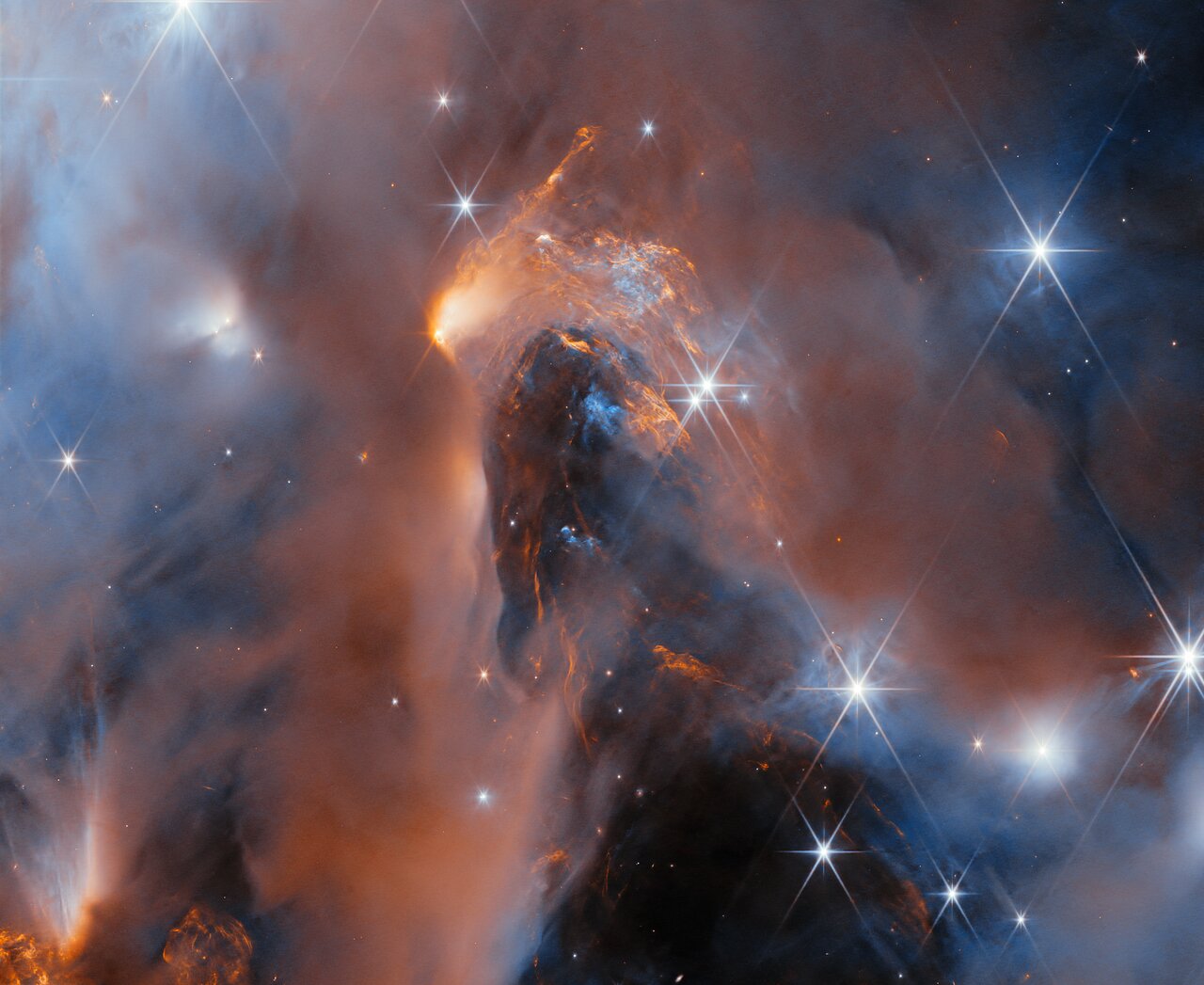
Image (Credit): The star-forming cluster NGC 1333 as seen by the JWST. (ESA/Webb, NASA & CSA, A. Scholz, K. Muzic, A. Langeveld, R. Jayawardhana)

This week’s image of a distant nebula with new stars was captured by the James Webb Space Telescope (JWST). The nebula, NGC 1333, is located in the Perseus molecular cloud, which is about 960 light-years away.

Here is more information on the image from the European Space Agency:

The centre of the image presents a deep peek into the heart of the NGC 1333 cloud. Across the image we see large patches of orange, which represent gas glowing in the infrared. These so-called Herbig-Haro objects form when ionised material ejected from young stars collides with the surrounding cloud. They are hallmarks of a very active site of star formation.

Many of the young stars in this image are surrounded by discs of gas and dust, which may eventually produce planetary systems. On the right hand side of the image, we can glimpse the shadow of one of these discs oriented edge-on — two dark cones emanating from opposite sides, seen against a bright background.

Similarly to the young stars in this mosaic, our own Sun and planets formed inside a dusty molecular cloud, 4.6 billion years ago. Our Sun didn’t form in isolation but as part of a cluster, which was perhaps even more massive than NGC 1333. The cluster in the mosaic, only 1–3 million years old, presents us with an opportunity to study stars like our Sun, as well as brown dwarfs and free-floating planets, in their nascent stages.

Pic of the Week: Picture Perfect Spiral Galaxy

Image (Credit): Hubble’s view of spiral galaxy IC 4709. (ESA/Hubble & NASA, M. Koss, A, Barth)

This week’s image comes from the Hubble Space Telescope. It shows an almost too perfect spiral galaxy that might have come from AI software, but it is a real image from NASA and ESA. You are looking at spiral galaxy IC 4709, which is about 240 million light-years away.

Here is more information on the image from the ESA’s Hubble site:

Its view here is studded with stars, many of which appear particularly large and bright thanks to their nearby locations in our own galaxy, and which feature the characteristic diffraction patterns caused by Hubble’s optics. Much further away — around 240 million light-years distant in fact, in the southern constellation Telescopium — is the spiral galaxy IC 4709. Its swirling disc filled with stars and dust bands is beautifully captured, as is the faint halo surrounding it. The compact region at its core might be the most remarkable sight, however: this is an active galactic nucleus (AGN).

Space Stories: ESA Drill Going to the Moon, ROMAN Takes on the Ever-changing Universe, and Six New Worlds Discovered

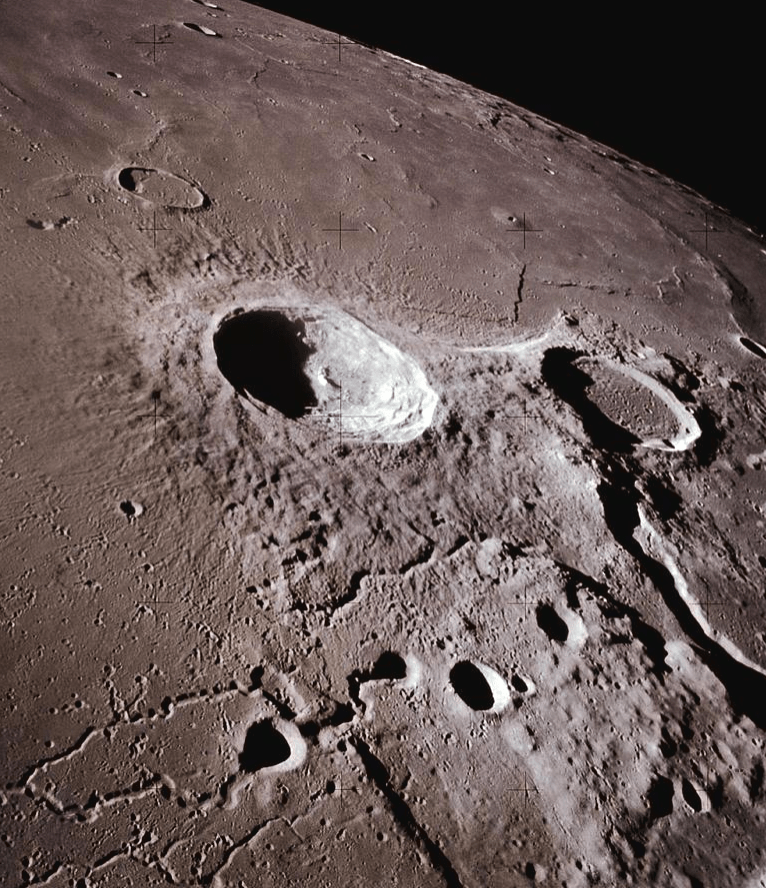
Image (Credit): The Hadley-Apennine region of the Moon photographed during the Apollo 15 mission of 1971. (NASA)

Here are some recent stories of interest.

European Space AgencyEuropean Drill and Mini Lab Secure Ride to the Moon

ESA’s Prospect package, including drill and a miniaturised laboratory, will fly to the Moon’s South Polar region in search of volatiles, including water ice, as part of NASA’s Commercial Lunar Payload Services initiative…NASA has selected Intuitive Machines for a flight opportunity in 2027 that will deepen our understanding of the Moon and answer key questions about where and how volatiles can be found on the lunar surface.V olatiles, such as water ice, are chemical components that easily evaporate or vaporise under certain conditions. Prospect is a suite of instruments that will drill up to at least one metre depth beneath the lunar surface, extract samples, and process them in a mini lab. The combination of robotic drill and sample analysis package aims to identify volatiles trapped beneath the surface at extremely cold temperatures down to –150 °C.

Space Telescope Science InstituteNASA’s Roman Space Telescope to Investigate Galactic Fossils

The universe may seem static, only capable of being captured in still frames, but that is far from the truth. It is actually ever-changing, just not on timescales clearly visible to humans. NASA’s upcoming Roman Space Telescope will bridge this gap in time, opening the way to the dynamic universe. RINGS, the Roman Infrared Nearby Galaxy Survey, will specifically uncover the dynamic universe by searching galaxies for fossils of their formation history. RINGS will also lead scientists to clues about the true nature of dark matter, the mysterious substance that makes up the majority of the mass in our universe. Roman will launch in 2027, prepared to revolutionize how scientists understand our universe and give them access to the vision of the universe as it truly is: changing.

Science DailySix New Rogue Worlds: Star Birth Clues

The James Webb Space Telescope has spotted six likely rogue worlds — objects with planet-like masses but untethered from any star’s gravity — including the lightest ever identified with a dusty disk around it. The elusive objects offer new evidence that the same cosmic processes that give birth to stars may also play a common role in making objects only slightly bigger than Jupiter.

Space Stories: A Polish Astronaut Heads to ISS, Two Astronauts Are Missing from Church, and Deadly Red Dwarves

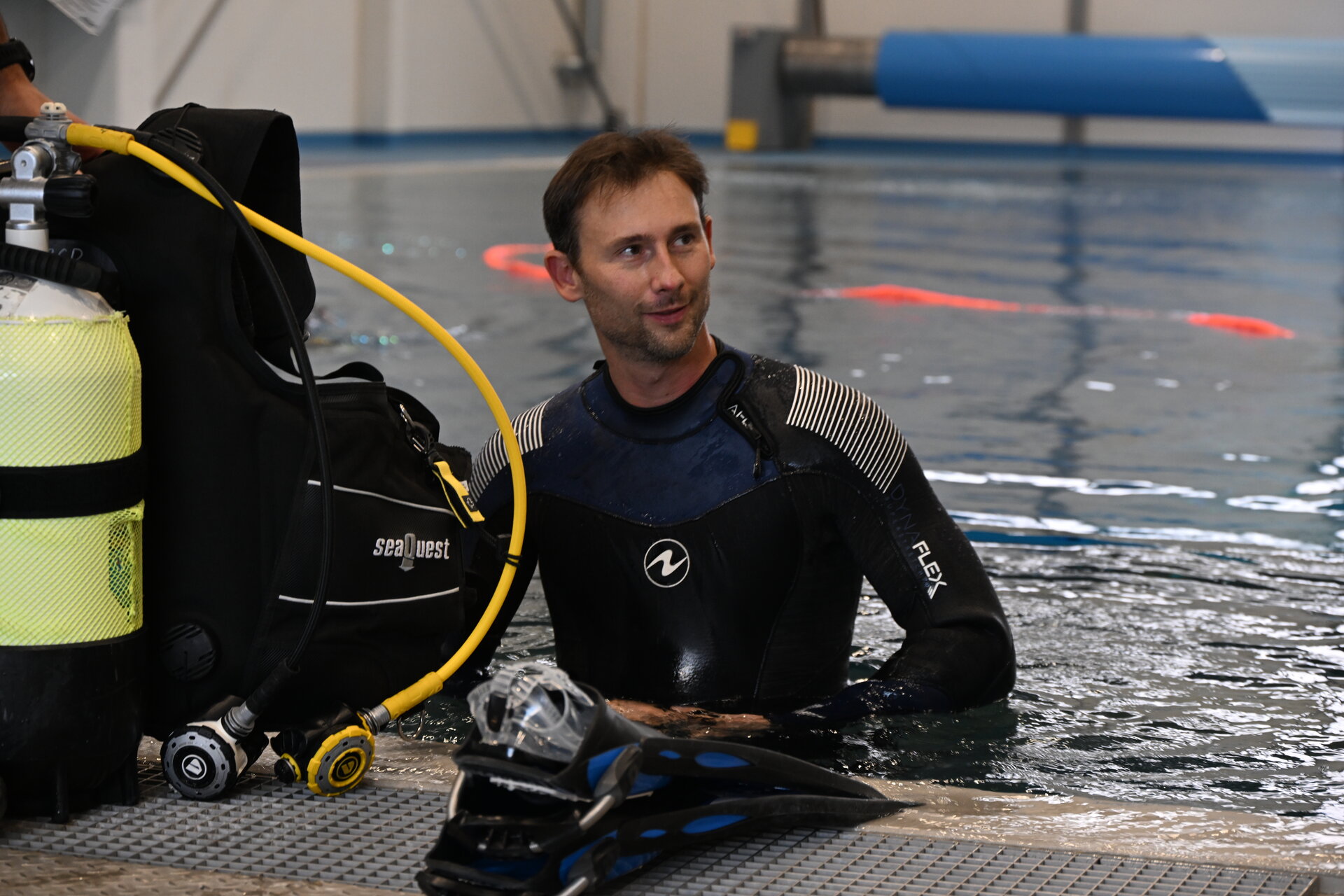
Image (Credit): Sławosz Uznański in ESA’s Neutral Buoyancy Facility. (ESA)

Here are some recent stories of interest.

European Space Agency (ESA)Sławosz Uznański from Poland Will fly to International Space Station on Rourth Axiom Space Mission

Axiom Space announced that it is partnering with India, Hungary, and with Poland through ESA to send three national astronauts to the International Space Station on Axiom Mission 4 (Ax-4). ESA project astronaut Sławosz Uznański has been assigned as mission specialist under the command of Axiom Space’s Chief Astronaut Peggy Whitson...The other two Ax-4 crew members are pilot Shubhanshu Shukla from India, and mission specialist Tibor Kapu from Hungary.

Associated PressOne Church, Two Astronauts. How a Texas Congregation is Supporting its Members on the Space Station

there’s no way on Earth for NASA astronauts Barry “Butch” Wilmore and Tracy Dyson to show up at Providence Baptist Church. They’re in space, orbiting the planet. More specifically, these two members are working on the International Space Station together...Dyson’s six-month mission isn’t scheduled to end until September, but Wilmore and his fellow NASA test pilot, Suni Williams, should have been back weeks ago. They are staying longer than expected following thruster failures and helium leaks on Boeing’s inaugural crew flight for its Starliner capsule. Wilmore and Williams have said they are confident the capsule will return them home safely; engineers are still poring over Starliner test data.

University of CambridgeAstronomers Uncover Risks to Planets that Could Host Life

Astronomers have discovered that red dwarf stars can produce stellar flares that carry far-ultraviolet (far-UV) radiation levels much higher than previously believed. The discovery suggests that the intense UV radiation from these flares could significantly impact whether planets around red dwarf stars can be habitable…According to researchers, UV radiation from stellar flares can either erode planetary atmospheres, threatening their potential to support life, or contribute to the formation of RNA building blocks, which are essential for the creation of life.

Resupply Mission to the Space Station Hits a Weather Bump

Image (Credit): Northrop Grumman’s Cygnus cargo spacecraft as seen from the ISS. (Northrop Grumman)

The weather in Florida has delayed today’s Northrop Grumman resupply mission to the International Space Station (ISS). In fact, SpaceX is launching the payload for Grumman from the Cape Canaveral Space Force Station rather than the typical launch facility in Virginia. The Northrop Grumman Cygnus cargo spacecraft with its 8,200 pounds of supplies will probably need to sit on the launch pad for a few more days until the weather clears.

Why is SpaceX launching a Grumman resupply mission, you might ask?  Doesn’t Grumman have its own rocket? Yes, and no. It has launches most of its resupply missions on its own Antares rocket, but the newest version of the rocket, the Antares 330, is still being finalized and is not expected to be ready until next year. As a result, Grumman procured three flights from SpaceX.

The ability of the commercial parties to support one another’s missions is encouraging, just as the European Space Agency dependied on SpaceX while it developed a new generation of its Ariane rocket.

SpaceX is always there to help (at a cost, of course) as other rocket companies prepare for the challenges ahead. In the case of Northrop Grumman, it needed to move away from its reliance on Ukrainian/Russian rockets and create a more reliable supply chain.

Now we just need the weather to cooperate.