Space Stories: New Horizon Questions, A Dark Spot on Neptune, and Prioritizing Exoplanets

Image (Credit): NASA’s New Horizons spacecraft. (NASA/Johns Hopkins University Applied Physics Laboratory/Southwest Research Institute)

Here are some recent stories of interest.

Space.com : “NASA’s New Horizons Mission Faces an Uncertain Future (op-ed)

With its budget being trimmed for 2024, NASA is making some weighty decisions… and one includes drastically trimming New Horizons funds by replacing the current science staff with a new team in an effort to save about $3 million—a rounding error in terms of the planetary science budget...As it stands, New Horizons will exit the Kuiper Belt around 2028 and should continue operating until 2050.

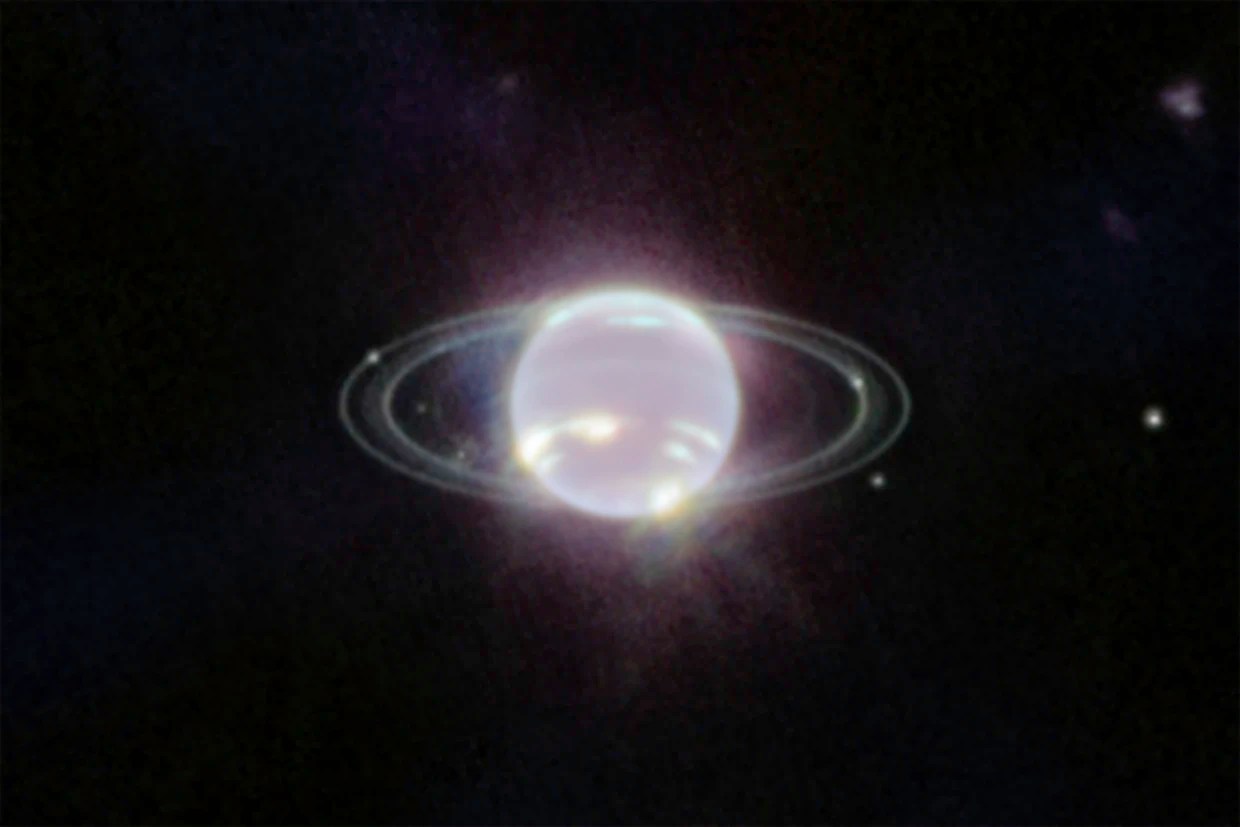
ScienceDaily : “Mysterious Neptune Dark Spot Detected from Earth for the First Time

Using ESO’s Very Large Telescope (VLT), astronomers have observed a large dark spot in Neptune’s atmosphere, with an unexpected smaller bright spot adjacent to it. This is the first time a dark spot on the planet has ever been observed with a telescope on Earth. These occasional features in the blue background of Neptune’s atmosphere are a mystery to astronomers, and the new results provide further clues as to their nature and origin.

Universe Today : “TESS has Found Thousands of Possible Exoplanets: Which Ones Should JWST Study?

We will soon have more than 10,000 worlds where life might be able to survive. It’s an amazing idea, but with so many exoplanets we don’t have the resources to search for life on all of them. So how do we prioritize our search? That’s the focus of a recent paper on the pre-print server arxiv. In it, the team strives to identify the “best in class” candidates for exoplanets that could be further studied by the spectroscopic cameras of the James Webb Space Telescope (JWST). Their list could not only help astronomers find evidence of life but also help us understand the range of atmospheres exoplanets have.

Space Stories: The End of Arecibo, Early Black Holes, and Habitable Red Dwarf Exoplanets

Image (Credit): Aerial view of the damaged Arecibo Observatory after one of the main cables holding the receiver broke in Arecibo, Puerto Rico, on December 1, 2020. (Photo by Ricardo ARDUENGO / AFP)

Here are some recent stories of interest.

Scientific American : “Arecibo Observatory Shuts Down Its Science

After weathering hurricanes, earthquakes, budget cuts and a pandemic-induced shutdown, the iconic Arecibo Observatory in Puerto Rico closed its doors on 14 August. After its main instrument collapsed two years ago, the site was supposed to shift from carrying out astronomy and other research to being a science education centre. But concrete plans for that have yet to materialize — and funding for current operations has run out. Scientists were disappointed that research would formally halt at the site, but they had hoped to keep some instruments running, both for the students who might use the educational centre and to continue the site’s astronomy legacy. Doubts now swirl, as equipment is taken offline and dismantled, that Arecibo will ever again study the sky.

Quanta Magazine : “JWST Spots Giant Black Holes All Over the Early Universe

In recent months, a torrent of observations of the cosmic smudges has delighted and confounded astronomers…The most straightforward explanation for the tornado-hearted galaxies is that large black holes weighing millions of suns are whipping the gas clouds into a frenzy. That finding is both expected and perplexing. It is expected because JWST was built, in part, to find the ancient objects. They are the ancestors of billion-sun behemoth black holes that seem to appear in the cosmic record inexplicably early. By studying these precursor black holes, such as three record-setting youngsters discovered this year, scientists hope to learn where the first humongous black holes came from and perhaps identify which of two competing theories better describes their formation: Did they grow extremely rapidly, or were they simply born big?

Phys.org : “New Study Suggests Some Exoplanets Orbiting Red Dwarfs May be Habitable After All

A team of astrophysicists from the University of Bordeaux and Observatoire Astronomique de l’Université de Genève is suggesting that some exoplanets may not have been too hot during their formative years to harbor life today. In their paper published in the journal Nature, the group suggests that due to factors not considered in the past, some exoplanets may not have grown so hot that they lost the water in their atmospheres to evaporation into space.

In Case You Missed It/Video: Missed Opportunity on Exomoons

Image (Credit): Assistant Professor of Astronomy David Kipping sharing his story of rejection. By the way, the image behind him is the exomoon Pandora from the movie Avatar. (Cool Worlds Lab)

A few months back, Assistant Professor of Astronomy David Kipping shared a short video regarding his organization’s failure to secure James Webb Space Telescope (JWST) time to search for exomoons that he knows are there. His organization, Cool Worlds Lab, has done some amazing work studying and publicizing issues related to astronomy. You should visit his site for some challenging topics.

What is unique about his video is that it was recorded only one hour after he learned that his organization would not be able to use JWST for his exomoon search and he wanted to share what rejection felt like “in real time.” He goes on to say that such rejection is part of science, as brutal as it may feel at the moment, noting that for every seven JWST proposals, only one will be approved.

Fortunately, we have scientists out there with very thick skin sharing new ideas and proposals. And Dr. Kipping will not be giving up on his exomoon push anytime soon. That is good news for all of us.

Space Stories: Rogue Exoplanets, ISS Power Problems, and Eco-Friendly Airlines

Image (Credit): Artist’s rendering of a rogue exoplanet. (NASA/JPL-Caltech)

Here are some recent stories of interest.

Space.com : “400 Earth-size Rogue Planets could be Wandering the Milky Way

New predictions suggest an upcoming NASA space telescope could spot over 400 Earth-mass worlds hidden throughout the Milky Way that have “gone rogue” and therefore wander our galaxy alone.  Such orphan worlds are thought to start their lives in a planetary system, akin to the solar system, but get kicked at some point out by a mechanism thus far unknown. Despite the familiar picture of planets neatly orbiting a star, new research suggests such orphaned starless worlds may outnumber stars in the Milky Way by 20 to 1. This implies untethered worlds in our galaxy are around six times more common than planets orbiting parent stars. 

ABC News : “NASA Power Outage Temporarily Halts Contact with Space Station

A NASA power outage disrupted communication between Mission Control and the International Space Station on Tuesday. Mission Control couldn’t send commands to the station and talk with the seven astronauts in orbit. The power outage hit as upgrade work was underway in the building at Houston’s Johnson Space Center. Space station program manager Joel Montalbano said neither the astronauts nor station were ever in any danger and that backup control systems took over within 90 minutes. The crew was notified of the problem through Russian communication systems, within 20 minutes of the outage.

GeekWire : “Boeing and NASA Partner with Alaska and Other Airlines on Eco-friendly X-66A Aircraft

Boeing and NASA say they’ll collaborate with Seattle-based Alaska Airlines and four other major airlines on the Sustainable Flight Demonstrator project, which aims to put Boeing’s innovative X-66 braced-wing aircraft design through flight tests in the 2028-2029 time frame. The X-66A makes use of a concept known as the Transonic Truss-Braced Wing, or TTBW, which features ultra-long, ultra-thin, drag-reducing wings that are stabilized by diagonal struts.

Travel to Moon and Mars Not Most Important Missions for the Public

While both Buzz Aldrin and I believe that lunar and Martian colonies are important, it would appear the public has other ideas about NASA’s priorities. The graphic above shows in a recent Pew Research Center study indicates the more Americans are interested in monitoring the Earth’s climate as well as watching for asteroids.

Even finding exoplanets that could support life seems to be more important than occupying local moons and planets. I am not sure how that would help us now if we want to spread the risk of living on one planet, as some propose. We are nowhere near sending a probe to exoplanets, let alone getting humans there.

The study has quite a bit to ponder, including:

  • 58% of U.S. adults believe it is essential to include the use of human astronauts in the U.S. space program, while 41% say astronauts are not essential;
  • Some 44% of Americans have a great deal of confidence private companies will make a profit in their space-related ventures;
  • As the public considers the possibilities ahead for ordinary citizens to orbit the Earth in a spacecraft, more Americans say they would not want to orbit the Earth than say they would (58% to 42%); and
  • About seven-in-ten Americans (72%) say it is essential for the U.S. to continue to be a world leader in space exploration, and eight-in-ten (80%) say the space station has been a good investment for the country.

I am not sure the survey shows a lot of consistency in the answers, but this can be a difficult topic at the outset. NASA should just be worried if Americans saw no reason for a space program, which does not seem to be the case. As noted above, the majority of Americans want a strong space program. Let’s see if that helps with the ongoing congressional budget discussions.