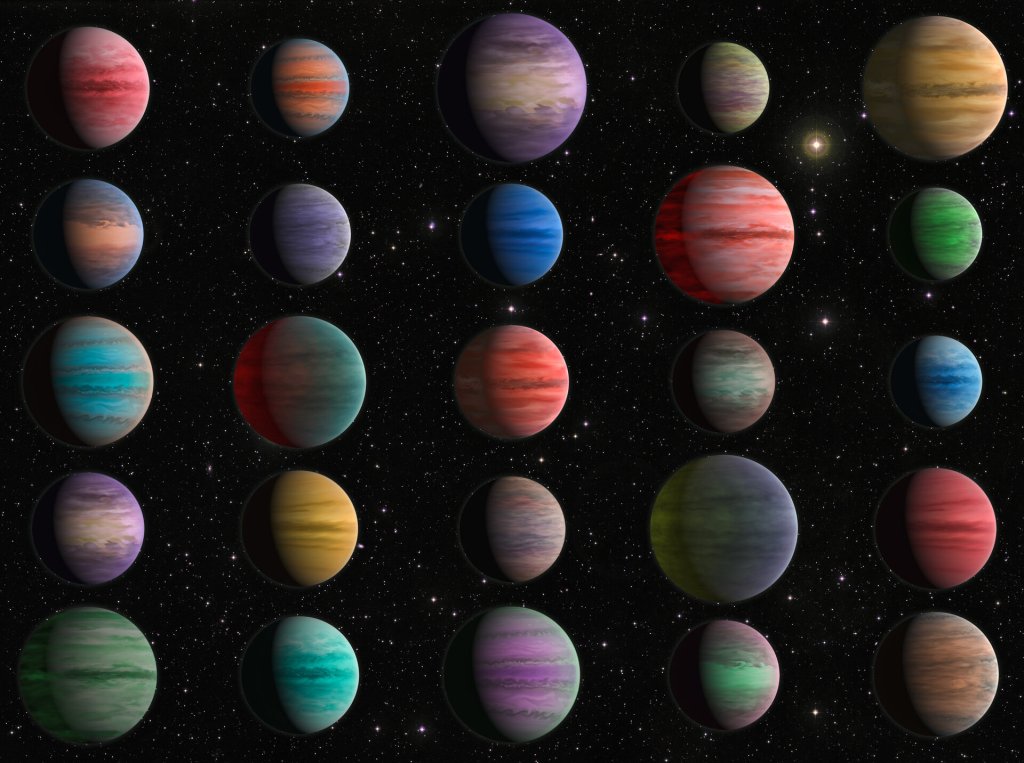
Last week’s news that a young exoplanet has been spotted has generated quite a bit of interest. The discovery was reported in the journal The Astrophysical Journal Letters. Of course, if you read the abstract of the study itself, you may be confused with all the scientific jargon:
We report the discovery of a circumplanetary disk (CPD) candidate embedded in the circumstellar disk of the T Tauri star AS 209 at a radial distance of about 200 au (on-sky separation of 1.4 from the star at a position angle of 161°), isolated via 13CO J = 2−1 emission. This is the first instance of CPD detection via gaseous emission capable of tracing the overall CPD mass. The CPD is spatially unresolved with a 117 × 82 mas beam and manifests as a point source in 13CO, indicating that its diameter is ≲14 au…
We could not fund the space program if this is what we shared with taxpayers. Fortunately, the accompanying press release was better:
Scientists using the Atacama Large Millimeter/submillimeter Array (ALMA)— in which the National Radio Astronomy Observatory (NRAO) is a partner— to study planet formation have made the first-ever detection of gas in a circumplanetary disk. What’s more, the detection also suggests the presence of a very young exoplanet. The results of the research are published in The Astrophysical Journal Letters…While studying AS 209— a young star located roughly 395 light-years from Earth in the constellation Ophiuchus— scientists observed a blob of emitted light in the middle of an otherwise empty gap in the gas surrounding the star. That led to the detection of the circumplanetary disk surrounding a potential Jupiter-mass planet. Scientists are watching the system closely, both because of the planet’s distance from its star and the star’s age. The exoplanet is located more than 200 astronomical units, or 18.59 billion miles, away from the host star, challenging currently accepted theories of planet formation. And if the host star’s estimated age of just 1.6 million years holds true, this exoplanet could be one of the youngest ever detected. Further study is needed, and scientists hope that upcoming observations with the James Webb Space Telescope will confirm the planet’s presence.
My first point is that communication matters, and we need both the scientists and the communicators if the public is to learn anything about what is being funded.
My second point relates to information found later in the press release about the new planet being 200 astronomical units from its sun. Pluto is only 39 astronomical units away from our Sun, so this is quite a difference. Which makes me wonder about our solar system and its various components. Even the hazy image above is more than we have of our own solar system as we guess about a ninth planet out there somewhere and hypothesize about the Oort Cloud. Should a civilization many light years away focus its best telescopes on our solar system , what could they tell us?
We seem to be explorers looking out over the sea at far-away islands not even understanding the components of the island we stand on. We certainly learn more every day as we pick and probe at the objects around us, yet it is clear that our knowledge of our own home has plenty of gaps. Maybe the solar system images from afar should be seen as weak reflections from our own solar system.
Given that the James Webb Space Telescope has yet to turn its attention to AS 209, we can expect even more surprises related to this distant solar system, and maybe our own.