Study Findings: Four Sub-Earth Planets Orbiting Barnard’s Star from MAROON-X and ESPRESSO

Image (Credit): Conceptual art showing Barnard’s Star from the surface of one of its four orbiting planets. (Illustration by International Gemini Observatory/NOIRLab/NSF/AURA/R. Proctor/J. Pollard)

The Astrophysical Journal Letters abstract of the study findings:

Barnard’s Star is an old, single M dwarf star that comprises the second-closest extrasolar system. It has a long history of claimed planet detections from both radial velocities and astrometry. However, none of these claimed detections have so far withstood further scrutiny. Continuing this story, extreme precision radial velocity measurements from the ESPRESSO instrument have recently been used to identify four new sub-Earth-mass planet candidates around Barnard’s Star. We present here 112 radial velocities of Barnard’s Star from the MAROON-X instrument that were obtained independently to search for planets around this compelling object.

Citation: Ritvik Basant et al. Four sub-Earth planets orbiting Barnard’s Star from MAROON-X and ESPRESSO. ApJL 982 L1 (2025).
https://doi.org/10.3847/2041-8213/adb8d5

Study-related stories:

The University of Chicago

SciTechDaily

Astronomy Magazine

Have We Detected Life on an Exoplanet?

Credit: Image by Adis Resic from Pixabay.

The news is filled this week with a story about possible life on a distant exoplanet? What did scientists find?

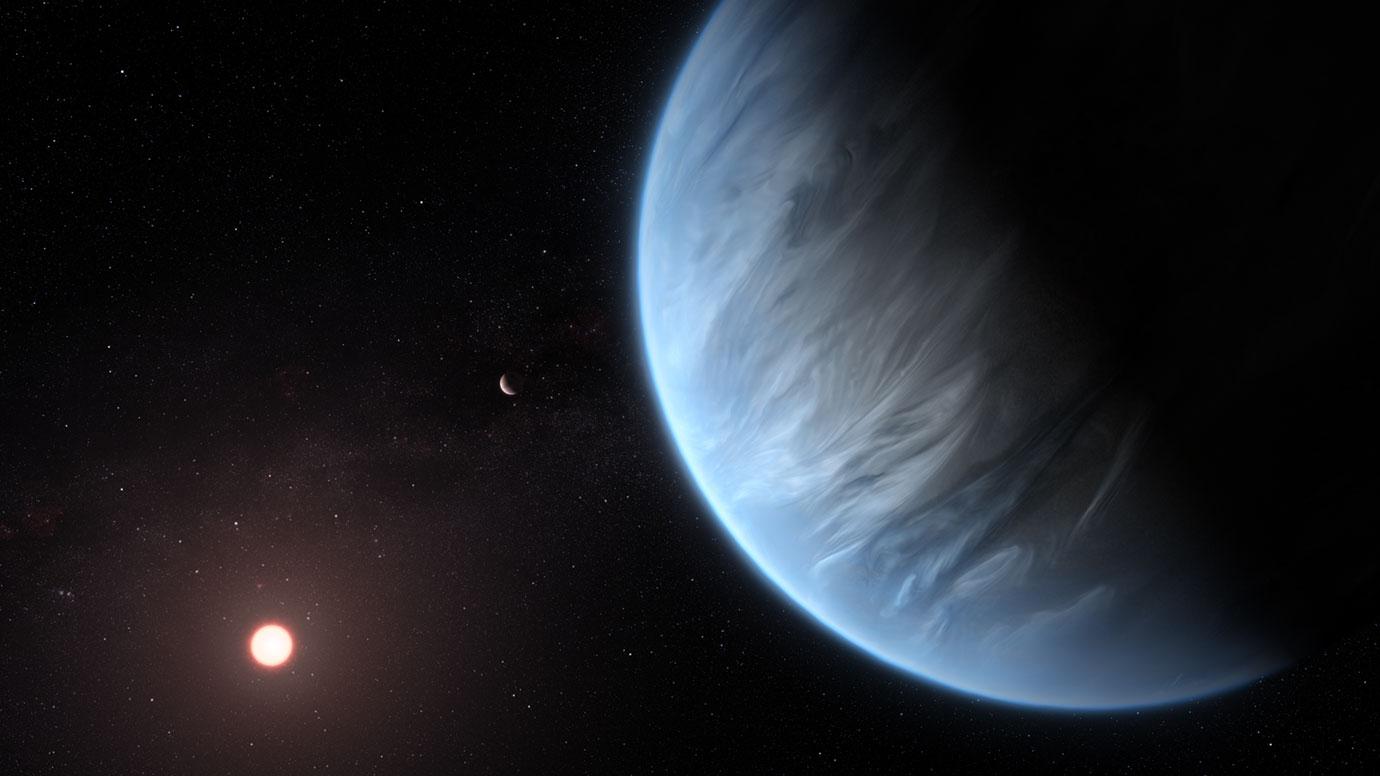
The exoplanet is named K2-18b, and it orbits a red star that is about 124 light-years away. It is also about 2.6 times larger than the Earth and 8.6 times as massive.

Scientists using data from the James Webb Space Telescope have detected a biosignature similar to molecules – dimethyl sulfide (DMS) and dimethyl disulfide (DMDS) – associated with marine phytoplankton on our planet.

Nikku Madhusudhan, professor of astrophysics and exoplanetary science at the University of Cambridge’s Institute of Astronomy, stated:

Earlier theoretical work had predicted that high levels of sulfur-based gases like DMS and DMDS are possible on Hycean worlds…And now we’ve observed it, in line with what was predicted. Given everything we know about this planet, a Hycean world with an ocean that is teeming with life is the scenario that best fits the data we have.

A Hycean planet is basically a world with liquid oceans and a hydrogen-rich atmosphere. Such planets are also more common around red dwarf stars.

Of course, more work is necessary to determine whether this finding could relate to something other than biological life, but its does offer exciting possibilities and a clear target for more study.

Good Article: Understanding Rogue Planets

Credit: Image by Dewald Van Rensburg from Pixabay.

Scientific American magazine has an interesting article on rogue planets, titled “How Many Rogue Planets Roam the Milky Way?” It discusses those lonely exoplanets that may or may not have started in a solar system, but nonetheless now drift in the darkness alone.

The article discusses a new paper from a team of astronomers at the Technion–Israel Institute of Technology that looked at the ejection of planets from planetary systems. Among the various findings noted, the team found that within the first billion years of a planetary system, on average as many as 3.5 planets are ejected , with most ejections happen within the first 100 million years. Moreover, systems with 10 or more planets eject more planets – as many as 70 percent of the system’s planets.

So that brings us back to our solar system. How many rogue planets did we spin off billions of years ago? We will never really know, but it gives one plenty to ponder when thinking about what awaits us out there should we venture beyond our present home system. Will we find old friends?

Note: An earlier article estimated there are seven rogue planets for every star in our galaxy, meaning the Milky Way may host trillions of rogue planets.

Protect NASA Astrobiology Research

Image (Credit): Artist’s conception of a planetary lineup showing habitable-zone exoplanets with similarities to Earth, featured on the far right. (NASA/Ames/JPL-Caltech)

The astrobiology community is looking for individuals to show their support for NASA’s efforts in this area. In a white paper highlighting the benefits of astrobiology research, some of the key points are:

  • Preserve Astrobiology Leadership: Astrobiology is a pillar of NASA’s mission with a storied legacy that must be safeguarded.
  • Unprecedented Discoveries Ahead: Mars, Ocean Worlds, and exoplanet missions in the coming decades could finally answer one of humanity’s most profound questions: “are we alone?
  • Public Passion and Impact: The public passionately supports the search for life – a pursuit that inspires, unites, and advances STEM engagement.
  • NASA’s Unique Role: NASA’s unique capabilities and infrastructure position it as a leader in astrobiology, working in collaboration with U.S. academia and industry to advance this field.
  • Preserve Astrobiology at Its Peak: Astrobiology is thriving; workforce and research funding reductions must not derail our best chance to find life beyond Earth.

At a time of unprecedented threats to NASA’s program and mission, it is important to send a message to Congress and others that we have just begun to understand the universe and its potential for other forms of life, and now is not the time to back away.

The paper notes:

As NASA navigates the administration’s government-wide workforce optimization initiative, it is vital that we do not undermine astrobiology research – a field at the very heart of our agency’s purpose and future. Acting leadership has rightly stated that any reductions must align with mission needs. Few needs are more central to NASA’s science mission than understanding life’s existence beyond Earth.

The same site provides a link to an endorsement page.

I expect this is one of many initiatives to bring attention to the threats facing our space program. It is true that some efficiencies can be found in government with the right level of analysis and careful consideration of existing programs (as has been done in the past), but that is not happening right now with the random and unexplainable cuts.

Space Stories: JWST Exoplanet Images, Nearby Exoplanets Located, and Exoplanet Biosignatures,

Image (Credit): Infrared view of the multi-planet system HR 8799. Colors are applied to filters from Webb’s NIRCam (Near-Infrared Camera). A star symbol marks the location of the host star HR 8799, whose light has been blocked by the coronagraph. (NASA, ESA, CSA, STScI, W. Balmer (JHU), L. Pueyo (STScI), M. Perrin (STScI))

Here are some recent stories of interest related to exoplanets.

Webbtelescope.org: NASA’s Webb Images Young, Giant Exoplanets, Detects Carbon Dioxide

The first planet outside our solar system was discovered in the 1990’s, but it wasn’t until more than a decade later astronomers actually obtained a direct image of one. It’s extremely difficult to image an exoplanet, as stars in other planetary systems can be thousands of times brighter and bigger than their planets. NASA’s James Webb Space Telescope is equipped with a highly sensitive coronagraph, a tiny mask that blocks the light of the star, allowing Webb to image exoplanets. Webb’s new images of two iconic systems, HR 8799 and 51 Eridani, and their planets have stunned researchers, and provided additional information into the chemical make-up of the young gas giants.

ABC News: Several Planets Found Orbiting Star Less Than 6 light-years Away

Astronomers have confirmed the existence of four planets orbiting a star less than 6 light-years away with help from some of the world’s most powerful telescopes. Research published in October 2024 revealed that one planet was rotating around Barnard’s Star, the second-closest single star system to Earth. But a combination of telescopes all over the world confirmed the presence of four small exoplanets, according to a study published last week in The Astrophysical Journal Letters.

Universe Today: Astronomers Think They’ve Found a Reliable Biosignature. But There’s a Catch

The search for life has become one of the holy grails of science. With the increasing number of exoplanet discoveries, astronomers are hunting for a chemical that can only be present in the atmosphere of a planet with life! A new paper suggests that methyl halides, which contain one carbon and three hydrogen atoms, may just do the trick. Here on Earth they are produced by bacteria, algae, fungi and some plants but not by any abiotic, non biological processes. There is a hitch, detecting these chemicals is beyond the reach of current telescopes.