Space Stories: New Artemis II Photos, JWST Studies Exoplanet Surface, and Japanese Space Sake for Sale

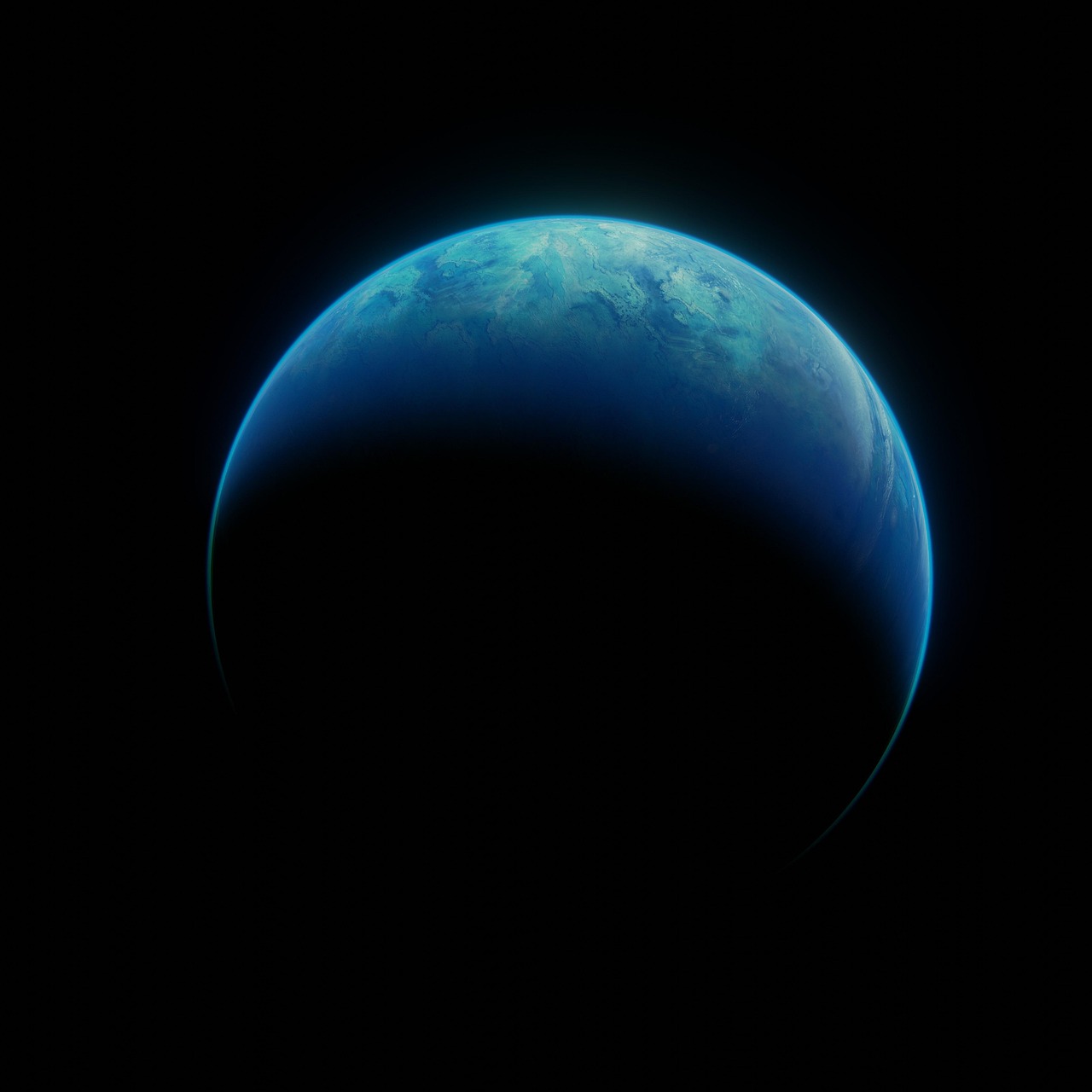
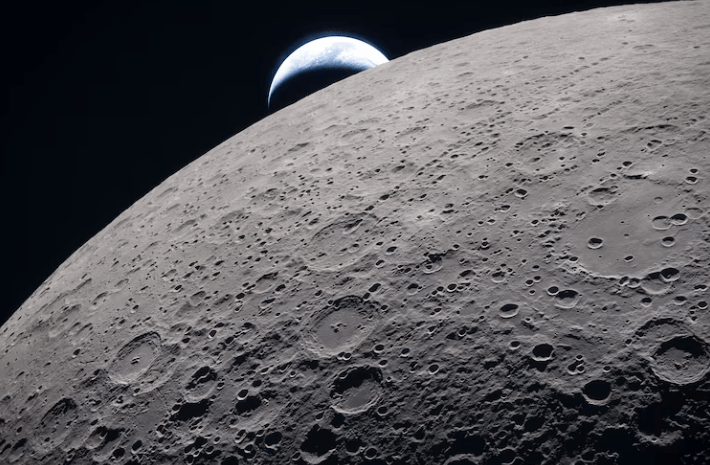
Image (Credit): One of the new photo from the Artemis II mission recently released by NASA. (NASA)

Here are some recent space-related stories.

—ABC News: “NASA Releases More Than 12,000 Images from Historic Artemis II Moon Mission“

Over the weekend, NASA made public more than 12,000 photos from the historic Artemis II lunar mission…Over the course of the mission, NASA released dozens of images of the astronauts, Earth, the moon and even a total solar eclipse. However, the new trove reveals some never-before-seen photos as well as new angles of objects in space, primarily using Nikon cameras and iPhone 17s.

—ZME Science: “Astronomers Determine the Surface of a Rocky Planet Beyond Our Solar System for the First Time“

A rocky planet nearly 50 light-years away appears to be airless, dark, and covered in volcanic or weathered rock, according to new observations from the James Webb Space Telescope. This is the first time that astronomers have obtained details about the surface of a rocky planet outside our solar system. The planet, LHS 3844 b, is not habitable. It is about 30 percent larger than Earth, orbits its star every 11 hours, and has one side permanently pointing towards the Sun, baked at about 725°C.

—The Korean Times: “Space-fermented Sake by Japanese Brewer Dassai Sells for $700,000“

Japanese brewer Dassai has sold a 100-milliliter bottle of sake fermented on the International Space Station for 110 million yen ($700,000). Dassai partnered with Mitsubishi Heavy Industries to ferment sake ingredients in space, the Yomiuri Shimbun newspaper reported Monday. Using the space-fermented mash, or moromi, the brewery finished brewing the sake on Earth, yielding 116 milliliters. Dassai sold a 100-milliliter bottle of the final product to an unnamed Japanese buyer. The company plans to donate the proceeds to Japan’s space program.
Study Findings: A Second Visit to Eps Ind Ab with JWST: New Photometry Confirms Ammonia and Suggests Thick Clouds in the Exoplanet Atmosphere of the Closest Super-Jupiter

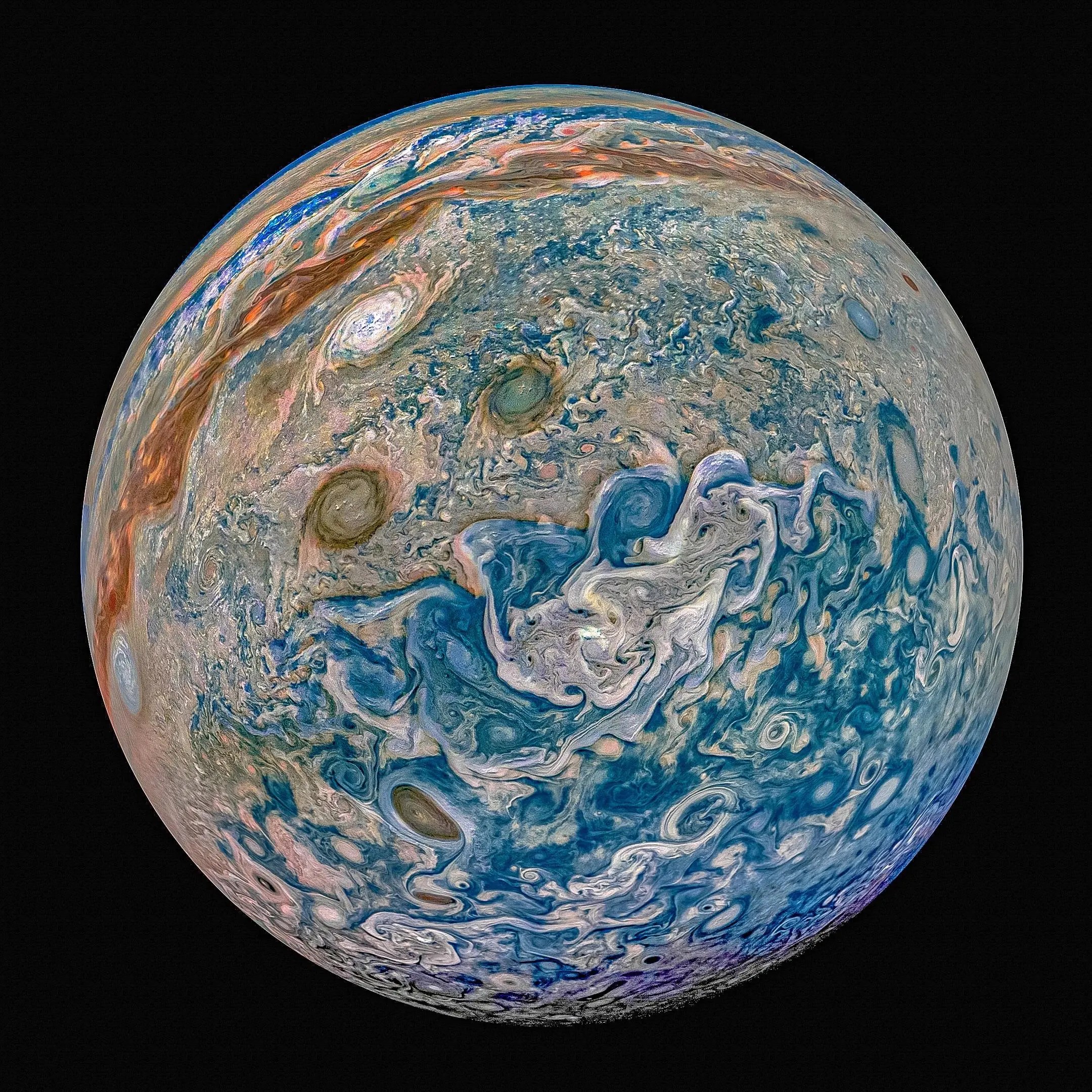
Image (Credit): Juno mission image of Jupiter taken on Juno’s 22nd close pass by Jupiter on Sept. 12, 2019. (NASA/JPL-Caltech/SwRI/MSSS / Image processing by Prateek Sarpal, © CC NC SA)

The Astrophysical Journal Letters abstract of study findings:

With JWST, we are directly imaging cold (∼200–300 K) solar-age giant exoplanets for the first time. At these temperatures, many molecular features appear, and water-ice clouds may condense and affect the emission spectrum; early photometric measurements of cold giant planets are already showing some tension with the predictions of cloud-free solar-metallicity atmosphere models. Here, we present new JWST/MIRI coronagraphic observations of the cold giant exoplanet Eps Ind Ab at 11.3 μm. Together with archival data, we use these new observations to study the atmosphere of this cold exoplanet, and we also refit its orbit, finding an updated mass of 7.6  ±  0.7MJup and an eccentricity of 0.24 +0.11/-0.08. The planet is significantly brighter (by 0.88  ±  0.08 mag) at 11.3 μm than at 10.6 μm, indicating the presence of ammonia. However, this ammonia feature is shallower than expected. This could indicate a low-metallicity or nitrogen-depleted atmosphere, but our preferred explanation is the presence of thick water-ice clouds that suppress the ammonia feature and the near-IR emission of Eps Ind Ab. Photometry of the small but growing sample of cold giant exoplanets demonstrates that they are consistently fainter than expected between 3 and 5 μm, consistent with the water-ice cloud hypothesis. 10.6 μm and 11.3 μm photometry of this cold exoplanet sample would be valuable to determine whether the suppressed ammonia feature is universal, and to frame a new open question about the underlying physical cause.

Citation: Elisabeth C. Matthews et al. a second visit to eps ind ab with JWST: new photometry confirms ammonia and suggests thick clouds in the exoplanet atmosphere of the closest super-Jupiter, ApJL 1002 L5 (2026).

DOI: 10.3847/2041-8213/ae5823

Study-related stories:

Max Planck Institute for Astronomy – “Cirrus Clouds Made of Water Ice May Surround a Jupiter-like Exoplanet”

Universe Today – “Webb Finds Water-Ice Clouds on Nearby Super-Jupiter”

Sci.News – “Webb Spots Icy Clouds on Distant Jupiter-Like Exoplane”

Space Stories: A New Type of Telescope to Spot Exoplanets, Walking Martian Robots, and Terraforming Mars in 15 Years

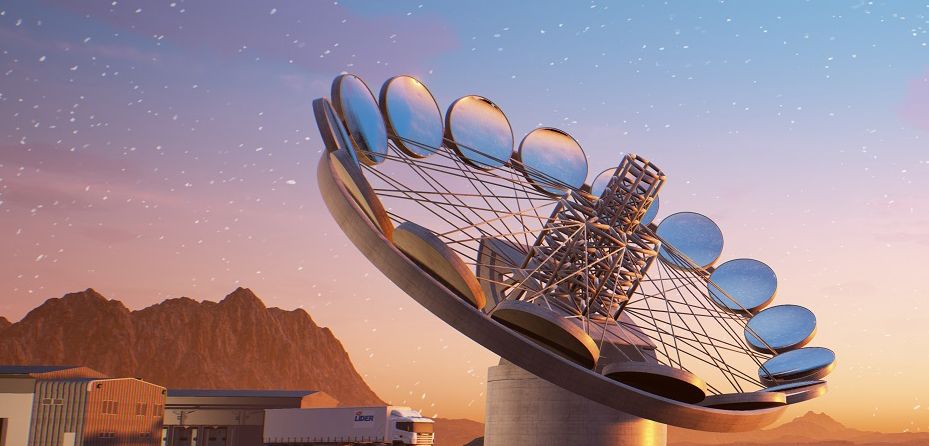
Image (Credit): An artist’s rendering of the ExoLife Finder telescope. (Astronomy.com)

Here are some recent space-related stories.

—Astronomy.com: “Could this Telescope Find Life on Alien Worlds?“

The ExoLife Finder (ELF) looks like no telescope ever built. A spectacular crown of 15 five-meter mirrors perches atop a sprawling metal lattice, resembling petals on a 10-story-tall mechanical flower — more sculpture than observatory. It is a fundamentally new type of telescope, one that its designers say could discover life on Earth-like planets beyond our solar system. The radical design is the brainchild of astrophysicist Jeff Kuhn of the University of Hawai‘i. For now, it exists only in renderings. To build it, Kuhn and the team he’s assembled must first develop and perfect techniques and technologies never before used in astronomy.

—EarthSky: “Walking Robots on Mars Could Speed Up Life Search“

Robotic rovers have become the go-to way to explore our neighbor planet, Mars. And they’ve been super successful. But they’re also big, heavy and slow. They have to move carefully across the rocky and sandy terrain of Mars. Plus, communication delays between the rovers and Earth – and data transfer limitations – also affect their missions. Is there a better way? On March 31, 2026, researchers in Switzerland and the Netherlands announced a new idea: walking Mars robots. The research team said these robotic explorers would be semi-autonomous. This means they wouldn’t need regular assistance from humans back on Earth. And, their makers say, they could explore their surroundings – on both Mars or the moon – faster than rovers.

—The Times of India: “Mars Could be Warm Enough for Humans in 15 Years; A Discovery that Changes Everything“

Mars has been viewed as a multi-millennial effort to terraform since the inception of the term, but there is new evidence that the time frame has changed dramatically. A published study in Science Advances gives new hope to those wishing to terraform Mars through nanoscopic engineered aerosol-like dust particles made from iron and aluminium found abundantly in the soils of Mars. Specifically, scientists feel that if we inject these engineered aerogels into the atmosphere, the resulting greenhouse effect will raise Mars’ surface temperature by over 50 degrees Fahrenheit in only 15 years.

Surviving on an Ice Planet

Credit: Aeon.co

Aeon always has some great articles every month, and one of these is titled “The Snowball Effect.”

The article discusses two periods when glaciers covered the Earth from pole to equator. The last time was 645 million years ago, with the ice remaining for about 10 million years. Even so, life survived and diversified under these conditions on a super-continent called Rodinia.

It may offer some lessons to us when we are looking at our Solar System’s moons as well as distant exoplanets wondering about the presence of life beneath a frozen surface. If the Earth was a snowball for millions of years before life as we know it came to be, it makes sense it would be the case elsewhere.

I recommend you review this article as well as others on Aeon. It is worth your time.

Study Findings: An Adolescent and Near-resonant Planetary System Near the End of Photoevaporation

Credit: Image by Adis Resic from Pixabay

Nature Astronomy abstract of study findings:

Young exoplanets provide vital insights into the early dynamical and atmospheric evolution of planetary systems. Many multi-planet systems younger than 100 Myr exhibit mean-motion resonances, probably established through convergent disk migration. Over time, however, these resonant chains are often disrupted, mirroring the Nice model proposed for the Solar System. Here we present a detailed characterization of the ~200-Myr-old TOI-2076 system, which contains four sub-Neptune planets between 1.4 and 3.5 Earth radii. We demonstrate that its planets are near to but not locked in mean-motion resonances, making the system dynamically fragile. The four planets have comparable core masses but display a monotonic increase in hydrogen and helium (H/He) envelope mass fractions (from stripped to 1%, 5% and 5%) with decreasing stellar insolation. This trend is consistent with atmospheric mass loss due to photoevaporation, which predicts that the envelopes of irradiated planets either erode completely or stabilize at a residual level of ~1% by mass within the first few hundred million years, with more distant, less-irradiated planets retaining most of their primordial envelopes. Additionally, previous detections of metastable helium outflows rule out a pure water-world scenario for the TOI-2076 planets. Our finding provides direct observational evidence that the dynamical and atmospheric reshaping of compact planetary systems begins early and offers an empirical anchor for models of their long-term evolution.

Citation: Wang, MT., Dai, F., Liu, HG. et al. An adolescent and near-resonant planetary system near the end of photoevaporation, Nat Astron (2026).

https://doi.org/10.1038/s41550-026-02795-9

Study-related stories:

Florida Tech – “Assessment of Rare Teenage Planetary System Deepens Understanding of Cosmic Evolution”

Universe Today – “Adolescence Is Tumultuous, Even For Exoplanets”

Daily Galaxy – “Scientists Discover ‘Teenage’ Planetary System, Unlocking Secrets of Cosmic Growth”