Books for NASA Foodies

Credit: Ballast Books

If you are a foodie and still looking for a holiday gift or just a fun gift, you might want to check out these two space-related books.

The first book by Vickie Kloeris, Space Bites: Reflections of a NASA Food Scientist, discusses the thinking that goes into the food prepared for NASA’s astronauts. In this case, Ms. Kloeris worked with the food eaten by astronauts on the space shuttles and the International Space Station.

Former NASA Astronaut Mike Massimino stated:

During her decades-long career at NASA, my friend and colleague Vickie Kloeris made sure my fellow astronauts and I were well-fed and healthy while in space. Space Bites is not only a compilation of stories of her amazing career but also a behind-the-scenes look at the evolution of human space travel. Read this book to be inspired and to learn, and don’t be surprised if it also leaves you hungry for some space food.

It might be the perfect book after holidays if you want some insight into the space program.

However, if you want to sample the astronaut food, you might want to check out this older book by Charles T. Borland and Gregory L. Vogt, The Astronaut’s Cookbook: Tales, Recipes, and More. It contains recipes allowing you to create astronaut-worthy meals without the freeze drying.

The book covers a lot of territory: Appetizers, Beverages, Bread and Tortillas, Cookies, Sandwiches, Desserts, Main Dishes, Soups and Salads, Vegetables, and Future Space Foods.

David W. Hughes from Astronomy Now noted:

Charles Bourland has just retired from his job as NASA’s ‘director of space foods’, and Gregory Vogt was an astronaut trainer. They have provided us with a fascinating insight into the job of the space dietician and nutritionist, as well as a wondrous collection of recipes for the meals that were served on Skylab, Apollo, thespace shuttle and the International Space Station. … This an intriguing book, well written, and colourfully reproduced with a host of appetising pictures.

It may not be fantastic food, yet you can eat like an astronaut (and maybe suffer like an astronaut). When you sit down to dine on this strange fare, you can be pretty certain that no one else in your neighborhood will have such a dinner that evening.

Credit: Springer

Space Stories: Firefly Wins Another NASA Contract, Commercial Space Station Progress, and Another Starliner Delay

Image (Credit): Firefly’s Blue Ghost lunar lander and a rover on the lunar surface. (Firefly Aerospace)

Here are some recent stories of interest.

Firefly AerospaceFirefly Awarded $179 Million NASA Contract for Moon Delivery to Gruithuisen Domes

Firefly Aerospace, Inc., the leader in end-to-end responsive space services, was awarded an approximately $179.6 million NASA contract to deliver and operate six NASA instruments in the Gruithuisen Domes on the Moon’s near side in 2028. As part of NASA’s Commercial Lunar Payload (CLPS) initiative, the mission will utilize Firefly’s Blue Ghost lunar lander, Elytra Dark orbital vehicle, and a rover from an industry provider to investigate the unique composition of the Gruithuisen Domes – a part of the Moon that has never been explored.

NASANASA Sees Progress on Starlab Commercial Space Station Development

A NASA-funded commercial space station, Starlab, recently completed four key developmental milestones, marking substantial progress in the station’s design and operational readiness. The four milestones are part of a NASA Space Act Agreement awarded in 2021 and focused on reviews of the habitat structural test article preliminary design, systems integration, integrated operations, and a habitat structural test plan. “These milestone achievements are great indicators to reflect Starlab’s commitment to the continued efforts and advancements of their commercial destination,” said Angela Hart, program manager for NASA’s Commercial Low Earth Orbit Development Program. “As we look forward to the future of low Earth orbit, every successful milestone is one step closer to creating a dynamic and robust commercialized low Earth orbit.”

Associated PressNASA’s 2 stuck Astronauts Face More Time in Space with Return Delayed Until at Least Late March

NASA’s two stuck astronauts just got their space mission extended again. That means they won’t be back on Earth until spring, 10 months after rocketing into orbit on Boeing’s Starliner capsule. NASA announced the latest delay in Butch Wilmore and Suni Williams’ homecoming on Tuesday. The two test pilots planned on being away just a week or so when they blasted off June 5 on Boeing’s first astronaut flight to the International Space Station. Their mission grew from eight days to eight months after NASA decided to send the company’s problem-plagued Starliner capsule back empty in September.

Pic of the Week: Thanksgiving on the ISS

Image (Credit): Expedition 72 astronauts on the ISS celebrating Thanksgiving. (NASA)

This week’s image shows the four US astronauts aboard the International Space Station (ISS) showing their Thanksgiving meal to all of us (contained in the white plastic bags). The astronauts pictured (clockwise from bottom left) are Nick Hague, Suni Williams, Butch Wilmore, and Don Pettit. You also watch a video where they share their holiday messages.

ISS Successfully Resupplied by Russian Mission

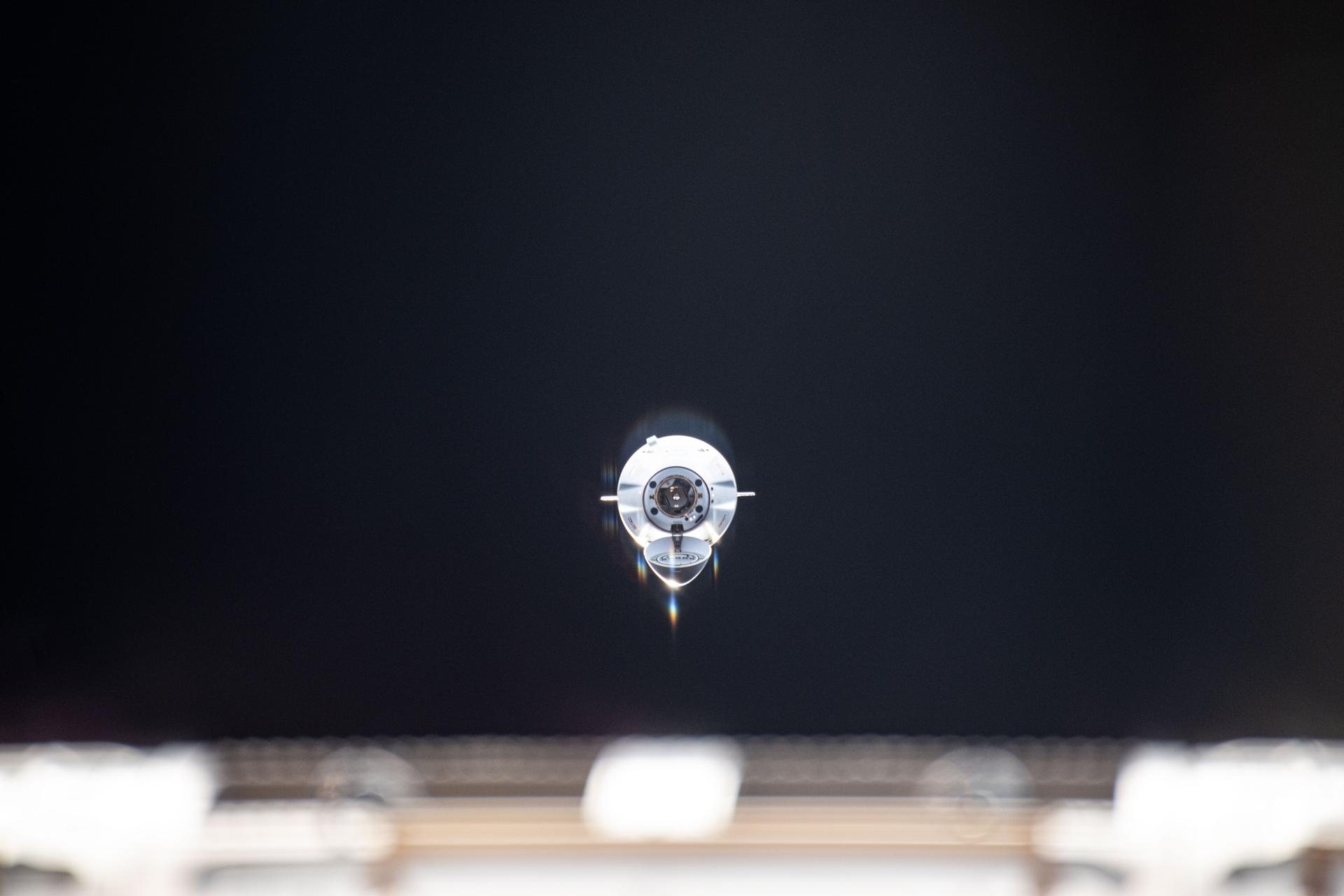
Image (Credit): Russia’s MS-19 Mission approaching the ISS yesterday. (NASA)

The International Space Station (ISS) had another visitor on Saturday morning – this time a Russian Soyuz capsule bringing about three tons of food, fuel, and supplies to the station as part of its Progress MS-29 mission (Progress 90 mission to NASA).

The Russian News Agency provided a list of items delivered to the ISS and also noted that the resupply mission also included Christmas gifts for the crew.

Here are the items delivered:

…869 kg of refueling propellant, 420 liters of potable water and 43 kg of pressurized nitrogen, and also 1,155 kg of material and equipment in the dry cargo hold, in particular, for experiments dubbed Vampire (growing crystals in an electric vacuum furnace), BTN-Neutron-2 (studying the neutron spectrum) and 3D Print (3D printing of polymer materials).

It nice that the Russians took the time to assist Santa with his gift giving.

Of course, the U.S. Department of Defense’s North American Aerospace Defense Command (NORAD) will be tracking the actions of Santa here on Earth this year, so be sure to visit the site closer to Christmas next month.

Space Stories: Potential Life on Uranus, a Sick ISS Astronaut, and a Feasting Black Hole

Image (Credit): Uranus captured the James Webb Telescope’s Near-Infrared Camera (NIRCam). This Webb image also shows 9 of the planet’s 27 moons. (NASA, ESA, CSA, STScI)

BBC: New Study on Moons of Uranus Raises Chance of Life

The Voyager 2 observations had suggested that its two largest moons — Titania and Oberon — often orbit outside the magnetosphere. However, the new study indicates they tend to stay inside the protective bubble, making it easier for scientists to magnetically detect potential subsurface oceans. “Both are thought to be prime candidates for hosting liquid water oceans in the Uranian system due to their large size relative to the other major moons,” Jet Propulsion Laboratory planetary scientist and study co-author Corey Cochrane said.

ScotsmanNasa Astronauts Tight-lipped on Who was Ill After Long Space Station Mission

Three Nasa astronauts whose prolonged space station mission ended with a trip to hospital last month have declined to say which one of them was sick. Astronauts Matthew Dominick, Michael Barratt and Jeanette Epps publicly discussed their spaceflight for the first time since returning from the International Space Station on October 25.

NOIRLabNSF NOIRLab Astronomers Discover the Fastest-Feeding Black Hole in the Early Universe

Supermassive black holes exist at the center of most galaxies, and modern telescopes continue to observe them at surprisingly early times in the Universe’s evolution. It’s difficult to understand how these black holes were able to grow so big so rapidly. But with the discovery of a low-mass supermassive black hole feasting on material at an extreme rate, seen just 1.5 billion years after the Big Bang, astronomers now have valuable new insights into the mechanisms of rapidly growing black holes in the early Universe.