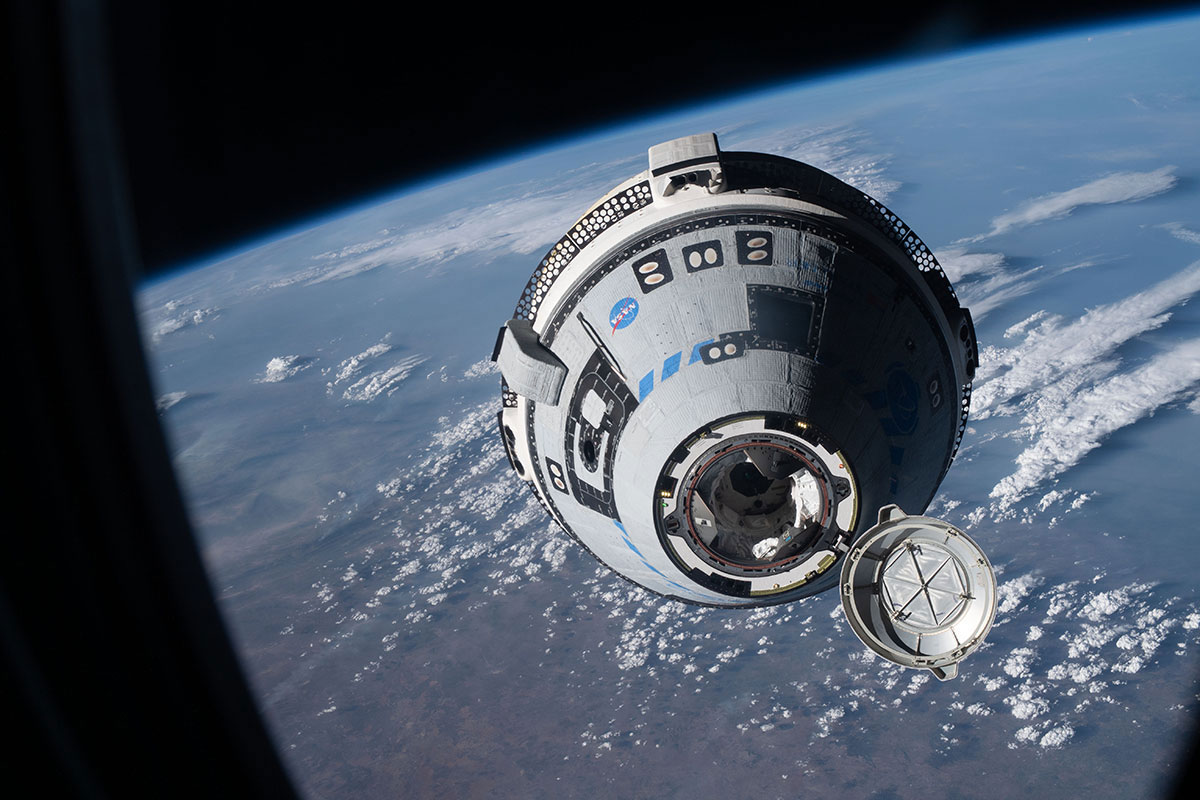
Image (Credit): The CST-100 Starliner approaching the ISS during an earlier uncrewed test flight in May 2022. (NASA)
“The @POTUS has asked @SpaceX to bring home the 2 astronauts stranded on the @Space_Station as soon as possible. We will do so. Terrible that the Biden administration left them there so long.”
-Statement tweeted by Elon Musk regarding the two astronauts on the International Space Station (ISS) following issues with the Boeing Starliner. Of course, the issue was already resolved by NASA via mission rotations, so Mr. Musk’s comments are needless and self-serving. It’s just one more chance for him to get attention as though he has not already done enough to warrant it, including that very odd hand gesture he made on stage.
In February, the first Moon landing through the agency’s Commercial Lunar Payload Services initiative brought NASA science to the lunar surface on Intuitive Machines’ Nova-C lander successfully capturing data that will help us better understand the Moon’s environment and improve landing precision and safety.
After launching into space in February, NASA’s Plankton, Aerosol, Cloud, ocean Ecosystem (PACE) satellite mission is successfully transmitting first-of-their-kind measurements of ocean health, air quality, and the effects of a changing climate.
In June, NASA astronauts Butch Wilmore and Suni Williams safely arrived at the space station aboard Boeing’s Starliner spacecraft following launch of their flight test. With Starliner’s arrival, it was the first time in station history three different spacecraft that carried crew to station were docked at the same time. Starliner returned uncrewed in September following a decision by NASA. Wilmore and Williams, now serving as part of the agency’s Crew-9 mission, will return to Earth in February 2025.
Deployed NASA’s Advanced Composite Solar Sail System in space, marking a successful test of its composite boom technology.
Awarded nearly $45 million to 21 higher-education institutions to help build capacity for research, and announced the recipients of grants that will support scientific and technical research projects for more than 20 universities and organizations across the United States.
The long list from which this was taken is impressive. However, we also need to note a few of the problems this year. This includes troubled commercial missions to the Moon, a Boeing crew stranded on the International Space Station after a problematic Starliner test, delays in the SpaceX Starship rocket tests, a cancelled Moon rover, budget cuts at NASA as well as layoffs at JPL, cost overruns on the Mars Sample Return mission, and a delay in the Artemis II and III launch dates.
This does not override the accomplishments, but it puts them into context at a time of changing administrations in Washington. This will come with hard questions about the viability of current missions as well as the cost of future missions.
I agree 2024 has plenty of proud moments. That said, 2025 will be a very challenging year for NASA. The agency will need solid answers to hard questions, cost effective options for struggling missions, and plenty of public support to weather calls for additional budget cuts.
I have confidence NASA will come out of this even stronger, even if it is a bit bruised in the process.
If you are a foodie and still looking for a holiday gift or just a fun gift, you might want to check out these two space-related books.
The first book by Vickie Kloeris, Space Bites: Reflections of a NASA Food Scientist, discusses the thinking that goes into the food prepared for NASA’s astronauts. In this case, Ms. Kloeris worked with the food eaten by astronauts on the space shuttles and the International Space Station.
Former NASA Astronaut Mike Massimino stated:
During her decades-long career at NASA, my friend and colleague Vickie Kloeris made sure my fellow astronauts and I were well-fed and healthy while in space. Space Bites is not only a compilation of stories of her amazing career but also a behind-the-scenes look at the evolution of human space travel. Read this book to be inspired and to learn, and don’t be surprised if it also leaves you hungry for some space food.
It might be the perfect book after holidays if you want some insight into the space program.
However, if you want to sample the astronaut food, you might want to check out this older book by Charles T. Borland and Gregory L. Vogt, The Astronaut’s Cookbook: Tales, Recipes, and More. It contains recipes allowing you to create astronaut-worthy meals without the freeze drying.
The book covers a lot of territory: Appetizers, Beverages, Bread and Tortillas, Cookies, Sandwiches, Desserts, Main Dishes, Soups and Salads, Vegetables, and Future Space Foods.
Charles Bourland has just retired from his job as NASA’s ‘director of space foods’, and Gregory Vogt was an astronaut trainer. They have provided us with a fascinating insight into the job of the space dietician and nutritionist, as well as a wondrous collection of recipes for the meals that were served on Skylab, Apollo, thespace shuttle and the International Space Station. … This an intriguing book, well written, and colourfully reproduced with a host of appetising pictures.
It may not be fantastic food, yet you can eat like an astronaut (and maybe suffer like an astronaut). When you sit down to dine on this strange fare, you can be pretty certain that no one else in your neighborhood will have such a dinner that evening.
Firefly Aerospace, Inc., the leader in end-to-end responsive space services, was awarded an approximately $179.6 million NASA contract to deliver and operate six NASA instruments in the Gruithuisen Domes on the Moon’s near side in 2028. As part of NASA’s Commercial Lunar Payload (CLPS) initiative, the mission will utilize Firefly’s Blue Ghost lunar lander, Elytra Dark orbital vehicle, and a rover from an industry provider to investigate the unique composition of the Gruithuisen Domes – a part of the Moon that has never been explored.
A NASA-funded commercial space station, Starlab, recently completed four key developmental milestones, marking substantial progress in the station’s design and operational readiness. The four milestones are part of a NASA Space Act Agreement awarded in 2021 and focused on reviews of the habitat structural test article preliminary design, systems integration, integrated operations, and a habitat structural test plan. “These milestone achievements are great indicators to reflect Starlab’s commitment to the continued efforts and advancements of their commercial destination,” said Angela Hart, program manager for NASA’s Commercial Low Earth Orbit Development Program. “As we look forward to the future of low Earth orbit, every successful milestone is one step closer to creating a dynamic and robust commercialized low Earth orbit.”
NASA’s two stuck astronauts just got their space mission extended again. That means they won’t be back on Earth until spring, 10 months after rocketing into orbit on Boeing’s Starliner capsule. NASA announced the latest delay in Butch Wilmore and Suni Williams’ homecoming on Tuesday. The two test pilots planned on being away just a week or so when they blasted off June 5 on Boeing’s first astronaut flight to the International Space Station. Their mission grew from eight days to eight months after NASA decided to send the company’s problem-plagued Starliner capsule back empty in September.