Image (Credit): Members of the Soyuz MS-25 crew – commander Oleg Novitskiy (bottom), NASA astronaut Tracy Dyson (middle), and Belarus guest cosmonaut Marina Vasilevskaya (top). (NASA/Bill Ingalls)
Earlier today, a Russian Soyuz rocket launched into space to bring three new crew members to the International Space Station (ISS).
The passengers on today’s delayed flight are cosmonauts Oleg Novitskiy and Marina Vasilevskaya as well as NASA astronaut Tracy Dyson. They are expected to board the ISS on Monday.
Astronaut Dyson, who plans to stay on the station for six months, will assist her fellow astronauts on the ISS with a variety of experiments, including “…[s]tudies of neurological organoids, plant growth, and shifts in body fluids,”
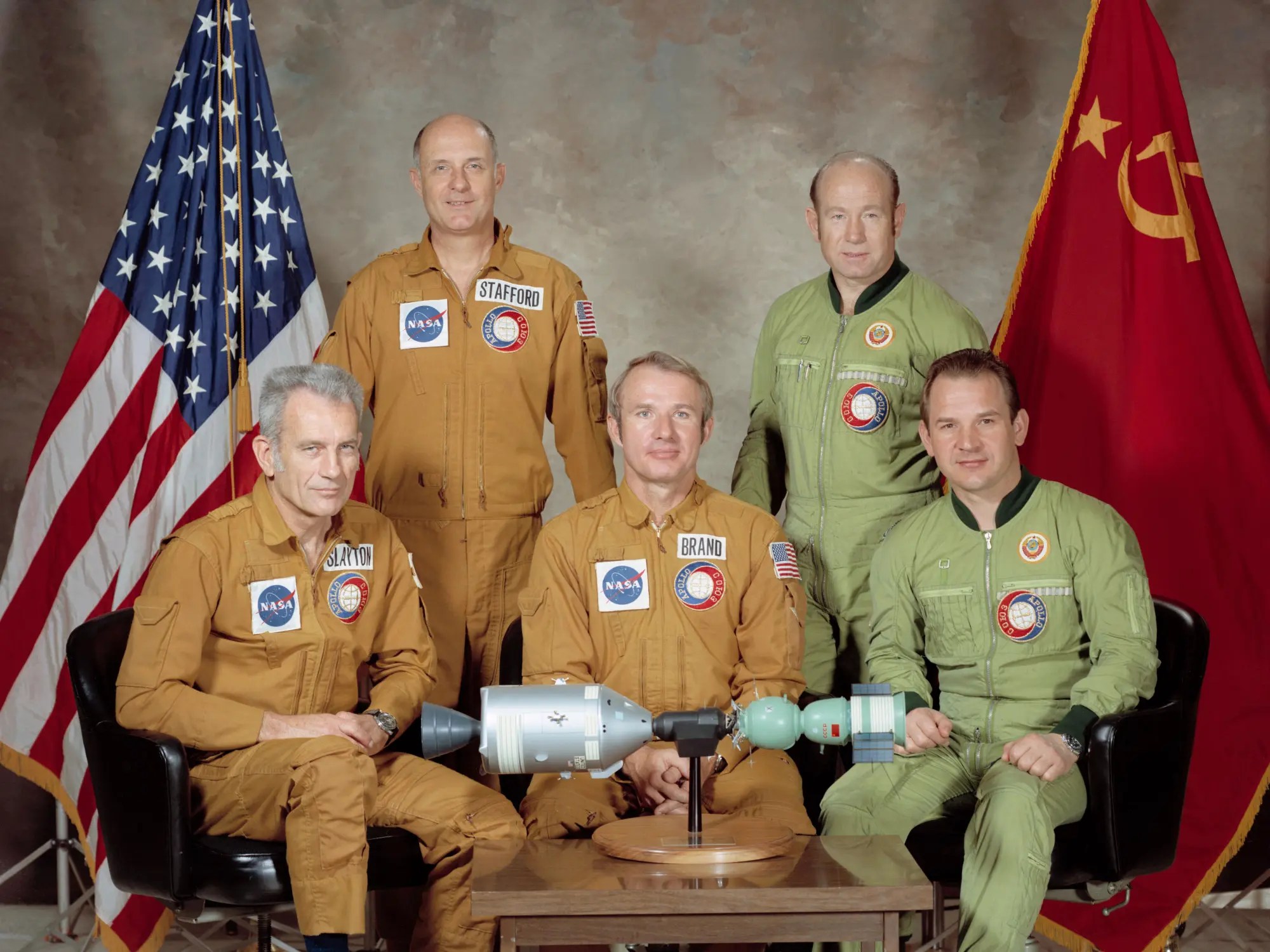
Image (Credit): The joint U.S.-USSR crew for the Apollo Soyuz Test Project. Astronaut Thomas P. Stafford (standing on left), commander of the American crew; Cosmonaut Aleksey A. Leonov (standing on right), commander of the Soviet crew; Astronaut Donald K. Slayton (seated on left), docking module pilot of the American crew; Astronaut Vance D. Brand (seated in center), command module pilot of the American crew; and Cosmonaut Valeriy N. Kubasov (seated on right), engineer on the Soviet crew. (NASA)
As we plan our return to the Moon, we cannot forget the Apollo astronauts who showed us the way last century. One of those astronauts, Thomas Stafford, died today at the age of 93.
Among his many achievements, including his Apollo 10 mission that prepared the way for the first Moon landing by Apollo 11, he may be most remembered for his 1975 space encounter with the U.S.S.R. cosmonauts.
The Apollo-Soyuz Test Project was the first international mission in space. It involved an Apollo spacecraft (crew of three) connecting with a Soyuz spacecraft (crew of two) in Earth orbit. The two days of joint activities created a precedent that was later followed by the International Space Station (ISS).
We were in the middle of the Cold War in 1975, so any cooperation with the U.S.S.R. was pretty amazing. It is just as surprising to witness SpaceX bringing cosmonauts to the ISS while the U.S. maintains severe sanctions on Russia.
Thomas Stafford died knowing that his early efforts to blaze a path to the Moon and cooperate with the Russians were still going strong today. That must have provided him with a little bit of peace in his final days.
You can watch a NASA video on Mr. Stafford’s accomplishments here.
You can also read more on Mr. Stafford’s life and career at these sites:
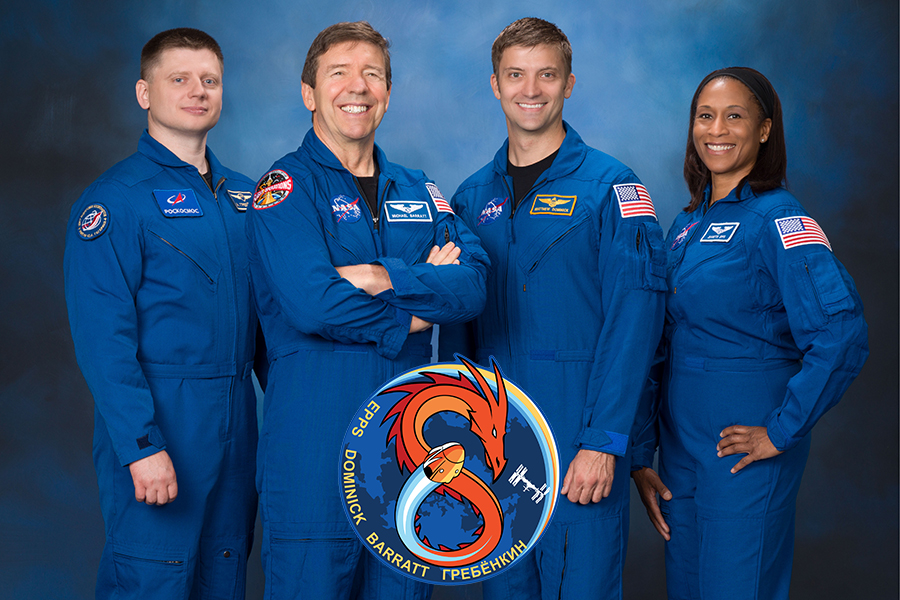
Image (Credit): The SpaceX Crew-8 (identified below) expected to depart later today. (NASA)
Later today, a SpaceX rocket with carry another crew to the International Space Station (ISS) after a few delays. The crew, shown above, consists of Alexander Grebenkin (Roscosmos), Michael Barratt (NASA), Matthew Dominick (NASA), Jeanette Epps (NASA).
The new crew will be approaching a space station already containing seven crew members as well as a module in need of repair. The Russian components of the space station have sprung a number of leaks over the past several years. The most recent appears to be a recurring oxygen leak.
To date, NASA is playing it cool, though I expect everyone on board would be happy to experience at leakless station as soon as possible. We know the ISS will not last forever, but until the day it is decommissioned it should be a safe vessel for the astronauts and cosmonauts aboard.
Update: The SpaceX launch went off without a hitch Sunday evening. The new crew on the Dragon spacecraft is expected to reach the ISS Tuesday morning.
(Image/Credit): Artist’s rendering of the wooden LignoSat satellite. (Kyoto University)
The satellite industry may never be the same again. While we hear so much about new metals in our rockets, how often do you hear of simply putting wood into orbit?
I guess we should not have been too surprised now that wood is being used to build office towers. And the best part is that wooden satellites burn cleaner than metal satellites, making them safer for the environment.
Last year we learned about the Kyoto University’s test of wood materials on the International Space Station. The findings indicated that magnolia wood was one of the better materials for spacecraft, though more testing was needed.
The plan is for a summer 2024 launch of a coffee-size probe called LignoSat that can then be monitored for six months. That should be time to better understand the strength and effectiveness of the wood before it burns up in the Earth’s atmosphere.
It reminds me of the old joke about the Americans inventing a billion-dollar pen to write upside down in space while the Russians simply used a pencil. Maybe the Japanese also have some to teach us.
Image (Credit): Intuitive Machines IM-1 mission on the launch pad at NASA’s Kennedy Space Center in Florida. (SpaceX)
The second NASA-related commercial Moon mission was set to launch earlier today, but SpaceX called it off at the last moment due to a methane issue with its Falcon 9 rocket. SpaceX is expected to try the launch tomorrow.
The launch of the Intuitive Machines IM-1 mission is related to NASA’s Commercial Lunar Payload Services (CLPS) initiative, and will serve as one of the first lunar-based pieces of the Artemis program.
Intuitive Machines’ Nova-C lander is expected to land on the Moon Thursday, Feb. 22. Among the items on its lander, the IM-1 mission will carry NASA science and technology instruments focusing on plume-surface interactions, space weather/lunar surface interactions, radio astronomy, precision landing technologies, and a communication and navigation node for future autonomous navigation technologies.
The Moon mission that failed last month was also part of NASA’s CLPS initiative. This program is off to a slow start, but hopefully it can be relied on to be a key component of the lunar space program going forward.
If you are looking for some good news, I can report that Russia’s Progress MS-26 International Space Station resupply mission successfully launched earlier today.




 Our Awesome Universe