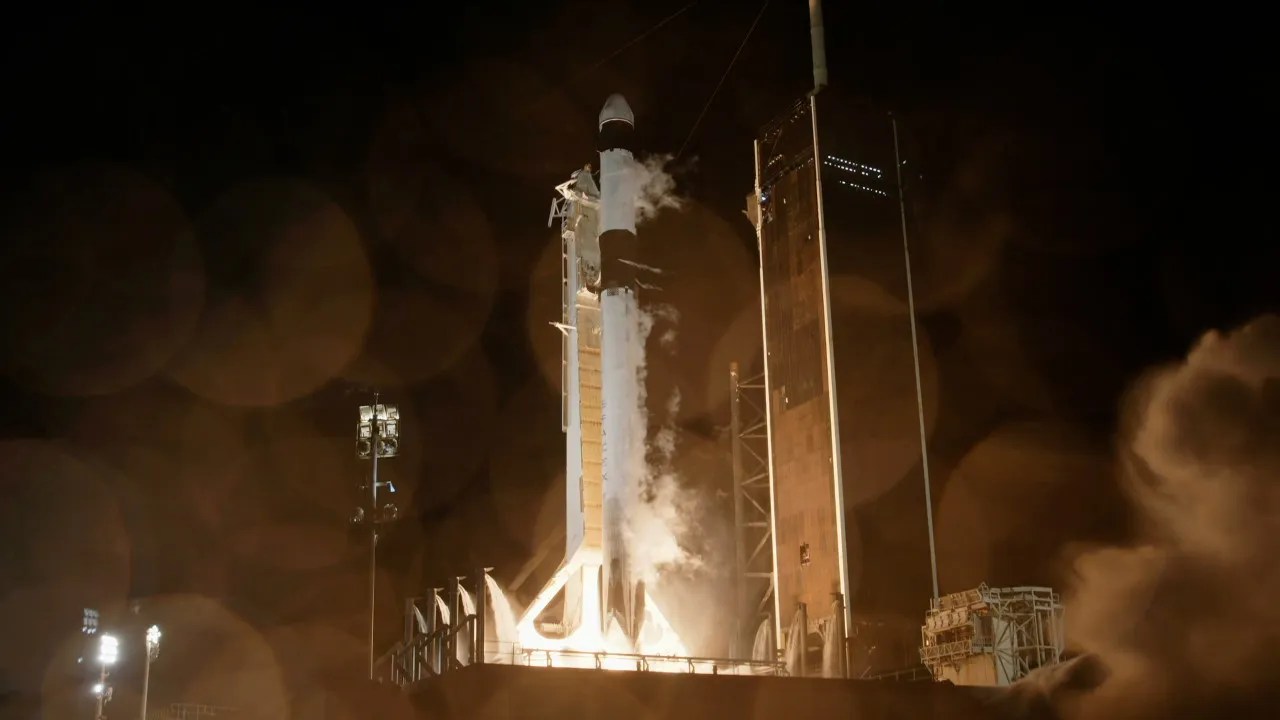
Image (Credit): The launch of the CRS-19 resupply mission to the ISS on Thursday, November 9. (NASA)
Yesterday, NASA sent another resupply mission to the International Space Station (ISS) aboard a SpaceX Dragon spacecraft. It will not rendezvous with the ISS until early Saturday morning (no sleeping in for the crew).
This mission, CRS-29, will be SpaceX’s 29th supply mission to the ISS. The next most frequent resupplier is Northrop Grumman, which has sent 19 resupply missions to the ISS.
If you are interested in the material being brought to the station, NASA discusses some of the contents here.
You can also follow the progress of the latest mission here.
Image (Credit): Sierra Space employees in front of the new Dream Chaser. (Sierra Nevada)
“I am reminded of a comment made by Steve Jobs that every once in a while, a revolutionary product comes along that changes everything. I think Dream Chaser is that product. This breakthrough shifts paradigms and redefines space travel. The Dream Chaser is not just a product; it’s a testament to human spirit, determination and the relentless pursuit of what lies beyond.”
-Statement by Sierra Space CEO Tom Vice in a company press release announcing the completion of the first Dream Chaser, said to be the “world’s sole commercial runway-capable spaceplane.” Its next stop is NASA’s Neil A. Armstrong Test Facility in Ohio for environmental testing. It is basically an advanced version of the earlier space shuttles that will be launched on a rocket and return by landing on a runway. NASA plans to use the spaceplane to bring cargo to the ISS. As with the initial space shuttle, the reusable craft makes a lot of sense and should help with overall costs. Of course, it is not clear why we had to go without a shuttle for 12 years.
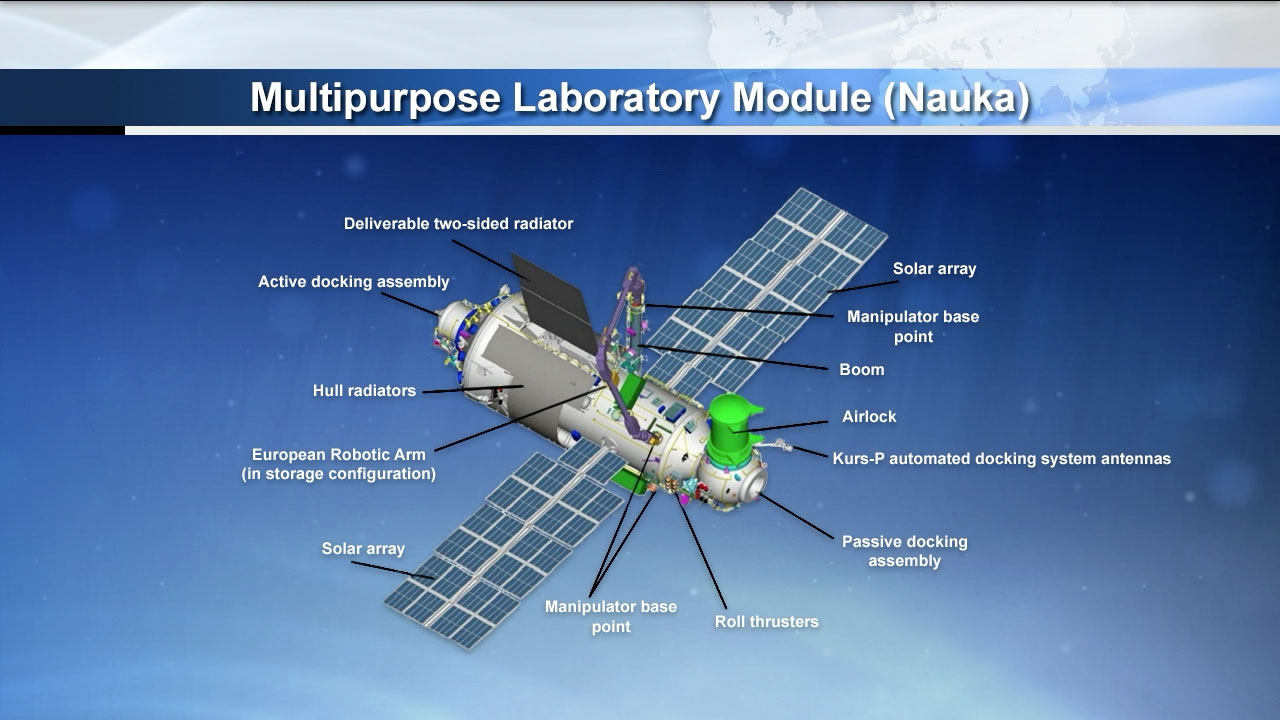
Image (Credit): Russia’s Nauka laboratory module on the ISS. (NASA)
We know Mr. Putin wants to pursue his own space station, but how about fixing the one Russia is already part of?
Cosmonauts Oleg Kononenko and Nikolai Chub conducted a spacewalk this week to investigate the third leak aboard the International Space Station (ISS). Luckily, the source of the leak was found – a 2010 radiator attached to Russia’s Nauka laboratory module.
News reports indicate that Russia’s space agency, Roscosmos, is downplaying the leak, noting that it did not impact the primary coolant loop. Roscosmos finished by stating, “the crew and the station are not in any danger.” That’s hopeful, but still a worrisome incident for the aging space station.
A disaster with the $100 billion space station will set back if not kill future funding for similar stations. As with the US space shuttle, the space station could be a passing phase if we cannot keep it running and our astronauts and cosmonauts safe.
Maybe it is time for Russia to go its own way if it is not willing to keep the ISS afloat. I would rather Russia steps up its game, but it may have trouble fighting wars and funding space at the same time.
Note: The US and Russian need to get this fixed so that the focus can return to science. While the ISS crew was searching for leaks this week, China sent another team to its Tiangong space station.
Image (Credit): View of the International Space Station from a Crew Dragon spacecraft. (NASA)
“Mistakes are mistakes. It is a shame for all of us. This is space exploration and everyone understands that. It is experience that we can use in the future.”
-Statement by Russia’s President Putin, as reported by Reuters, addressing the Luna-25 crash on the Moon in August. He added that the lunar missions will continue. He also said Russia also hopes to have its first segment of a new space station in operation by 2027, stating, “As the resources of the International Space Station run out, we need not just one segment, but the entire station to be brought into service.”
Fashion house Prada has teamed up with commercial space company Axiom Space to create lunar spacesuits for NASA’s Artemis III mission, which will be the first crewed moon landing since 1972.Called Axiom Extravehicular Mobility Unit (AxEMU), the suits will be designed to give astronauts “advanced capabilities for space exploration,” Prada said. They are an evolution of NASA’s Exploration Extravehicular Mobility Unit (xEMU) spacesuit design and will use “innovative technologies and design” to be more flexible and provide more protection against the harsh lunar environment, according to the brand.
On some nights, one of the brightest objects in the sky is neither a planet nor a star. It is a telecommunications satellite called BlueWalker 3, and at times it outshines 99% of the stars visible from a dark location on Earth, according to observations reported today in Nature. BlueWalker 3 is the most brilliant recent addition to a sky that is already swarming with satellites. The spaceflight company SpaceX alone has launched more than 5,000 satellites into orbit, and companies around the globe have collectively proposed launching more than half a million satellites in the coming years — a scenario that astronomers fear could hamper scientific observations of the Universe.
The Russian segment of the International Space Station (ISS) has sprung its third coolant leak in under a year, raising new questions about the reliability of the country’s space programme even as officials said crew members were not in danger. Flakes of frozen coolant spraying into space were seen in an official live feed of the orbital lab provided by Nasa on Monday, and confirmed in radio chatter between US mission control and astronauts. “The Nauka module of the Russian segment of the ISS has suffered a coolant leak from the external (backup) radiator circuit, which was delivered to the station in 2012,” Russian space agency Roscosmos said on Telegram, adding temperatures remained normal in the affected unit.