
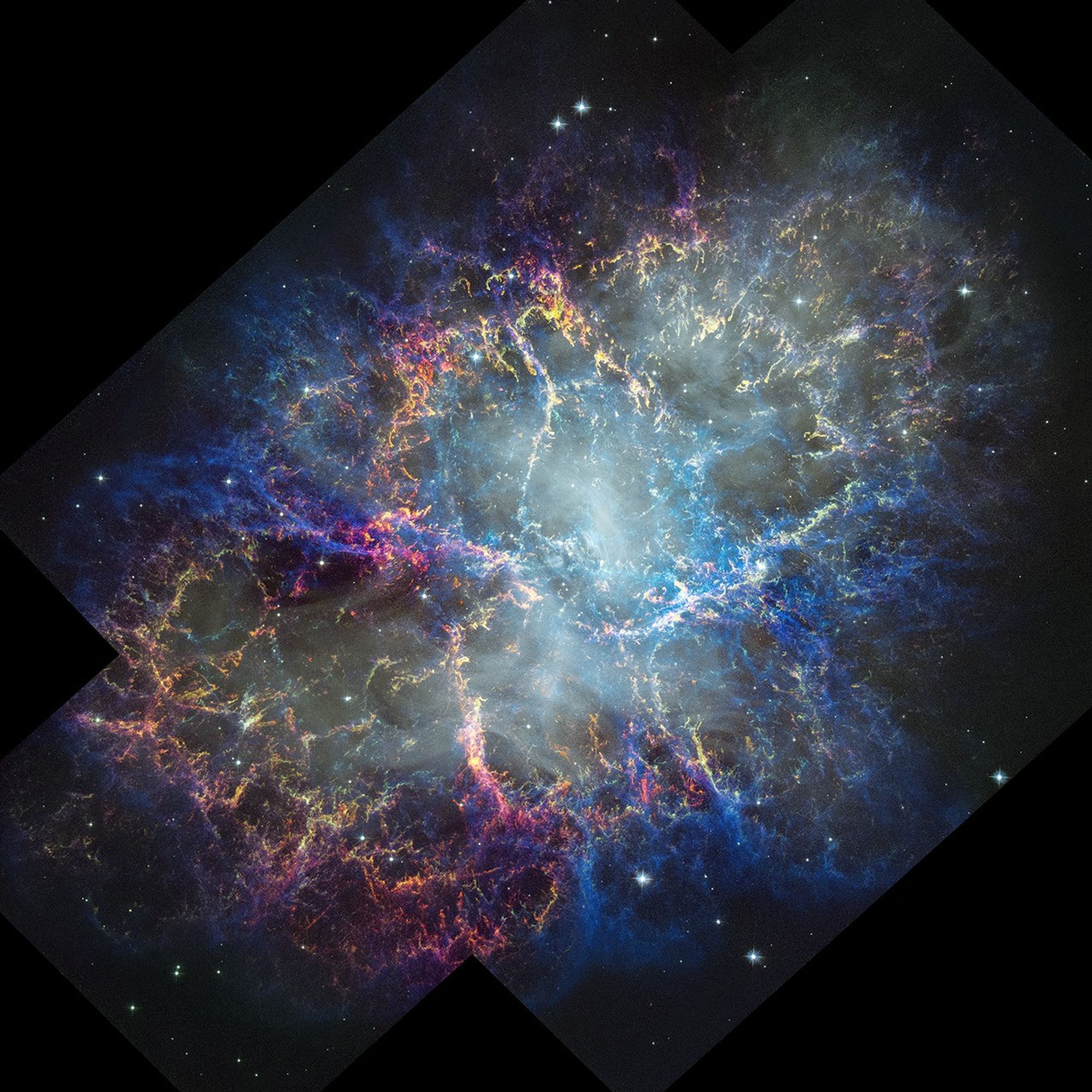
This week’s image is from the Hubble Space Telescope. It is an image of the Crab Nebula taken 25 years after the Hubble’s first image of the nebula. If you want to learn more about this history, a paper titled The Crab Nebula Revisited Using HST/WFC3 can be found in The Astrophysical Journal.
Here is a little more from NASA on earlier sightings of the nebula:
This new Hubble observation continues a legacy that stretches back nearly 1,000 years, when astronomers in 1054 recorded the supernova as an impressively bright new star that, for weeks, was visible even during the day. The Crab Nebula is the aftermath of SN 1054, located 6,500 light-years from Earth in the constellation Taurus…
The supernova remnant was discovered in the mid-18th century, and in the 1950s Edwin Hubble was among several astronomers who noted the close correlation between Chinese astronomical records of a supernova and the position of the Crab Nebula. The discovery that the heart of the Crab contained a pulsar — a rapidly rotating neutron star — that was powering the nebula’s expansion finally aligned modern observations and ancient records.

