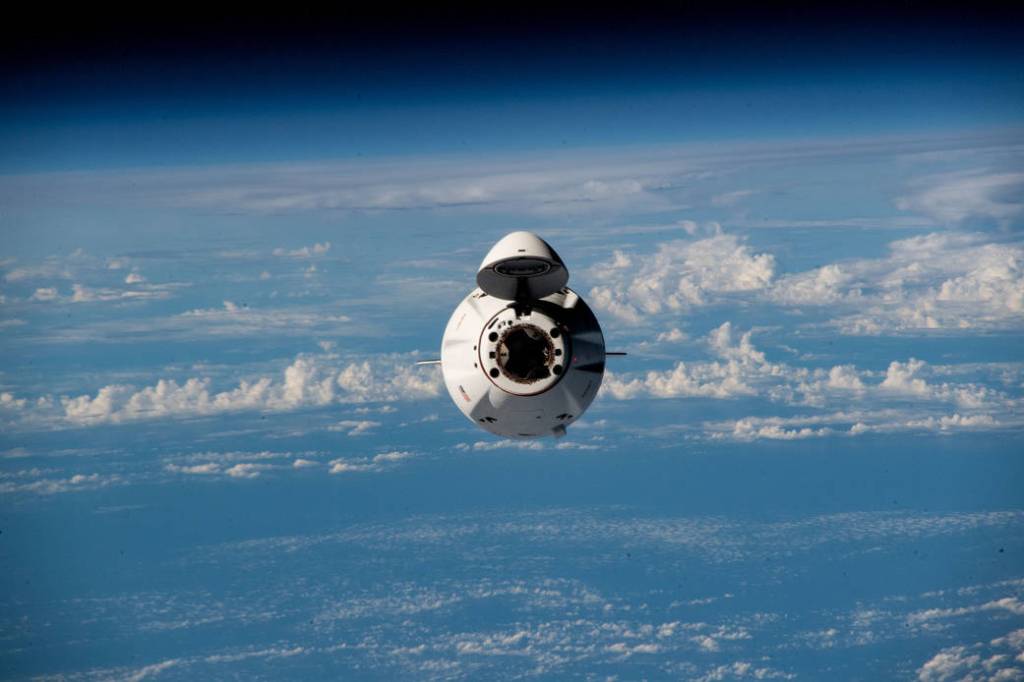
Image (Credit): SpaceX Dragon approaching the ISS. (NASA)
This week’s image comes from NASA showing a Dragon cargo ship approaching the International Space Station (ISS) earlier this month with supplies for the Expedition 68 crew. In this photo, the Dragon is above the Indian Ocean near Madagascar.
It is an amazing image each and every time. What a workplace and what a view. Telework just isn’t the same.
Image (Credit): A destroyed Russian tank in the village of Dmytrivka, Ukraine. (CNN/Alex Chan Tsz Yuk/SOPA Images/Sipa/Reuters)
Wired magazine’s latest article, “Russia’s Space Program Is in Big Trouble,” summarizes a sad trend since Russia’s invasion of Ukraine. With all of the nation’s attention on an unnecessary war, the space program, like many things nowadays in Russia, has taken a back seat.
Problems can be seen with the spacecraft – two Russian capsules at the International Space Station (ISS) sprung leaks – as well as ground control. Assets at Russia’s spaceport in Kazakhstan are being seized, while corruption and other problems are delaying a new spaceport within Russia’s borders.
Russia also lacks a partner for a new space station after the ISS, and its mission to the Moon with China look’s tenuous. Does the country have a plan for the future beyond militarizing space?
The article concludes with these words:
The Soviet Union may have put the first human into space—but now, 60 years later, Russia faces a near-future in which it is no longer able to do that.
No Pyrrhic victory in Ukraine will change this.
Extra:The Wall Street Journal also had a good article about the situation in Russia. The article, “Russia’s Economy is Starting to Come Undone,” includes an interview with Oleg Mansurov, who hoped to create the next SpaceX with his company SR Space. However, the situation in Ukraine has caused his investors to flee. As a result, he is staying afloat as an IT company for now. He notes:
We became more focused not on the development of a long-term product that would make some kind of qualitative leap but on simply becoming a classic business and generating revenue…We understood we just had to survive.
Image (Credit): Artist’s rendering of Boeing’s Starliner capsule. (Boeing)
So what is the status of Boeing’s Starliner? Last May, an uncrewed Starliner capsule safely arrived at the International Space Station (ISS). So when will we see a crewed mission? The latest plan was for an April launch after some technical issues back in February.
However, in a tweet on Thursday, Kathy Lueders, who serves as NASA’s human spaceflight chief, stated:
Boeing We’re adjusting the @Space_Station schedule including the launch date for our Boeing Crew Flight Test as teams assess readiness and complete verification work. CFT now will launch following Axiom Mission 2 for optimized station operations…Target launch dates for Ax-2, still planned in early May, and Starliner will be shared soon. We’ll plan a media update after we have the space station schedule set. As always, we will fly when we are ready.
So first the private Ax-2 mission (also called space tourism) needs to occur, and then NASA can fit in another Starliner mission in May or later so that we have greater redundancy in our travel to the ISS, which was the purpose of NASA’s Commercial Crew Program. Given the issues with recent Russian Soyuz mission, this extra capacity cannot come soon enough. I just hope Starliner “technical issues” and not space tourism is responsible for this latest delay.
Image (Credit): Night sky over Sacramento, CA on March 17, 2023. (Associated Press)
UFOs came up again last week pertaining to lights over Sacramento, California. As fireballs streaked across the night sky, a few citizens thought they might be watching fireworks or even the arrival of distant visitors to celebrate St. Patrick’s Day.
The explanation for the lights was interesting, but not because it was a UFO. It turns out the International Space Station (ISS) dumped a 683 pounds of Japanese communications equipment back in 2020. It took that long for the equipment to return towards Earth as a molten mass. The US Space Force later confirmed this explanation.
As noted in an earlier post, this ISS debris is not unusual, and can contain huge objects such as a cargo capsule.
The BBC recently noted that your chance of being struck by space debris is one in a trillion. So you can look up, but don’t worry about covering your head.
NASA is projecting spending nearly $1 billion on a tug to deorbit the International Space Station at the end of the decade to provide redundancy for safely disposing of the station. NASA released additional details March 13 about its fiscal year 2024 budget proposal. An outline of the proposal, published by the White House March 9, requested $27.2 billion for the agency, a 7.1% increase from 2023 that roughly keeps pace with inflation.
Kazakh authorities have impounded the property of Russia’s main operator of spacecraft launching sites in Baikonur (Baiqonyr) in the Central Asian nation’s southern region of Qyzylorda…According to the media outlet, the decision was made due to the Russian state company’s debt of 13.5 billion tenges ($29.7 million) to the Baiterek Kazakh-Russian joint venture for work related to estimating ecological damage caused by Souyz-5 rockets.
NASA and the Department of Energy (DOE) are working together to develop a science instrument that will survive the harsh and unforgiving environment of the lunar surface at night on the far side of the Moon to attempt first-of-its-kind measurements of the Dark Ages of the Universe. The instrument, named the Lunar Surface Electromagnetics Experiment – Night (LuSEE-Night), is a collaboration between DOE’s Brookhaven National Laboratory, the DOE Office of Science, UC Berkeley’s Space Sciences Laboratory, and NASA’s Science Mission Directorate.



 Our Awesome Universe