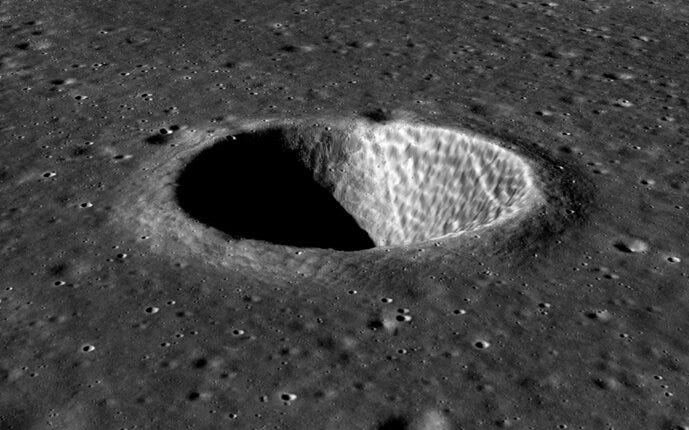
Image (Credit): 3D view of a crater on the Moon generated from images captured by Chandrayaan 2 orbiter’s Terrain Mapping Camera in 2019. (ISRO)
“…a comparison with India is illuminating: India’s economy was about half the size of Russia’s when the Berlin Wall came down in 1989. Today, India’s economy is 50 percent bigger than Russia’s. Forget about keeping pace with the United States: Russia can’t keep up with India.”
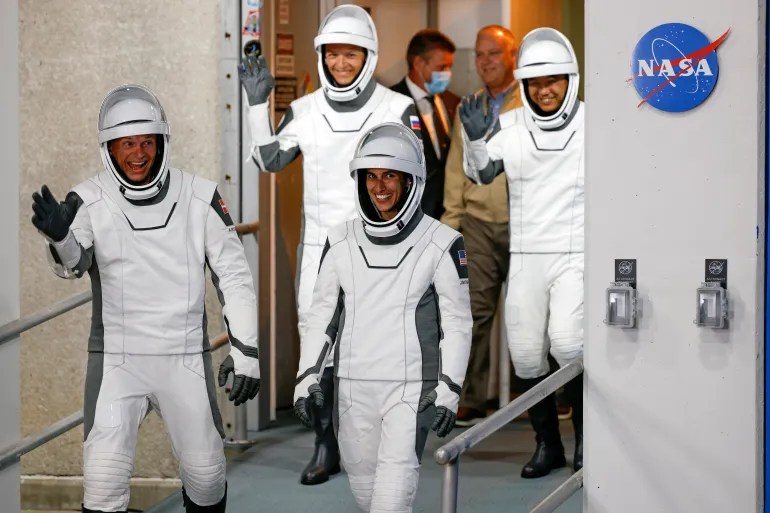
Image (Credit): ISS crew preparing for August 26, 2023 launch. (Terry Renna/AP Photo)
A new crew departed Earth for the International Space Station (ISS) at 3:27am ET today from NASA’s Kennedy Space Center in Florida via a SpaceX Falcon 9 rocket. The crew includes:
NASA astronaut Jasmin Moghbeli,
ESA (European Space Agency) astronaut Andreas Mogensen,
JAXA (Japan Aerospace Exploration Agency) astronaut Satoshi Furukawa, and
Roscosmos cosmonaut Konstantin Borisov.
The new crew should be onboard the ISS tomorrow morning, bringing the number of occupants at the station to 11 until 4 crew members return to Earth in a few days.
Russia is probably happy to have attention back on the ISS rather than the Moon for the moment. It has not been a good week for the Russian space program.
You can read more about the new crew members at this NASA site.
NASA’s Mars Ascent Vehicle (MAV) recently reached some major milestones in support of the Mars Sample Return program. The Mars Ascent Vehicle would be the first launch of a rocket from the surface of another planet. The team developing MAV conducted successful tests of the first and second stage solid rocket motors needed for the launch.Mars Sample Return will bring scientifically selected samples to Earth for study using the most sophisticated instrumentation around the world. This strategic partnership with ESA (European Space Agency) features the first mission to return samples from another planet. The samples currently being collected by NASA’s Perseverance Rover during its exploration of an ancient river delta have the potential to reveal the early evolution of Mars, including the potential for ancient life.
The James Webb Space Telescope has spotted objects in the early universe that might be a new kind of star — one powered by dark matter. These “dark stars” are still hypothetical. Their identification in JWST images is far from certain. But if any of the three candidates — reported in the July 25 Proceedings of the National Academy of Sciences — turn out to be this new type of star, they could offer a glimpse of star formation in the early universe, hint at the nature of dark matter and possibly explain the origins of supermassive black holes.
The head of Russia’s space agency has extended an offer to Moscow’s partners in the BRICS group – Brazil, India, China and South Africa – to participate in the construction of a joint module for its planned orbital space station, state media reported Monday. Construction of the planned space station follows Moscow’s decision last year to end its decades-long partnership with NASA and withdraw from the aging International Space Station – one of the last remaining channels of cooperation between Russia and the United States.
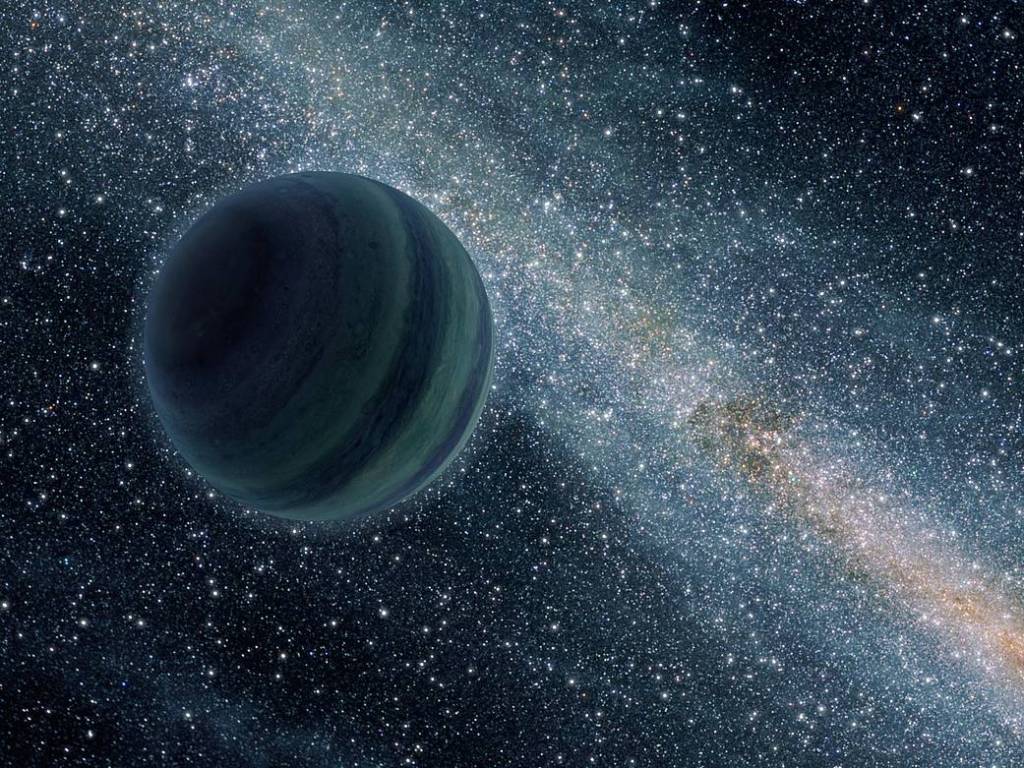
New predictions suggest an upcoming NASA space telescope could spot over 400 Earth-mass worlds hidden throughout the Milky Way that have “gone rogue” and therefore wander our galaxy alone. Such orphan worlds are thought to start their lives in a planetary system, akin to the solar system, but get kicked at some point out by a mechanism thus far unknown. Despite the familiar picture of planets neatly orbiting a star, new research suggests such orphaned starless worlds may outnumber stars in the Milky Way by 20 to 1. This implies untethered worlds in our galaxy are around six times more common than planets orbiting parent stars.
A NASA power outage disrupted communication between Mission Control and the International Space Station on Tuesday. Mission Control couldn’t send commands to the station and talk with the seven astronauts in orbit. The power outage hit as upgrade work was underway in the building at Houston’s Johnson Space Center. Space station program manager Joel Montalbano said neither the astronauts nor station were ever in any danger and that backup control systems took over within 90 minutes. The crew was notified of the problem through Russian communication systems, within 20 minutes of the outage.
Boeing and NASA say they’ll collaborate with Seattle-based Alaska Airlines and four other major airlines on the Sustainable Flight Demonstrator project, which aims to put Boeing’s innovative X-66 braced-wing aircraft design through flight tests in the 2028-2029 time frame. The X-66A makes use of a concept known as the Transonic Truss-Braced Wing, or TTBW, which features ultra-long, ultra-thin, drag-reducing wings that are stabilized by diagonal struts.
The CEO of the South African National Space Agency announced plans to send two female astronauts to the International Space Station (ISS). It is something that the space agency hopes to accomplish in the next two years.
This latest announcement appears to be based on Russian efforts to parlay better relations with African nations. The Russian RT news recently stated:
Roscosmos announced plans last month to expand its space partnerships with African countries. According to its director, an agreement will be signed with a number of the continent’s nations at the Russia-Africa summit this week in St. Petersburg.
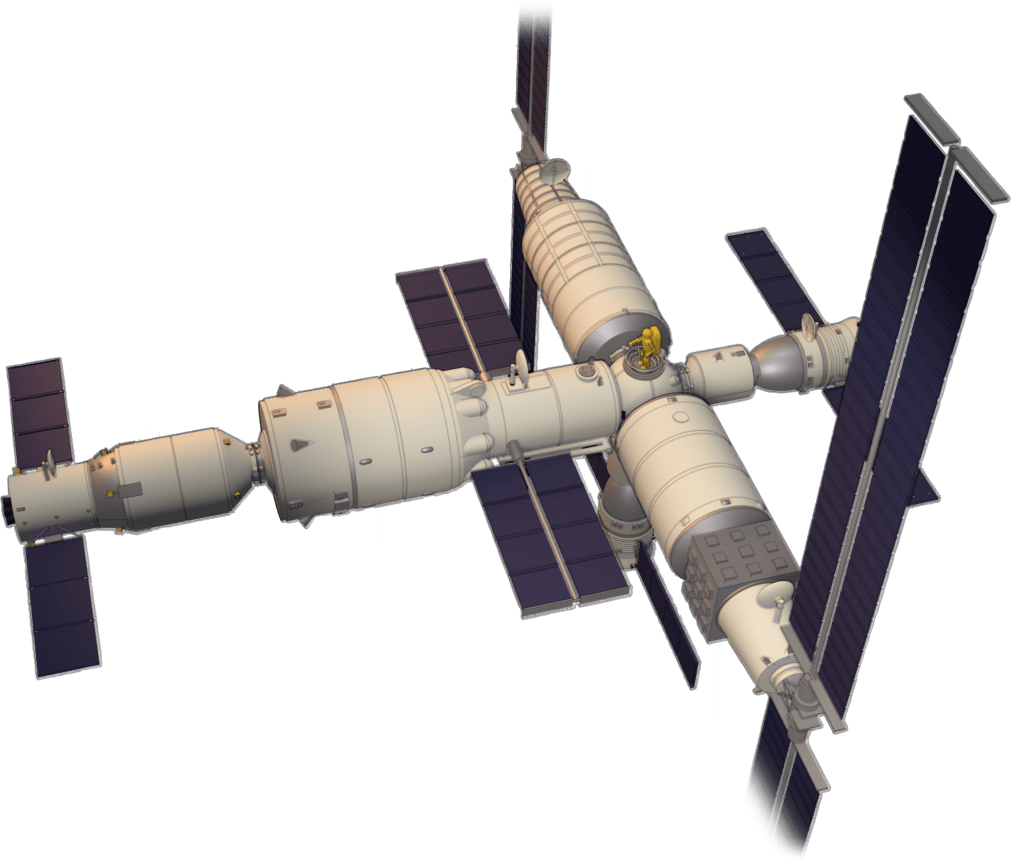
In other news, the Chinese Tiangong space station is also getting visitors – zebrafish. The fish are part of experiments to learn more about bone loss in astronauts. The news story goes on to note that the Russians were the first to use zebrafish in space back in 1976.